Asset tokenization converts ownership rights to a real-world asset into a blockchain token. The token lives onchain. The asset lives inside a legal structure such as a special purpose vehicle (SPV) or trust. The token is not the asset itself. It is a digital record of a claim on an asset that exists in the legal world.
Many founders approach tokenization as a technical decision. It is a legal one first. The legal wrapper determines who owns the asset, how transfers are enforced, and which regulator has oversight.
For help navigating the regulatory architecture for your tokenization project, speak with a specialist.
What is asset tokenization?
Asset tokenization places a real-world asset, such as a commercial building or a private equity stake, inside a legal wrapper and issues a blockchain token that represents ownership rights in that asset. The underlying asset is held by an SPV, a trust, or a comparable legal entity. The token is minted on a blockchain and transferred according to smart contract rules.
Cryptocurrencies like Bitcoin and Ethereum are different. Those tokens are native to their own blockchains and have no underlying legal claim. Bitcoin is a digital commodity. A tokenized building is a security that happens to trade on a blockchain.
The legal wrapper is the load-bearing element. When you buy a tokenized real estate unit, you own a share of an SPV that owns the building. Your token gives you the economic rights. Enforcement of those rights runs through contract law, not through the blockchain.
Tokenization also does not remove legal obligations. If the token functions as a security, securities law applies. If the issuer accepts investors from a regulated jurisdiction, licensing requirements apply. The blockchain does not override the law.
Under MiCA, the EU crypto-asset framework in Regulation (EU) 2023/1114, most tokenized real-world assets qualify as crypto-assets. MiCA defines crypto-assets in Article 3(1) as digital representations of value or rights that can be transferred and stored electronically using distributed ledger technology. Whether your token falls under MiCA’s utility token rules, asset-referenced token rules, or e-money token rules depends on how the token is structured and what rights it carries.
What assets can be tokenized?
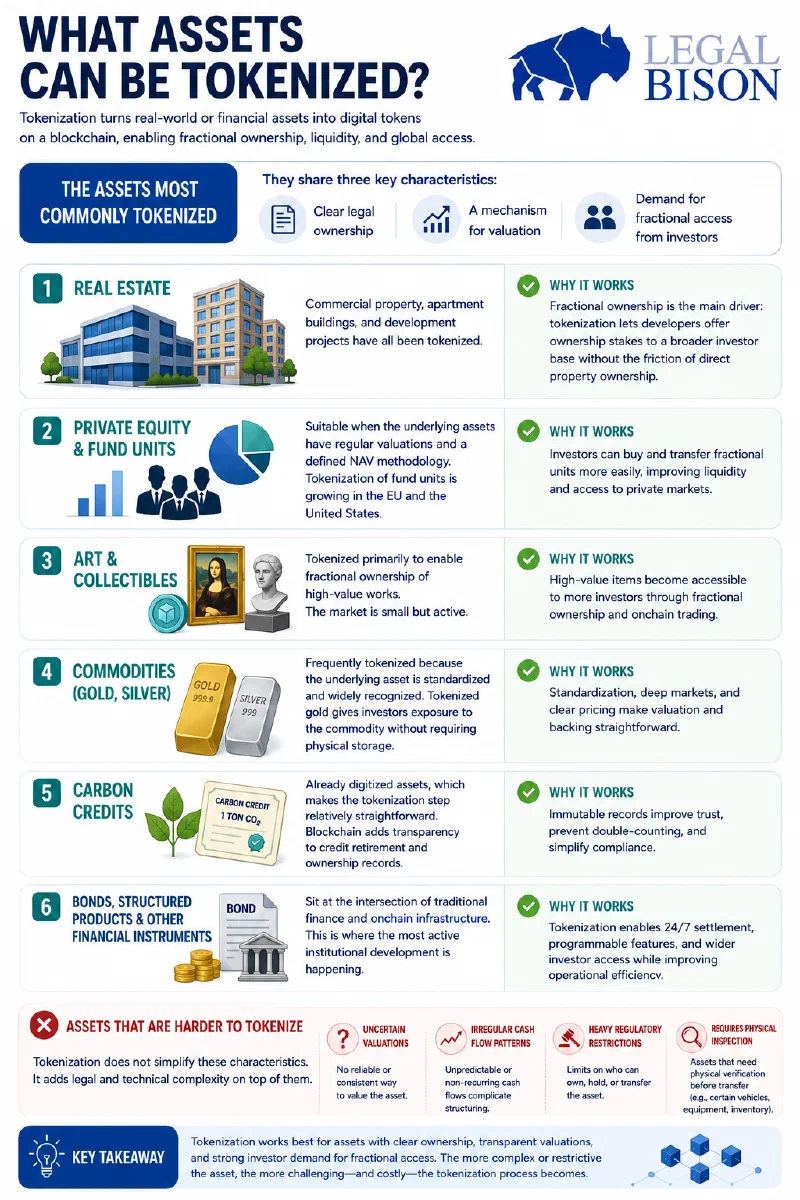
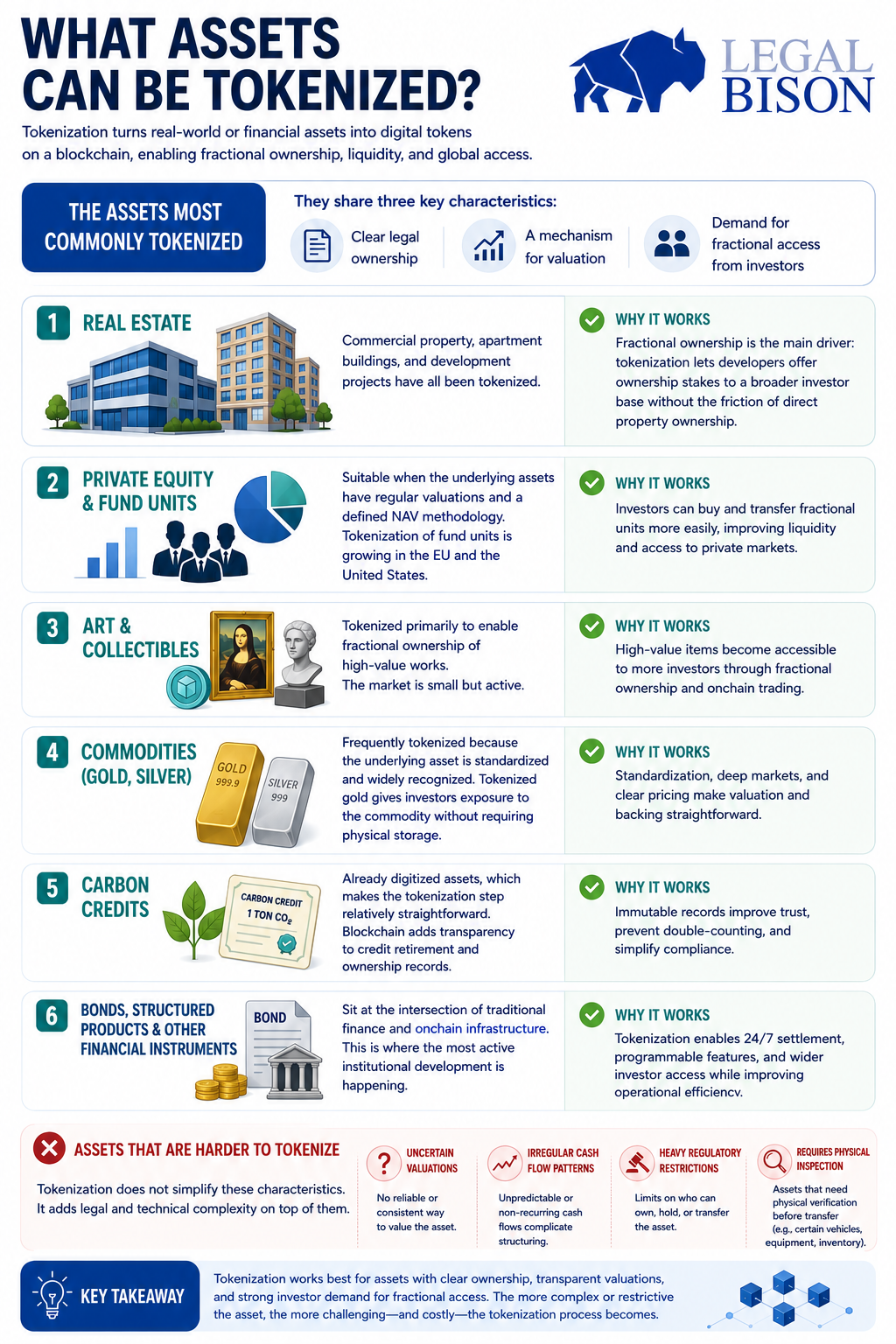
The assets most commonly tokenized share a set of characteristics: clear legal ownership, a mechanism for valuation, and demand for fractional access from investors who cannot or prefer not to buy the asset outright.
Real estate is the clearest use case. Commercial property, apartment buildings, and development projects have all been tokenized. Fractional ownership is the main driver: tokenization lets developers offer ownership stakes to a broader investor base without the friction of direct property ownership.
Private equity and fund units suit tokenization well when the underlying assets have regular valuations and a defined NAV methodology. Tokenization of fund units is growing in the EU and the United States. More recent use case for this is CIMB Islamic Bank which settled RM1.38B in tokenized sukuk via tokenized deposits in Malaysia’s central bank sandbox, paving the way for DLT-backed Islamic finance.
Art and collectibles have been tokenized primarily to enable fractional ownership of high-value works. The market is small but active.
Commodities including gold and silver are frequently tokenized because the underlying asset is standardized and widely recognized. Tokenized gold gives investors exposure to the commodity without requiring physical storage.
Carbon credits are already digitized assets, which makes the tokenization step relatively straightforward. Blockchain adds transparency to credit retirement and ownership records.
Bonds, structured products, and other financial instruments sit at the intersection of traditional finance and onchain infrastructure. This is where the most active institutional development is happening.
Assets that are harder to tokenize include those with uncertain valuations, irregular cash flow patterns, heavy regulatory restrictions on transfer, or requirements for physical inspection before ownership. Tokenization does not simplify these characteristics. It adds legal and technical complexity on top of them.
Tokenized commodities: how commodity tokens work
Tokenized commodities are blockchain tokens that represent ownership of a physical commodity such as gold, silver, oil, or wheat. Each token is a claim on metal or product held in a vault or warehouse. The holder does not store the commodity. The holder owns a legal claim that tracks its price and allows redemption or sale under the token terms.
Gold dominates tokenized commodities today. The structure is standard: an SPV or trust holds allocated bars, tokens are minted against that inventory, holders can sell on a venue or redeem under the token terms, and an auditor checks the stock against the supply. For the full mechanics, see our guide to tokenized gold.
Silver follows the same pattern. Energy and agriculture are earlier stage. Crude, natural gas, and grain tokens exist as pilots or private placements, but they face harder problems than gold: storage costs, quality variation, delivery logistics, and seasonal pricing. Uranium and industrial metals sit in the same group. The token adds a legal and technical layer on top of those physical constraints. It does not remove them.
Classification decides the legal path. A gold token that tracks the spot price with redemption rights can look like a commodity product. A commodity token that pays yield or pools investor funds can look like a security. In the US, that line runs through the Howey test and CFTC commodity oversight. In the EU, it runs through MiCA and national securities law. Confirm the classification before you choose the issuer vehicle, because the vehicle, the disclosures, and the venue license all follow from it.
If you plan a commodity token, start from custody and redemption. Name the custodian, the bar or lot standard, the audit cycle, and who pays storage. Then map the offer to one regulatory path. Projects that skip this order usually stall at listing.
Tokenization use cases that already work
Tokenization use cases cluster around assets with clear ownership, reliable valuation, and demand for fractional access. The table below shows the patterns that already clear legal review, with the path each one usually takes.
Two patterns fail often. Tokenizing assets with unclear title or volatile valuation adds complexity without benefit. Tokenizing for secondary trading before any venue will list the token assumes liquidity that rarely exists.
If one row above matches your asset, read how to tokenize assets for the six step process, or speak with a specialist to map your structure.
Pros and cons of asset tokenization
Asset tokenization offers real advantages in the right context. It also carries genuine costs that many promotional articles skip.
The advantages:
- Fractional ownership lowers the minimum investment threshold and lets projects reach retail investors alongside institutional ones.
- 24/7 trading potential removes the scheduling constraints of traditional capital markets.
- Global access through blockchain networks reaches investors worldwide without establishing a local banking relationship for each investor.
- Programmable distributions through smart contracts can automate coupon and dividend payments and reduce intermediary costs.
- Onchain audit trail creates a transparent, tamper-resistant record of ownership and transfers that regulators can inspect directly.
The costs:
- Secondary markets for tokenized assets remain thin in most cases. Illiquidity is a structural problem, not a technology problem.
- Legal and technical setup costs are significant. This is not a cheap alternative to traditional securities issuance.
- Ongoing compliance under AML, Travel Rule, and applicable securities law requires dedicated infrastructure and legal support.
- Smart contract risk remains. Code bugs can lock funds or misroute distributions.
- Regulatory uncertainty across jurisdictions means each cross-border offering needs separate legal analysis.
Tokenization is a legal and structural upgrade to securities issuance. It is not a shortcut around securities law and it does not automatically solve illiquidity. Projects that treat it as a technical novelty rather than a legal instrument tend to face problems.
How to tokenize an asset: step by step
The process has six stages. Skipping stages is the most common reason tokenization projects fail to launch.
Step 1: Define the asset and get a valuation. Identify exactly what you are tokenizing and how it will be valued. For real estate this means an independent appraisal. For fund units it means a NAV calculation. For art it means a professional assessment. The valuation method shapes the token economics and the investor narrative.
Step 2: Select the blockchain and token standard. Ethereum with an ERC-20 standard is the most widely supported fungible token format and integrates with the most exchanges and custodians. For securities with transfer restrictions, ERC-1400 (an evolving draft security token standard, requiring ERC-20 as a base) or comparable standards from Polymath or Securitize add built-in controls. Permissioned blockchains such as Hyperledger Fabric suit institutions that want more control over infrastructure. Consider regulatory recognition, exchange support, and node operation costs when choosing.
Step 3: Engage a legal advisor in the target jurisdiction. Before issuing tokens, confirm the regulatory classification with a lawyer who knows the relevant regime to determine the nature of the token and list out the licensing requirements and also proposed legal structure. In the EU this means a MiCA analysis. In the United States it means a Howey test analysis. In Singapore it means a PSA 2019 licensing assessment. The classification determines everything that follows.
Step 4: Obtain the required license. The legal structure holds the underlying asset and issues the tokens. Common options include an SPV for separation from the issuer’s balance sheet, a trust for investor protection in common law jurisdictions, and fund structures such as a Luxembourg SICAV or a Cayman Islands exempted limited partnership. LegalBison’s company formation services cover SPV and fund structure setup across multiple jurisdictions. The structure affects which investors can participate, which regulator has jurisdiction, and how the token is treated for tax purposes.
Step 5: Prepare the regulatory filing or white paper. MiCA requires a crypto-asset white paper for most token types under Article 6 of Regulation (EU) 2023/1114. The white paper must be notified to the home national competent authority at least 20 working days before any marketing activity in the EU. No NCA approval is required for non-ART/EMT tokens. In the United States, a token classified as a security requires either an SEC registration statement or a valid exemption such as Regulation D for private placements or Regulation S for offerings to non-US persons. In Singapore, token issuers may need to file a white paper with MAS under the PSA 2019. See Singapore’s PSA 2019 licensing requirements for details depending on the token type and platform involvement.
Step 6: Issue and list. After the legal groundwork is complete, issue the tokens and list them on a trading platform. The platform may itself require licensing as a digital payment token service provider in Singapore or as a CASP in the EU. An alternative is to issue directly to investors through a private placement and avoid a public listing entirely.
Read our full coverage on how to tokenize assets here.
Best jurisdictions for asset tokenization
The jurisdiction determines your regulatory obligations, your investor base, and your ability to passport services across borders.
European Union
MiCA applies to crypto-asset service providers and to issuers who market tokens to EU investors, regardless of where the issuer is based. A CASP license granted in one EEA jurisdiction passports to all 30 EEA states. As of mid-2026, approximately 325 CASPs are registered across 26 EEA jurisdictions, with Germany, France, the Netherlands, and Lithuania accounting for the largest numbers. The current register is available via the ESMA crypto-asset register. The EU tokenizes real-world assets primarily under the utility token framework, although the classification depends on the specific structure.
United States
The SEC applies the Howey test from the 1946 Supreme Court decision SEC v. W.J. Howey Co. to determine whether a token is a security. Tokens that pass the test are securities and require either SEC registration or a valid exemption. The CFTC asserts oversight over tokens classified as commodities. Regulation D private placements and Regulation S offerings are the most common pathways for issuers who do not want to register with the SEC.
Singapore
The PSA 2019 regulates digital payment token services. Token issuers and exchanges dealing in Singapore may require licensing from MAS. The Variable Capital Company (VCC) structure, introduced in 2020 and enhanced since, is popular for tokenized fund structures because it supports both conventional and onchain operations under a single entity. See Singapore payment services licensing for the full PSA 2019 framework.
El Salvador
El Salvador is the only country with a purpose-built digital asset issuance statute. The Ley de Activos Digitales (LEAD), enacted in January 2023 and reformed in August 2024, creates a dedicated framework for token issuance that is not adapted from securities law. The National Digital Assets Commission (CNAD) is the single specialized regulator. Digital assets under LEAD are not classified as securities. The Securities Market Law and Investment Law do not apply.
CNAD uses a functional classification approach: it analyzes what the token actually does (debt, equity, revenue, hybrid, stablecoin), not what the issuer labels it. Debt tokens, equity tokens, revenue tokens, hybrid structures, and stablecoins are all expressly recognized. Utility tokens are excluded if they are exchangeable only for goods or services of the issuer. CNAD claims a 5-business-day fast-track approval for straightforward filings.
Tax incentives include capital gains exemption for digital asset exchanges, VAT exemption on token issuances, and a potential three-year corporate income tax exemption for issuers. Issuance costs run 2 to 4 percent of capital raised. Foreign entities are explicitly welcomed through three pathways: domiciled in El Salvador, using a Salvadoran exchange, or promoting offerings to Salvadoran acquirers. The flagship issuance is the Volcano Bond, a USD 500 million debt token at 9.75 percent annual interest with a five-year maturity.
In April 2025, CNAD met with the US SEC Crypto Task Force and proposed a cross-border regulatory sandbox for tokenization. The SEC evaluated the proposal positively. The sandbox has not yet launched. Limitations: El Salvador’s domestic market is small and its secondary market for tokenized assets remains thin. LEAD does not grant passporting to EU or US investors. MiCA does not recognize LEAD as equivalent. The regulatory framework is young with limited enforcement precedent and is closely tied to the current administration. El Salvador works best for projects seeking fast, low-cost regulated issuance for international distribution, not for projects that need deep secondary liquidity or automatic access to EU or US retail investors.
Non-EU options
BVI, Cayman Islands, Liechtenstein under the TVTG, and Dubai DMCC are commonly used for token issuers who want to limit immediate EU or US regulatory exposure. These jurisdictions do not grant automatic market access to EU or US investors, and marketing to those investors from an offshore base does not eliminate obligations under MiCA or US securities law. Offshore structures work when the investor base is genuinely limited to jurisdictions without triggering regulation. See LegalBison’s offshore company formation page for jurisdiction options.
The jurisdiction choice matters most for two decisions: who your investors are and which regulator you report to. A structure that works for a Singapore-based fund raising from institutional investors does not work for a EU-facing retail offering.
When does tokenization make sense?
Tokenization makes sense when the asset is illiquid and high-value, the investor base is geographically dispersed, fractional ownership adds genuine access, and the project has the compliance infrastructure to support a regulated instrument.
Ask these questions before deciding:
- Do your target investors need onchain access, or would a traditional structure serve them just as well? If investors are comfortable with conventional securities, tokenization adds complexity without clear benefit.
- Does the asset have clear, stable legal ownership and a reliable valuation method? Tokenization amplifies problems with unclear ownership or volatile valuations.
- Is your project able to bear the ongoing compliance costs of a regulated instrument? Legal, compliance, and administration costs do not stop at launch.
- Does the project have the infrastructure to comply with AML and Travel Rule obligations? Every token transfer triggers AML requirements in most regulated jurisdictions.
- Is the regulatory exposure manageable in your target jurisdiction? Some structures that work in Singapore create unacceptable exposure in the EU or the United States.
Tokenization is not inherently simpler or cheaper than traditional securities issuance. It offers specific advantages, primarily around fractional access and programmable distributions, in specific contexts. For projects that do not need those features, a conventional structure is faster and cheaper.
Regulatory obligations
Regulatory obligations follow from the token classification and the jurisdictions involved. There is no single global framework. Each regime that applies to your project brings its own requirements.
MiCA (EU). MiCA classifies crypto-assets into utility tokens, asset-referenced tokens (ARTs), and e-money tokens (EMTs). Most tokenized real-world assets do not qualify as utility tokens. Those structured as investment contracts or equity interests fall outside MiCA’s crypto-asset framework and are regulated under national securities law or the Prospectus Regulation. Only tokens that grant access to a service or platform, with no underlying financial claim, qualify as utility tokens. ARTs and EMTs face more stringent requirements including mandatory EU incorporation for issuers and stricter reserve and disclosure obligations. If you market tokens to EU investors, MiCA applies from the point of marketing, regardless of where your issuer is incorporated. CASPs that handle your token need their own CASP license. See the MiCA CASP license register for current data on licensed providers across EEA jurisdictions.
US securities law. The Howey test determines whether a token is a security. The test asks whether an investor is led to expect profits from the efforts of others. Tokens sold in an investment contract structure almost always fail the test. If your token is a security, SEC registration or a valid exemption is required. Regulation D Rule 506(b) and 506(c) are common private placement exemptions. Regulation S allows offerings to non-US persons without SEC registration. Commodity tokens under CFTC oversight face a lighter regulatory load but are not exempt from CFTC anti-fraud authority.
Singapore PSA 2019. The PSA 2019 requires licensing for any entity that provides a digital payment token service to persons in Singapore. A DPT service is defined broadly. If your token platform accepts Singapore dollar or stablecoin payments, or enables crypto-to-crypto exchanges that touch Singapore users, PSA 2019 licensing from MAS is required. PSA 2019 licensing applies to the platform, not to the token itself, but the two are closely linked in practice.
AML and Travel Rule. The FATF Travel Rule requires that originator and beneficiary information accompany transfers of crypto-assets. In the EU, the Transfer of Funds Regulation (EU) 2023/1113 applies the Travel Rule to crypto-asset transfers with no minimum threshold. Every transfer must carry Travel Rule data from the first unit transferred. For transfers to or from a self-hosted wallet above EUR 1,000, the CASP must additionally verify that the self-hosted address is owned or controlled by its own customer. FinCEN applies a comparable rule in the United States. Singapore’s PSA 2019 also imposes AML obligations on licensed DPT service providers. AML compliance is not optional and is not simplified by onchain operations.
FAQ about assets tokenization
What is the difference between a tokenized asset and a cryptocurrency?
Cryptocurrencies such as Bitcoin and Ethereum are native digital assets with no underlying legal claim. The token is the asset. Tokenized assets represent ownership of something that exists in the legal world, such as real estate or a fund. The token is a record of that ownership claim. The distinction matters for regulation: most cryptocurrencies are commodities or utility tokens, while tokenized real-world assets are usually securities.
Does tokenization replace securities law?
No. Tokenization moves the security onto a blockchain. It does not remove the security status. If the token grants investors a share of revenue, equity, or a financial instrument, securities law applies in every jurisdiction that recognizes the investor. MiCA, the US securities acts, and Singapore’s PSA 2019 all apply to tokenized securities regardless of the blockchain infrastructure.
Can I tokenize assets without registering with a regulator?
Some jurisdictions allow unregistered offerings. Regulation D private placements in the United States let issuers sell securities to accredited investors without SEC registration. Regulation S does the same for non-US persons. In the EU, marketing tokens to retail investors without a registered white paper violates MiCA. In Singapore, any DPT service provided without a PSA 2019 license is an offense. The availability of an unregistered pathway depends entirely on your target investor base and their jurisdiction.
How long does it take to tokenize an asset?
A straightforward private placement tokenization in a single jurisdiction takes 3 to 6 months from asset definition to first issuance, assuming the legal structure is clear and the regulatory filing is complete. Cross-border offerings involving EU passporting or US and Singapore simultaneously can take 9 to 18 months. Delays usually come from two sources: incomplete legal structure preparation and regulatory review timelines that regulators control.
What does tokenization cost?
Legal and setup costs for a single-jurisdiction tokenization typically run from USD 50,000 to USD 200,000, depending on the asset type, the legal structure, and the jurisdiction. Cross-border offerings with passporting or multiple regulatory filings cost more. Ongoing compliance adds annual costs for legal, compliance, and administration staff. These costs compare to traditional securities issuance infrastructure, not to the cost of launching a consumer app.
Does LegalBison help with tokenization projects?
Yes. LegalBison works with issuers and platforms on the regulatory architecture for tokenization projects, including jurisdiction selection, licensing applications under MiCA, PSA 2019, and US securities exemptions, white paper preparation, and CASP or DPT license applications. Speak with LegalBison tokenization specialist to discuss your specific asset and structure.
What are tokenized commodities?
Tokenized commodities are tokens that represent ownership of physical commodities such as gold, silver, oil, or agricultural products. The commodity sits with a custodian. The token records your claim and sets the redemption or sale terms.
What are the main tokenization use cases?
The main tokenization use cases are real estate, fund units, treasuries and bonds, gold and commodities, bank deposits, carbon credits, and art. Each one works when ownership is clear, valuation is reliable, and the offer follows the securities or banking rules of the target market.