Meme coins aren’t a fringe curiosity anymore. In 2026, the sector’s combined market cap sits near USD 30 billion, down from a peak above USD 75 billion (1), and regulators are paying closer attention to how these tokens get issued and who’s actually behind them. For anyone building a meme coin project today, that shift matters more than picking a mascot.
A turning point came in March 2026, when U.S. regulators classified several leading meme coins, including Dogecoin, as digital commodities. That classification changed how institutions can hold and trade these assets, and it confirmed meme coins now fall within the reach of financial regulation rather than sitting outside it.
What Classifies as a Meme Coin?
Before diving into the specific structures of today’s top tokens, it is important to define what exactly makes a cryptocurrency a “meme coin” in the eyes of the law and the market. According to recent regulatory guidance, including a pivotal 2025 SEC staff statement and subsequent 2026 commodity classifications, meme coins share several distinct characteristics:
- Cultural and Social Appeal: They are primarily inspired by internet memes, characters, current events, or trends, relying on enthusiastic online communities for their growth and trading volume.
- Speculative Value: Unlike utility tokens or securities that generate a yield or convey rights to future company profits, a meme coin’s value is driven almost entirely by market demand, collective sentiment, and speculation. In this sense, regulators often view them as akin to digital collectibles.
- Limited Utility: They typically offer limited to no inherent functionality or use case beyond entertainment, social interaction, or acting as a trading instrument.
- High Volatility: Due to their reliance on hype and market sentiment, meme coins tend to experience significant and rapid price volatility.
- Clear Disclaimers: Legally compliant meme coin projects are often accompanied by explicit statements acknowledging their lack of intrinsic utility and the high financial risks associated with holding them.
Crucially, because purchasers do not pool funds in a common enterprise with the expectation of profits derived from the managerial efforts of others (failing the traditional Howey test), standard meme coins are generally not classified as securities. Instead, their classification as digital commodities places them under different regulatory frameworks, dictating how exchanges can list them and how founders must structure their issuing entities.
The list below covers eight widely traded meme coins in 2026 and the legal or corporate structures behind each one. It’s not a ranking, a recommendation, or investment guidance. The point is to show, through real examples, how differently these projects have chosen to structure themselves, and what that means for anyone planning to launch a meme coin of their own.
DOGE
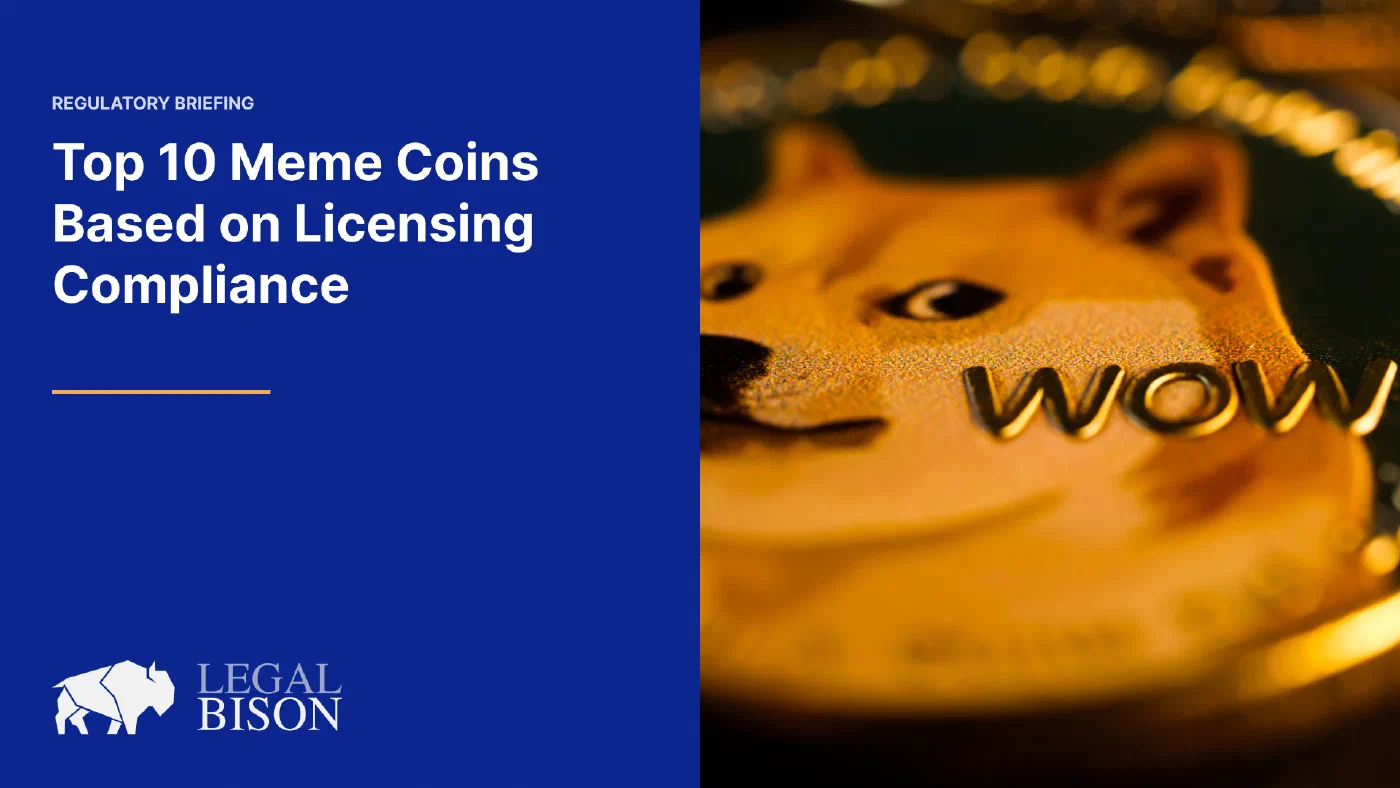
Dogecoin remains the largest meme coin by market cap, trading near USD 13 billion in mid-2026. U.S. regulators classified it as a digital commodity in March 2026, which eased the path for institutional involvement. The Dogecoin Foundation still handles trademark protection and community coordination, backed by registered entities in the UK, the US, and Australia.
SHIB
Shiba Inu has grown from a Dogecoin imitator into a broader Ethereum-based ecosystem with its own decentralized applications. It operates through a Cayman Islands foundation alongside several community-run DAOs, keeping day-to-day governance separate from any single corporate owner.
PEPE
Pepe’s team has stayed anonymous since launch, and the project hasn’t disclosed any licensing or regulatory registration. That silence says something on its own: without a named legal entity, holders have no clear counterparty if a dispute or regulatory action comes up.
TRUMP
Official Trump (TRUMP) launched on Solana in January 2025. Eighty percent of its one billion token supply is held by Trump-affiliated entities, CIC Digital LLC and Fight Fight Fight LLC, under a multi-year unlocking schedule. As of March 2026, updated SEC and CFTC guidance classified TRUMP as a digital commodity or collectible, a category with lighter disclosure requirements than a registered security.
BONK
Bonk was built for the Solana community by the Solana community, and it runs on a DAO framework rather than a single corporate entity. It hasn’t published formal licensing details, leaning instead on its on-chain integrations and community governance for legitimacy.
FLOKI
Floki pairs meme branding with a small suite of applications, including a metaverse project and an education platform. Smart contract audits from CertiK and Solidity Finance back the token, and its whitepaper includes a legal disclaimer similar in structure to standard token issuance documentation.
PENGU
Pudgy Penguins started as an Ethereum NFT collection before entrepreneur Luca Netz acquired the brand in 2022 and expanded it into merchandise and licensing deals. The PENGU token launched on Solana in December 2024, issued through Igloo Inc., the company behind the Pudgy Penguins brand. That corporate-entity-plus-IP-licensing setup looks nothing like the anonymous or DAO-governed projects elsewhere on this list.
SPX6900
SPX6900 bills itself as a satirical parody of the S&P 500. It has no whitepaper, no roadmap, and no identified founding team, and it explicitly disclaims any DeFi or AI-related utility. Distribution is decentralized, with no formal foundation or company behind it.
What this means for meme coin creators in 2026
The structures above break down into three rough categories, and each one carries different regulatory exposure for a creator building a new meme coin today.
Projects with a named foundation or company, like Dogecoin’s foundation setup or Pudgy Penguins’ corporate-and-licensing model, give regulators and exchanges a clear counterparty. That usually makes it easier to get listed on major exchanges and lowers the risk of the project being treated as an unregistered enterprise. Anonymous or fully decentralized projects, like Pepe or SPX6900, dodge that scrutiny at launch but leave the market with no accountable party if something goes wrong later. Politically or celebrity-branded coins, like TRUMP, bring their own disclosure and conflict-of-interest questions that regulators are still sorting out.
For a founder planning a launch, the practical questions don’t change much across these categories: which jurisdiction will hold the issuing entity, what licensing or registration applies to that entity’s activities, and what AML and KYC obligations attach to the exchanges or on-ramps the token will use. These are corporate structuring and crypto licensing questions, and they apply across EU-regulated environments, offshore jurisdictions, and everywhere in between.
LegalBison advises founders on the entity structuring, jurisdiction selection, and regulatory positioning behind a meme coin launch, using the same corporate and licensing frameworks it applies to exchanges, token issuers, and other digital asset projects. For more on the legal side of meme coin launches, visit the MemeCoins solution page, or get in touch through LegalBison to talk through your project’s structure.
Reference:
(1) https://www.kucoin.com/es/news/flash/memecoin-market-cap-drops-from-150b-to-31b-amid-deleveraging-and-cooling-speculation