





DAO
Crypto licensing
MiCA
What Is a DAO? How It Works, Real Examples, and the Legal Structures Behind It
How a DAO works, what happened to The DAO and Ooki DAO, and which legal wrappers and licenses apply once a DAO holds funds. see more...
How a crypto payment moves from checkout to settlement, what the fees look like, and which authorization a processor needs.
Crypto payment processing is the mix of software and licensed financial rails that lets a business accept crypto from customers and settle in crypto or fiat. A checkout quotes a price, the customer sends a transfer, the network confirms it, and the processor either passes the crypto through or converts it and pays the merchant out.
This guide covers how that flow works, what it costs in structural terms, how a gateway differs from a processor, and which authorization a processor itself needs. Most explainers stop before the licensing question, which is where the legal exposure begins.
A payment moves through six steps, and the licensing questions are in steps five and six:
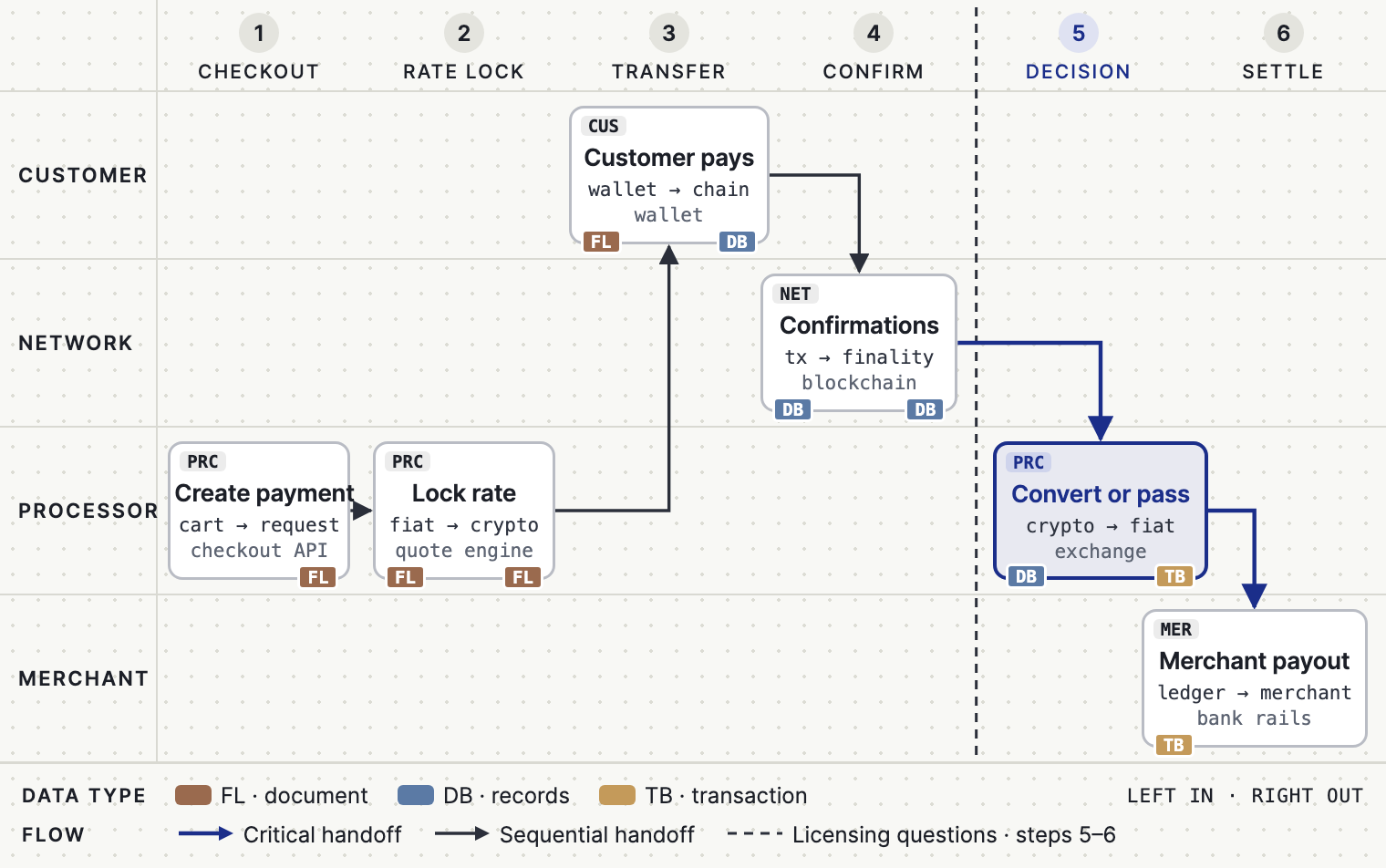 How a crypto payment moves: checkout, rate lock, customer transfer, confirmations, conversion decision, and merchant settlement.
Fees come in four layers, and a merchant should ask a provider about each one by name. No provider rates are quoted here, since rate cards change and differ by volume.
Every on-chain transfer pays a network fee. The amount depends on congestion and on the chain, and the customer usually bears it, or it is built into the quote. When the processor converts crypto to fiat, it also earns or loses on the gap between its quoted rate and the market rate. That spread is often the least visible cost.
The processor then charges for the service itself, commonly a percentage of each payment, a fixed amount, or both, and some add a monthly or integration fee. Moving crypto out to a merchant wallet or sending fiat to a bank can carry a further charge, including banking fees on cross-border payouts.
Chargebacks work differently from cards. A confirmed crypto transfer is final, and the customer cannot reverse it through the network. A refund is a new transfer started by the merchant. That removes chargeback risk for the merchant, and it leaves disputes, errors, and refunds to the merchant’s own policies.
A gateway is the technical layer, and processing is the licensed money flow. A gateway presents the checkout, creates payment requests, tracks their status, and sends notifications to the merchant’s system. What a payment gateway is has its own guide, and this page covers only what is needed to reach the licensing question.
Processing starts when the firm touches value: receiving crypto or funds, converting, holding balances for the merchant, or paying out. The market uses the two words loosely, so a provider’s label does not decide its legal position. This is the function’s job.
Companies that offer crypto payment processing fall into four groups: crypto-native gateways, payment institutions and electronic money institutions that added crypto acceptance, exchanges with merchant tools, and card networks and large payment platforms with crypto features. These are categories, and no group is endorsed here.
The authorization depends on what the processor does with money and crypto-assets. In the EU, two separate regimes can apply, and they are not interchangeable.
Payment services law covers fiat funds. Its core texts are the Payment Services Directive (PSD2, Directive (EU) 2015/2366) and the E-Money Directive (Directive 2009/110/EC). A firm that provides payment services needs authorization as a payment institution (PI), and a firm that issues electronic money needs authorization as an electronic money institution (EMI). Both fall under the broader label of payment service provider (PSP). LegalBison’s PSP license and EMI license pages hold the country details.
Crypto-asset law is the Markets in Crypto-Assets Regulation (MiCA, Regulation (EU) 2023/1114). A firm that provides crypto-asset services professionally needs authorization as a crypto-asset service provider (CASP), described on the MiCA license and CASP license pages. MiCA’s transitional arrangements for existing providers ended by July 1, 2026 at the latest, so the question now is authorization.
The table shows which authorization each model triggers:
| Model | What the firm does | EU position | US position |
|---|---|---|---|
| Pure gateway | Software only. Never controls funds or crypto-assets, and the merchant receives payments directly | May fall outside both regimes, because PSD2 excludes technical service providers that never take possession of funds. Facts decide, so a written analysis is advisable | Depends on whether the firm accepts and transmits value. Software-only models can fall outside |
| Converting processor | Receives crypto, converts it, and pays the merchant in fiat | CASP authorization for exchanging crypto-assets for funds (Class 2 under Annex IV, minimum capital EUR 125,000), plus payment services authorization where the firm receives or transmits the merchant’s fiat funds | Money transmitter, registered with FinCEN as a money services business (MSB) and licensed state by state |
| Custodial balances | Holds merchant balances in crypto or fiat before payout | CASP authorization for custody and administration (Class 2) for crypto balances, and EMI authorization for fiat balances that amount to e-money | Money transmitter analysis applies, with state licensing |
MiCA Annex IV sets minimum capital by CASP class. Class 1 (EUR 50,000) covers services such as execution, placing, transfer services, and order reception. Class 2 (EUR 125,000) adds custody and administration and the exchange of crypto-assets for funds or for other crypto-assets. Class 3 (EUR 150,000) adds operating a trading platform. A firm authorized for several services holds the capital for the highest class, and the ESMA Q&A on the point confirms that approach (ESMA Q&A 2343). Article 67 also sets an overhead-based test, so the class minimum is a floor.
E-money tokens add a second layer. The European Banking Authority advised national authorities to treat the transfer of crypto-assets involving e-money tokens, carried out for clients, as a payment service under PSD2. It expected PSD2 authorization from March 2, 2026, with streamlined procedures where a CASP applies, and it said CASP authorization alone does not address the risks of e-money token transactions (EBA, No Action letter). A processor that moves stablecoins classed as e-money tokens can therefore need both authorizations.
The Transfer of Funds Regulation (Regulation (EU) 2023/1113), known as the travel rule, requires crypto-asset service providers to collect and pass on information about the sender and recipient with crypto transfers. A licensed processor builds this into its flows.
The payments rulebook is also changing. The PSD3 and Payment Services Regulation package was politically agreed in November 2025, and the Council published final texts in April 2026. Formal adoption and publication in the Official Journal had not been confirmed in early October 2026, so PSD2 and the E-Money Directive remain the operative law until the new rules apply.
In the United States, FinCEN’s 2019 guidance on convertible virtual currency states that payment processors that accept and transmit crypto for merchants are money transmitters and do not qualify for the payment processor exemption (FinCEN FIN-2019-G001). State money transmission licenses are a separate layer, and each state regulator is the source for its requirements. Other regions have their own routes, and the primary regulator is the place to confirm them.
Fiat-to-crypto payment processing, where the customer pays in fiat and the merchant receives crypto, usually adds a conversion step that raises the same CASP and payment-services questions in reverse.
Merchants and operators face different tasks, and each starts with a licensing question. A merchant integrates a processor that already holds the right authorization. It should check the provider’s license on the regulator’s register, who holds the funds, the settlement schedule, and how refunds and underpayments are handled. An operator that wants to become the processor takes on everything above: authorization, capital, governance, AML and travel rule controls, banking, and settlement partners.
LegalBison’s guide to starting a payment processing company covers the business side of the operator route. Either track can start with a discussion of the project with LegalBison through the contact page below.
LegalBison is a global boutique legal and business services firm and licensed corporate service provider, with offices across Europe, MENA, Latin America, and Asia and operational reach in 50+ jurisdictions. For crypto payment processors, the firm maps the model to the authorizations it triggers, structures EMI and PI applications alongside CASP work, prepares the legal documentation, and forms and administers the operating entities. Its legal services cover the corporate and regulatory work around a processing business. Regulators decide outcomes, and LegalBison does not guarantee approvals. To discuss a processor project, contact LegalBison.
A processor quotes a crypto amount for a fiat price, the customer sends the transfer, and the network confirms it. The processor then passes the crypto to the merchant or converts it and pays out in fiat. The conversion and payout steps are the regulated ones.
No single method wins. The answer depends on settlement speed, transfer cost, and price stability during the payment window. Stable-value tokens reduce price movement between quote and settlement, and low-fee networks cut the cost of small payments. This describes the trade-offs and does not recommend any token.
Licensed payment processors, crypto-native gateways, some exchanges, and payment institutions offer API access, usually with hosted checkout, status notifications, and settlement reporting. Before integrating, check the provider’s authorization on the regulator’s register, who controls the funds at each step, and what the settlement terms say.
Start by defining what the firm will do with money and crypto-assets, because that decides the license. Then map the model to the EU, US, or other authorizations it triggers, choose the jurisdiction and entity, and fund the capital and governance the regulator expects. Build AML, KYC, and travel rule controls before the application, and line up banking and settlement partners. The full operator guide is on starting a payment processing company.
Our team of experts will be glad to provide you with answers and a one-stop-shop solution to all your legal corporate needs.
How a DAO works, what happened to The DAO and Ooki DAO, and which legal wrappers and licenses apply once a DAO holds funds. see more...
A practical guide to KYC due diligence: the three tiers, the five stages, when enhanced checks apply, and what a compliant customer file needs. see more...
Backed or synthetic, direct or indirect ownership: what tokenized stocks really give a holder and where US and EU rules draw the line. see more...