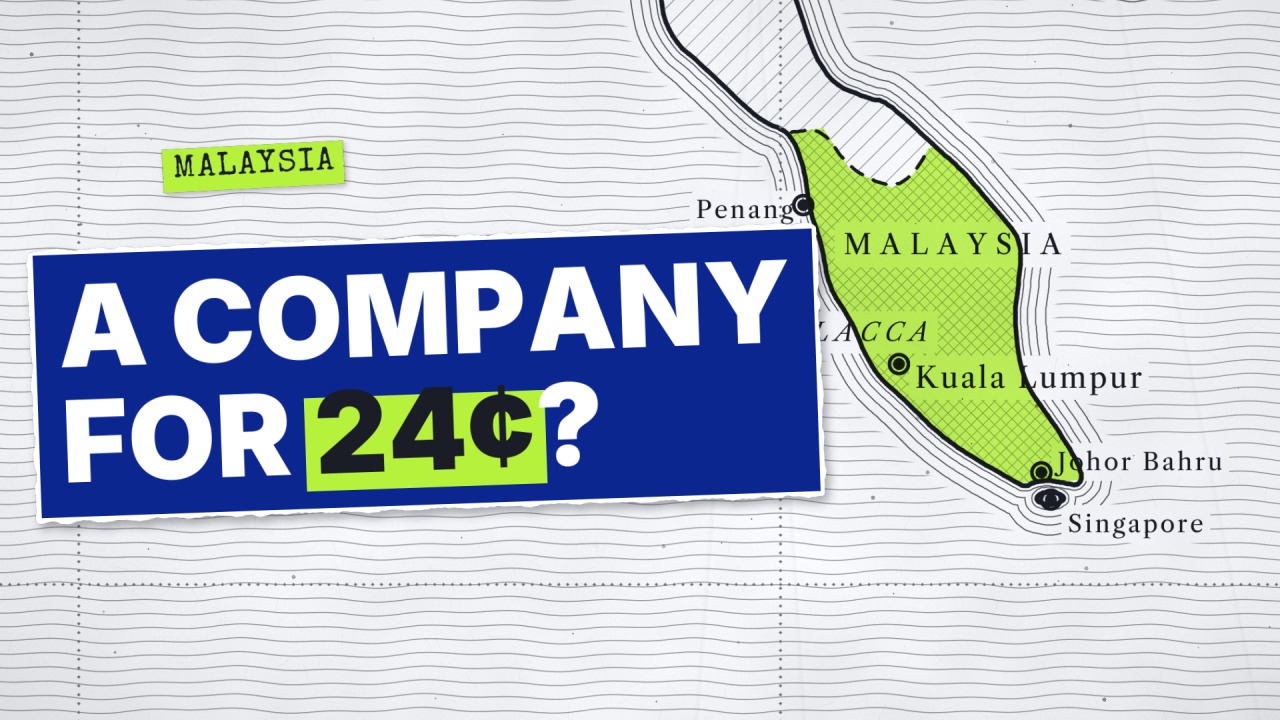
A Malaysian company can start with one ringgit of share capital. On 24 November 2026 that was about 24 US cents (OFX).
For a foreign founder, that isn’t what it really costs. The real planning comes from a director who lives in Malaysia, the paid-up capital you need to put yourself on an employment pass, the bank’s checks, the tax rules, and the filings every year. This guide covers each one, and every number links to the source it comes from. Facts were checked on 24–25 November 2026.
 The 7-minute video covers the same ground as this guide, chapter by chapter.
Prefer to watch? Play the 7-minute video on YouTube.
The short answer
Can a foreigner own 100% of a Malaysian company?
For most new businesses, yes. Malaysia has allowed full foreign ownership of new projects since June 2003 (MIDA equity policy). Some sectors are still capped by their regulators, including telecoms, financial services and transport (MITI).
The usual vehicle is a private company limited by shares, the Sdn Bhd. It is governed by the Companies Act 2016 (Act 777), in force since 31 January 2017 (ACCA).
What the Act requires (SSM CA 2016 FAQ, SSM directors’ booklet):
- One shareholder and one director are enough, and they can be the same person.
- The director must be a natural person, not a company.
- At least one director must ordinarily reside in Malaysia (section 196(4)). This is the first surprise for most founders abroad.
Registering with SSM: the government fees
Incorporation goes through SSM, the Companies Commission of Malaysia. The government fee is RM1,000, and reserving the name first costs RM50 (SSM Table of Fees). A company secretary registered with SSM lodges the paperwork; secretary registration under section 241 has been in force since 15 March 2019 (SSM Part K).
There is no par value under the 2016 Act, and a company needs only “one or more shares”, so one RM1 share is the usual minimum (SSM). That is where the 24 cents comes from.
So far, it’s cheap. The next step is where the cost goes up. For the full service, see company registration in Malaysia.
The RM500,000 question: minimum capital for a foreign-owned company
If you want to work in your own Malaysian company, you need an employment pass, and your company has to qualify to hire expatriates. That is where the capital requirement comes in.
Under MIDA’s employment pass guidelines (1 June 2026), the minimum paid-up capital is (MIDA, MDEC):
The takeaway: the company is cheap to open, but putting yourself on its payroll is not. Decide who will run the company on the ground before you decide how much capital to put in.
Opening a corporate bank account as a foreign founder
The paid-up capital has to sit in a corporate bank account, and this is where many foreign-owned companies stall.
Malaysian banks are reporting institutions under the Anti-Money Laundering Act 2001 (AMLA). Before opening an account, they must carry out customer due diligence, which includes identifying the beneficial owner: the natural person who ultimately owns or controls the company (AMLA 2001, SSM–BNM beneficial ownership notes).
For a foreign founder, that usually means passports, proof of address and a clear account of where the funds come from. A holding company in a third country adds a layer the bank has to see through, and every extra layer means another set of documents.
More banks, same checks. On 29 April 2022, Bank Negara Malaysia picked five digital banks out of 29 applications (BNM). The first began operating in September 2023 (NST). The due diligence rules apply to them too.
Moving money in and out. Under Bank Negara’s foreign exchange policy, non-residents can invest in ringgit or foreign-currency assets without restriction. Profits, dividends and divestment proceeds can be repatriated freely in foreign currency (BNM FEP). Each transfer still goes through the bank’s normal checks.
The smoothest path is to walk in with the paperwork already in order.
Is a Malaysian company taken seriously abroad?
Founders often ask whether banks, payment providers and partners abroad will trust a Malaysian company.
One answer comes from the Financial Action Task Force (FATF), the global anti-money-laundering standard-setter. FATF and APG assessors visited Malaysia in February 2025, and their mutual evaluation report was published in December 2025. It placed Malaysia in regular follow-up, the best follow-up category in the process. The assessors also named work still to do, mainly on prosecutions and convictions (FATF, BNM, The Star).
A properly set-up Sdn Bhd is mainstream. What partners check is the structure around it: who owns it and where the money comes from. Get that clear, and the country on your letterhead stops being the question.
Corporate tax in Malaysia, and the Labuan “loophole”
The headline rate is 24%. Small and medium companies pay lower rates on their first RM600,000 of chargeable income. But from year of assessment 2024, a company that is more than 20% foreign-owned loses the small-company rates (LHDN, Deloitte). A fully foreign-owned startup therefore pays 24% from the first ringgit.
Service tax. If you sell taxable services, the main service tax rate rose from 6% to 8% on 1 March 2024, and some services stay at 6% (KPMG).
Labuan. Labuan, an island off Borneo, was set up as an international financial centre in 1990. Qualifying Labuan trading companies pay 3% on net audited profits. Since 2019 that rate has depended on real substance on the island, meaning a minimum number of staff and minimum annual spending there. A company that misses the substance requirements is taxed at 24% (Labuan IBFC, ACCA).
Labuan suits holding and regional structures. It is not a shortcut around operating in Kuala Lumpur.
If your company will also earn abroad, read does a Malaysia company pay tax on foreign-sourced income?
The yearly compliance calendar for a Sdn Bhd
Incorporation is day one. The paperwork runs every year after it:
- Beneficial ownership reporting. Since 1 April 2024, companies must report their beneficial owners to SSM through e-BOS (SSM BO FAQ).
- Annual return (section 68), lodged with SSM every year (SSM).
- Financial statements (section 259). Companies must keep proper accounting records, and most must lodge audited accounts. This is a separate filing from the annual return (SSM FAQ Part M).
- e-Invoicing. LHDN began rolling it out on 1 August 2024, starting with the largest taxpayers. From 1 January 2026 it covers companies with RM1–5 million in annual revenue (LHDN timeline).
The hard part isn’t any single filing. It’s keeping track of different deadlines on different portals every year while you run the business. Miss one, and the bank, the payment provider and your investors start asking why.
Why founders still choose Malaysia
Singapore is across the Causeway. In January 2025 the two governments signed the agreement for the Johor–Singapore Special Economic Zone (JS-SEZ), which covers more than 3,500 km², or more than four times the size of Singapore (EDB Singapore, MIDA).
Malaysia also offers regional reach, Southeast Asian customers, and a regulator that international assessors rate well.
The trade-off is planning. Get four things right before you file, not after:
- The resident director
- The RM500,000 paid-up capital, if you will work in the company yourself
- The bank’s questions, with documents ready for every ownership layer
- The 20% rule, which decides whether you get small-company tax rates
Plan it before you file
LegalBison forms your company in Malaysia, and one team handles the admin that keeps it running and compliant, from the first question to the yearly filings. We look at how you’ll earn and recommend the structure that fits.
This article is general information, not legal or tax advice. Rates, thresholds and dates were checked on 24–25 November 2026 and can change; check the linked sources before acting.