A tokenized stock is a blockchain token that represents or tracks the shares of a listed company. Two models are behind the label. In one, real shares are held by a custodian and the token points to them. In the other, the token gives price exposure only, and no share stands behind it. That difference determines what a holder owns, what happens if the provider fails, and which rules apply.
This guide explains how tokenized stocks work, what a holder actually owns, how the SEC treats them, and who can buy. Platform facts reflect public disclosures checked in October 2026.
What tokenized stocks are (tokenized equities)
A tokenized stock is a digital token that represents a listed company’s share or follows its price. The market also calls them tokenized equities, and a single token is a tokenized equity.
SEC staff defines a tokenized security as an instrument that already counts as a “security” under federal law and is formatted as, or represented by, a crypto asset, with ownership recorded in whole or in part on a crypto network (SEC Statement on Tokenized Securities, January 28, 2026). A tokenized stock is that definition applied to equity. The label tells a buyer little, and the legal structure behind the token is what matters.
Tokenized stocks vs tokenized securities
Tokenized securities are the broader category, and tokenized stocks are its equity branch. The category also includes bonds, notes, and fund interests. All of these are forms of asset tokenization, as are adjacent examples such as tokenized real estate.
This page stays on equities: what a holder owns, how the market is organized, and who may buy. Category definitions, classification, custody, and the issuance process are on the tokenized securities page. A security token is the related term for tokens that are themselves securities.
How tokenized stocks work
A provider holds real shares, creates tokens against them, and lets holders move the tokens on a blockchain.
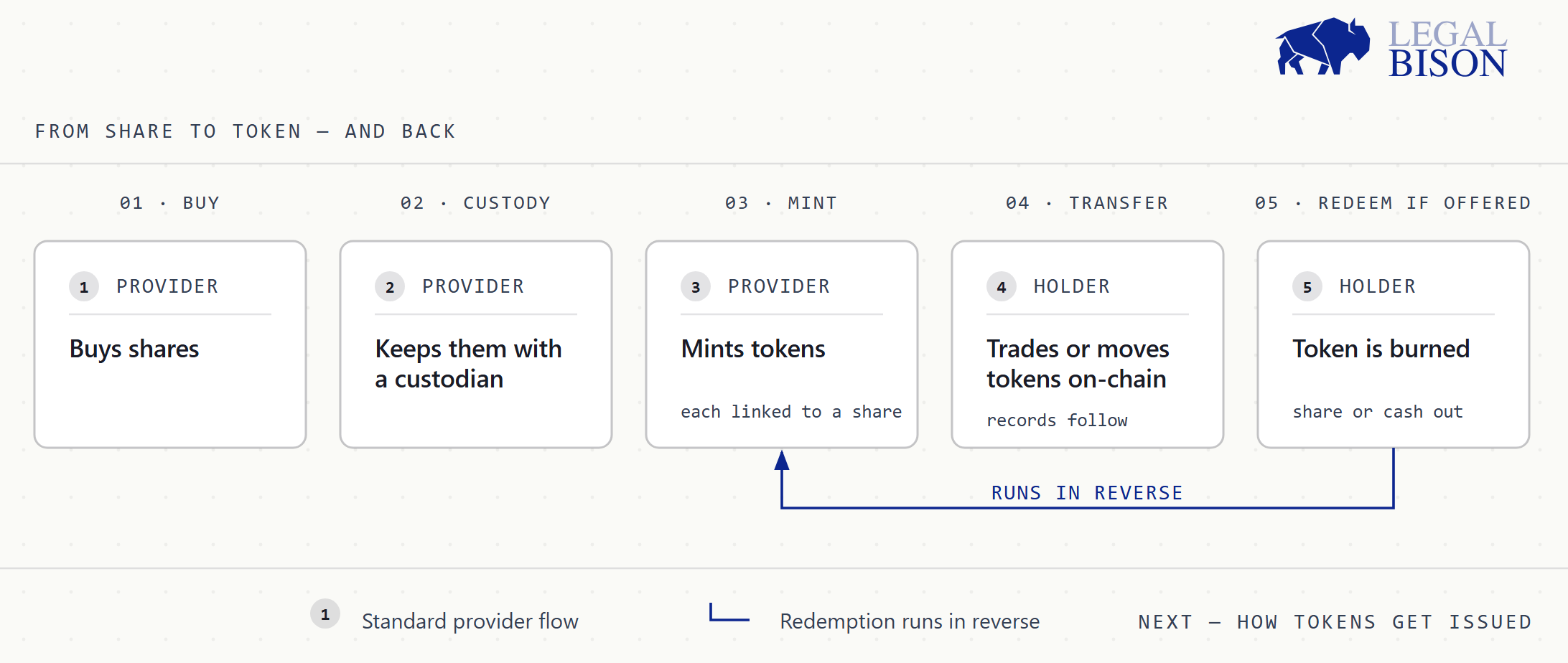
The provider buys shares and keeps them with a custodian. It then mints tokens, each linked to a share or a fraction of one. Holders trade or transfer the tokens like any other on-chain asset, and the provider’s records follow. Where redemption is offered, the process runs in reverse: the token is burned, and the holder receives the share or its cash value.
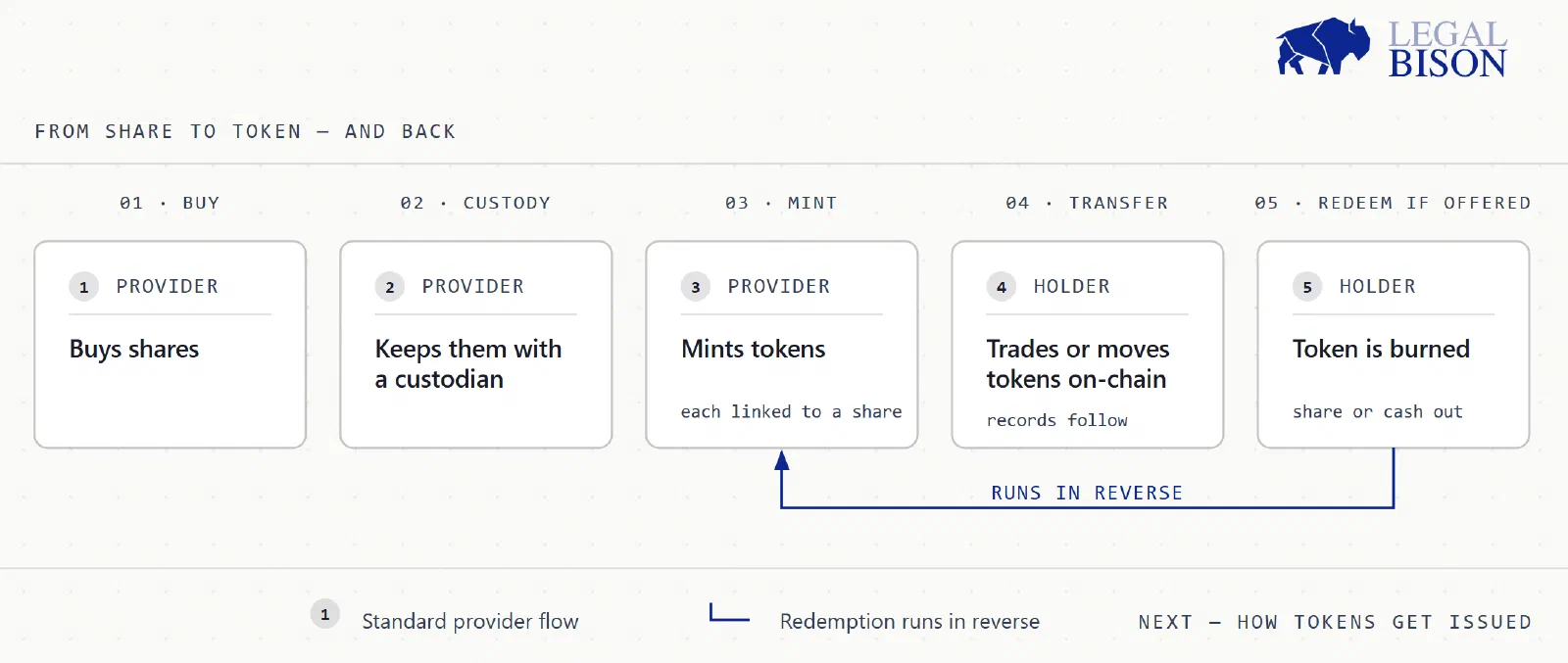 From share to token: the provider buys and holds the shares, mints linked tokens, holders trade them on-chain, and redemption burns the token for the share or its cash value.
Some issuers do it differently. In the issuer-sponsored model the SEC describes, the company or its agent keeps the master securityholder file on-chain, so a token transfer is the share transfer. The only difference from a conventional share is where the record lives.
Buying follows the provider’s onboarding: identity verification, confirmation of country and eligibility, funding, and then a purchase inside the provider’s app. Some tokens can later be withdrawn to a self-custody wallet. Kraken’s steps, for example, ask users to confirm they are not in the United States or a US person before the first purchase (Kraken, Getting started with xStocks).
Fully backed vs synthetic exposure
The central question is whether a real share sits behind the token. Backed tokens do hold shares at a custodian, but synthetic tokens do not.
SEC staff describes the same split for third-party tokens. Under the custodial model, the underlying security is held in custody and the token evidences the holder’s direct or indirect interest in it. Under the synthetic model, the third party issues its own security that gives exposure to the referenced stock. That instrument is not an obligation of the stock’s issuer and gives no rights against that issuer. The staff also warns that holders of third-party tokens may face risks, such as the provider’s bankruptcy, that a direct shareholder would not.
Are tokenized stocks backed by real shares? Some are, and some are not. A 1:1 backing claim doesn’t settle the matter either. Kraken describes xStocks as backed one for one by the underlying equity in regulated custody. Its own disclosure also says the tokens are issued under an EU-registered prospectus and provide price exposure only, with no voting or dividend rights (Kraken, SpaceX IPO access). Backing and shareholder rights are separate questions.
Four questions sort most products:
- Who issues the token, and is it the same company as the stock’s issuer?
- Where are the shares held, and by whom?
- What does the holder own: a direct interest, an indirect one, or a claim against the provider?
- Is redemption offered, and on what conditions?
What you actually own
Holding a tokenized stock does not automatically make you a shareholder. The product terms decide, and they differ more than the marketing suggests.
In a custodial structure, the holder usually has an indirect interest through the provider’s records, much like holding shares through a broker. In a synthetic structure, the holder has a claim on the provider. In an issuer-sponsored structure, the holder can own the share itself.
Dividends reach the holder only if the terms pass them through. Some providers have described designs that pay dividends and adjust for splits at the token level, while Kraken’s xStocks disclosure says there are no dividend rights. Find the dividend clause before buying, including how payment works and whether tax is withheld.
Voting isn’t a given. Shares held by a custodian rarely carry instructions back to the token holder, and some structures exclude voting by design. The SEC staff says plainly that third-party tokens may or may not confer rights as a holder of the underlying security.
Splits, mergers, spin-offs, tender offers, and delistings each need a rule in the product terms. The questions to ask are who receives what, how balances or prices adjust, and what happens to the token if the stock stops trading. A product that is silent on these points leaves the holder exposed.
A redemption right turns the token back into a share or cash. It can come with minimum sizes, eligibility checks, or delays, and no provider can promise it will always be available.
The SEC’s September 2026 innovation exemption points at the same issue. A trading venue must verify that any tokenized NMS stock it lists carries the same rights and privileges as traditional stock of an equivalent class, and synthetic instruments are excluded from that definition (SEC fact sheet, Release No. 34-106402).
The market landscape
The market is small next to the equity market it tracks, and it is concentrated in offshore distribution to non-US customers. Size depends on who is counting. CoinGecko measured tokenized stocks at USD 486.69 million on March 31, 2026, up from USD 2.09 million at the end of June 2025 (CoinGecko, RWA Report 2026). a16z crypto put the figure near USD 1.5 billion in mid-2026, against global equities worth well over USD 100 trillion (a16z crypto). The gap probably comes from what each tracker counts.
Long-range forecasts cover a wider field. Standard Chartered projects tokenized real-world assets above USD 30 trillion by 2034, a figure that includes commodities and trade finance and is not a forecast for stocks alone (as summarized by a16z crypto, above).
Distribution falls into three patterns:
- Third-party tokenizers on exchanges. Kraken lists xStocks, which are issued by Backed Assets (JE) Limited and offered to eligible non-US customers (Kraken, xStocks FAQ);
- Platform-issued tokens. Robinhood launched stock tokens for EU customers in June 2025, and Coinbase released tokenized stocks on its Base network in August 2026 for eligible users outside the United States, described as backed one-for-one through a custodian;
- Onchain and institutional initiatives. Ondo and Dinari work in the same space, often through RWA tokenization infrastructure.
This is a market survey, not a ranked list, and a mention is not an endorsement. Product terms, backing models, and geographic limits change quickly, so read the current prospectus and eligibility terms of the specific provider before buying.
Are tokenized stocks legal?
Existing securities law applies to tokenized stocks in full, and tokenization creates no exemption. The SEC staff’s joint statement of January 28, 2026, from the Divisions of Corporation Finance, Investment Management, and Trading and Markets, says the format of a security or the method of recording holders does not change how federal securities laws apply.
Every offer of a security must be registered unless an exemption exists, and stock is an equity security in any format. The statement is a staff view and carries no legal force. Investor.gov gives retail investors the same message: tokenized securities are securities (Investor.gov, Tokenized Securities).
Synthetic tokens face an added layer. The staff notes that a tokenized security-based swap cannot be offered to people who are not eligible contract participants unless a registration statement is in effect and trading takes place on a national securities exchange.
On September 17, 2026, the Commission issued Release No. 34-106402, a temporary and conditional “innovation exemption.” It gives five-year relief for permissioned secondary trading of tokenized NMS stock on tokenized securities venues that use automated market makers and liquidity pools, and it asks for public comment (SEC order).
In the EU, a token that qualifies as a financial instrument falls under MiFID II (Directive 2014/65/EU), and MiCA does not apply to crypto-assets that qualify as financial instruments (Regulation (EU) 2023/1114). The classification test is covered on the tokenized securities page and in LegalBison’s guide to MiCA token issuance.
Can US persons buy tokenized stocks?
For most offshore tokenized stock products, no. Kraken states that xStocks are not accessible in the United States or to US persons, nor in Canada, the UK, or Australia, and that they are not registered under the US Securities Act (Kraken, xStocks FAQ). Coinbase’s tokens have been described as offered to eligible non-US users and unavailable to people in the United States.
The reason is registration. Offering securities to US persons requires registration or an exemption, and the SEC staff says tokenization changes neither point. Offshore programs avoid the burden by excluding US persons. Synthetic tokens add the swap-eligibility limits described above, which narrows retail access further.
US investors can still own the underlying companies through a US broker. The innovation exemption may open a US-regulated route for permissioned trading, but it is recent, limited by symbol and volume caps, and not a general retail channel. Geographic restrictions move, so check each provider’s current terms before relying on this answer.
How tokenized stocks get issued
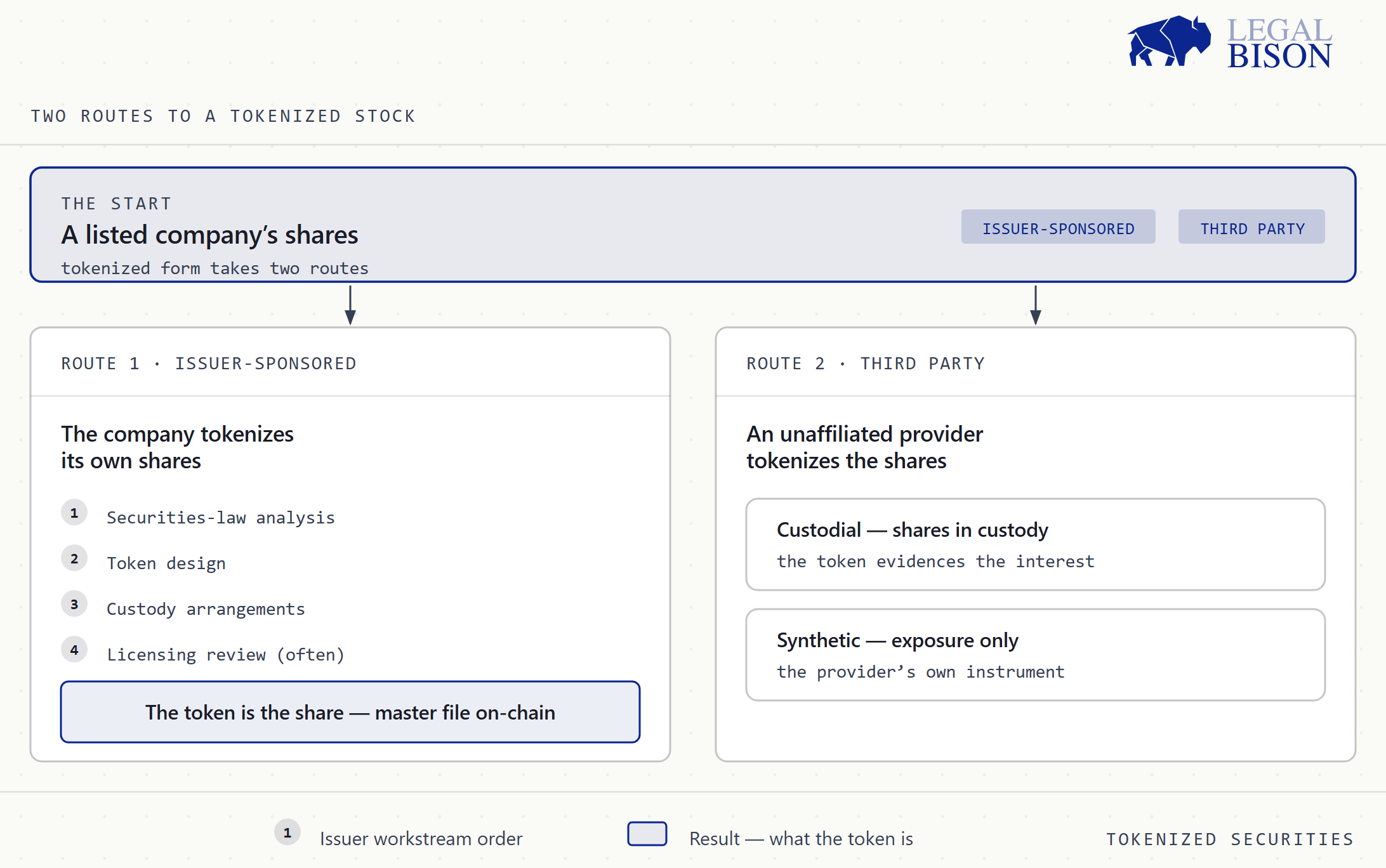
Issuers reach tokenized form in two ways. A company can tokenize its own shares, or an unaffiliated third party can tokenize shares it holds in custody or issue exposure to them. The issuer path involves securities-law analysis, token design, custody arrangements, and often a licensing review. The full process is on the tokenized securities page, and issuers raising capital through tokens can also look at the security token offering route.
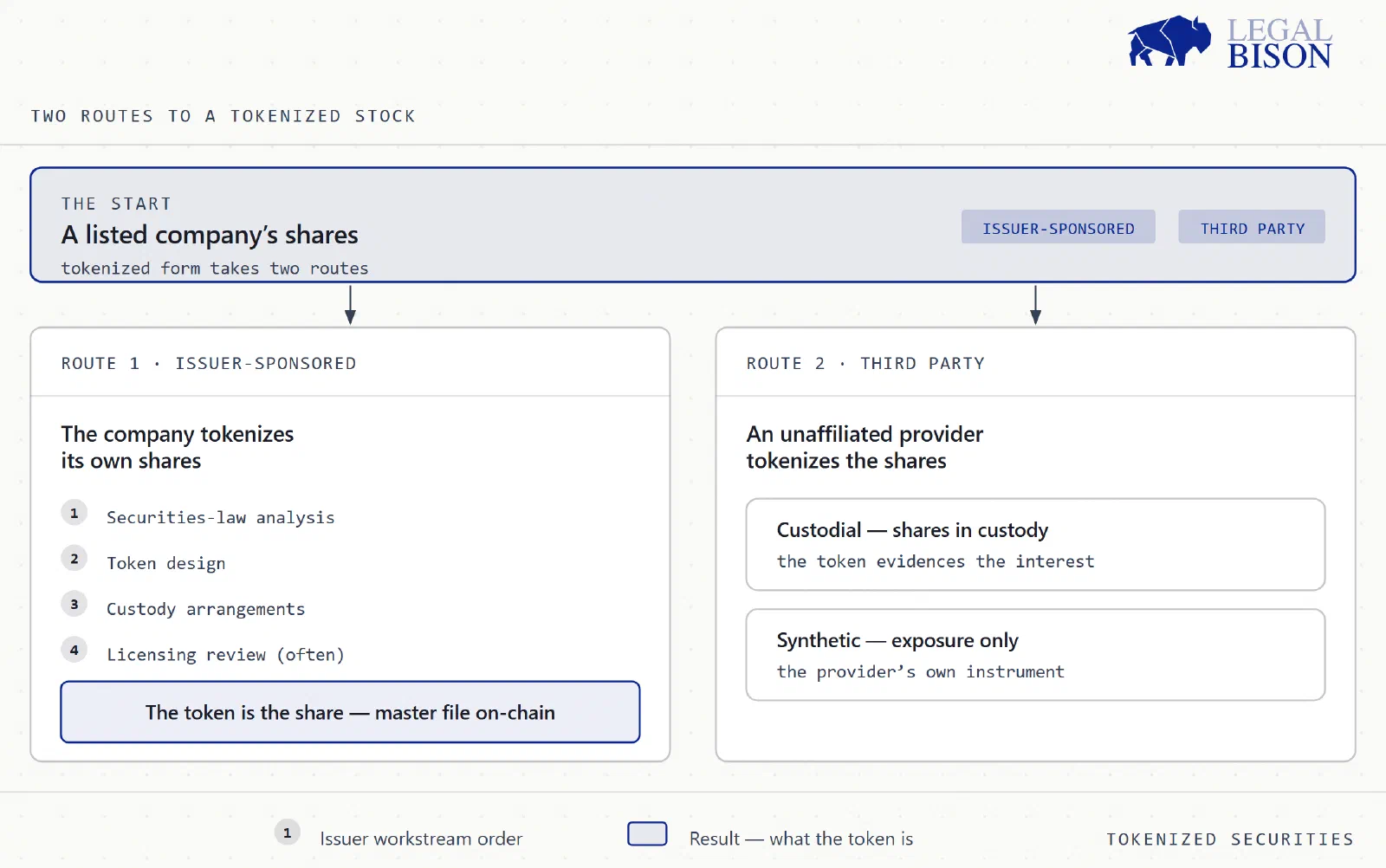 Two routes to a tokenized stock: the issuer tokenizes its own shares, or a third party issues custodial or synthetic tokens.
How LegalBison helps
LegalBison is a global boutique legal and business services firm and licensed corporate service provider, with offices across Europe, MENA, Latin America, and Asia and operational reach in 50+ jurisdictions. For issuers, the firm structures tokenization and securities projects, prepares the legal documentation, and handles regulatory compliance work through a single point of contact. Where an activity triggers licensing, the team assesses the route, including an investment license where one applies. LegalBison’s legal services cover the corporate and regulatory layers around a token project. Outcomes depend on the regulator and the facts, and LegalBison does not guarantee approvals. To discuss a project, contact LegalBison.
Frequently asked questions
What are tokenized stocks?
Tokenized stocks are blockchain tokens that represent or track the shares of a listed company. Some are backed by real shares held in custody, and others give price exposure only.
How do tokenized stocks work?
A provider holds shares, mints tokens against them, and lets holders transfer the tokens on-chain. Where redemption is offered, the token is retired, and the holder receives the share or its value. The exact rights depend on the product terms.
Are tokenized stocks backed by real shares?
Some are. Custodial tokens are backed by shares held at a custodian, while synthetic tokens are not. Even a 1:1 backed token may carry no voting or dividend rights, so the prospectus matters as much as the backing claim.
Are tokenized stocks legal?
Yes, within existing securities law, which applies to them in full. SEC staff stated in January 2026 that tokenization does not change that framework, and the EU treats qualifying tokens as financial instruments under MiFID II. Legality still depends on who offers the token, to whom, and under which exemption or registration.
Can US persons buy tokenized stocks?
Generally not through offshore products. Major offshore providers state that their tokens are unavailable to US persons. The SEC’s September 2026 innovation exemption creates a limited, permissioned trading pathway, and availability may change.
Do tokenized stocks pay dividends?
It depends on the terms. Some products pass dividends through, and at least one major provider states that its tokens carry no dividend rights. The dividend clause in the prospectus is the answer for any given token.