A DAO, short for decentralized autonomous organization, is a crypto term. In blockchain terms, a DAO is an organization whose rules live in smart contracts and whose decisions are made by token holders voting, rather than by a board or a CEO.
This piece covers how a DAO actually works, looks at a few real examples, and gets into something most explainers skip: what happens legally once a DAO is holding real money.
How a DAO works
A DAO swaps out a company’s bylaws for code. Smart contracts hold the rules for how the organization spends money, lets in new members, and updates its own settings, and those rules run automatically once the conditions are met.
Governance tokens work like voting shares. Holding one usually lets you propose changes and vote on them, and your voting power is tied to how many tokens you hold.
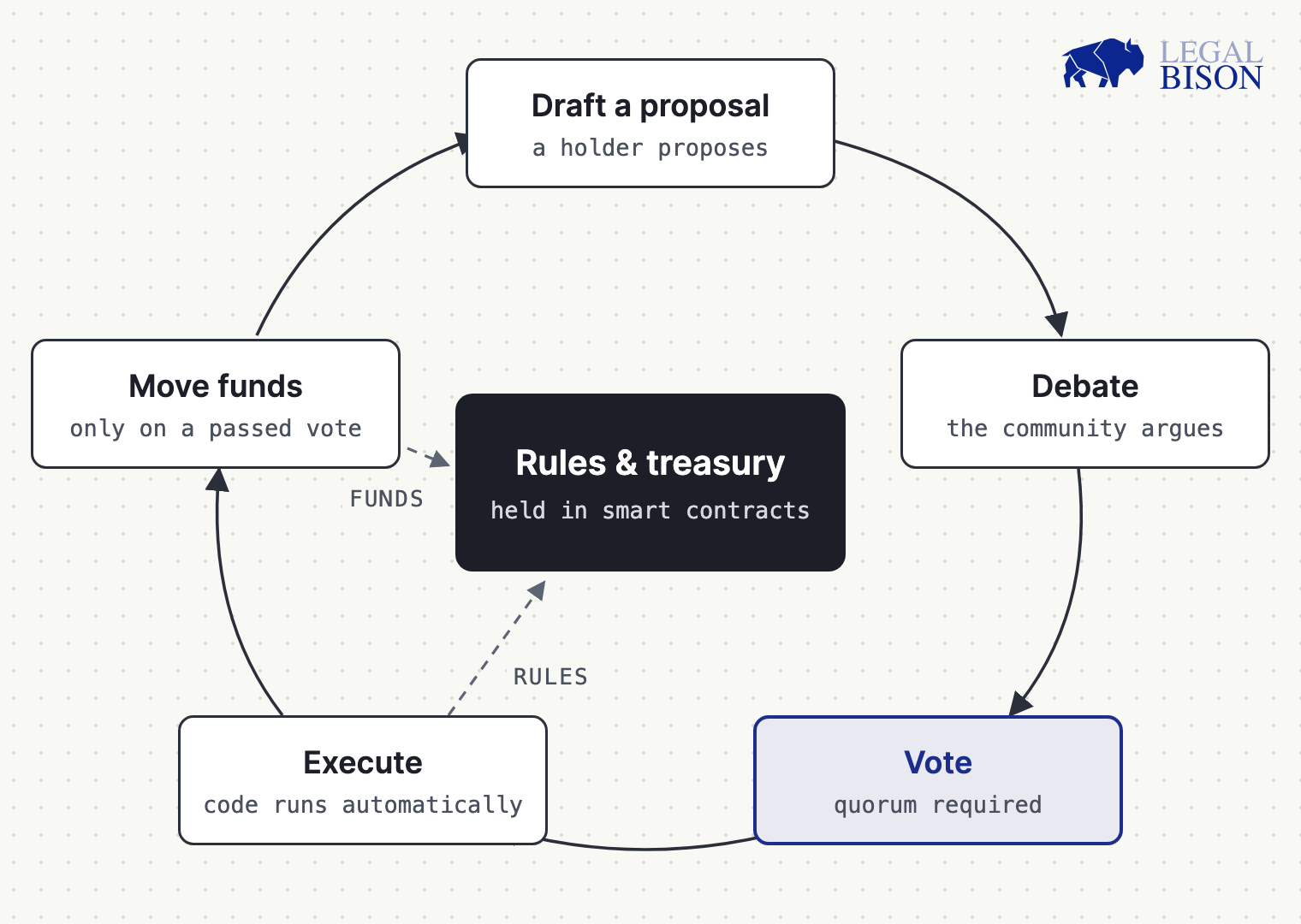
Proposals follow a rough pattern: someone drafts one, the community argues about it, and a vote settles it, often with a quorum requirement so a small group of holders can’t push changes through on their own.
The treasury lives on-chain. Funds sit in a smart contract wallet that only moves when the DAO’s voting process says so, not at the say-so of one person. That’s what makes DAO treasuries transparent, and, as it turns out, legally exposed.
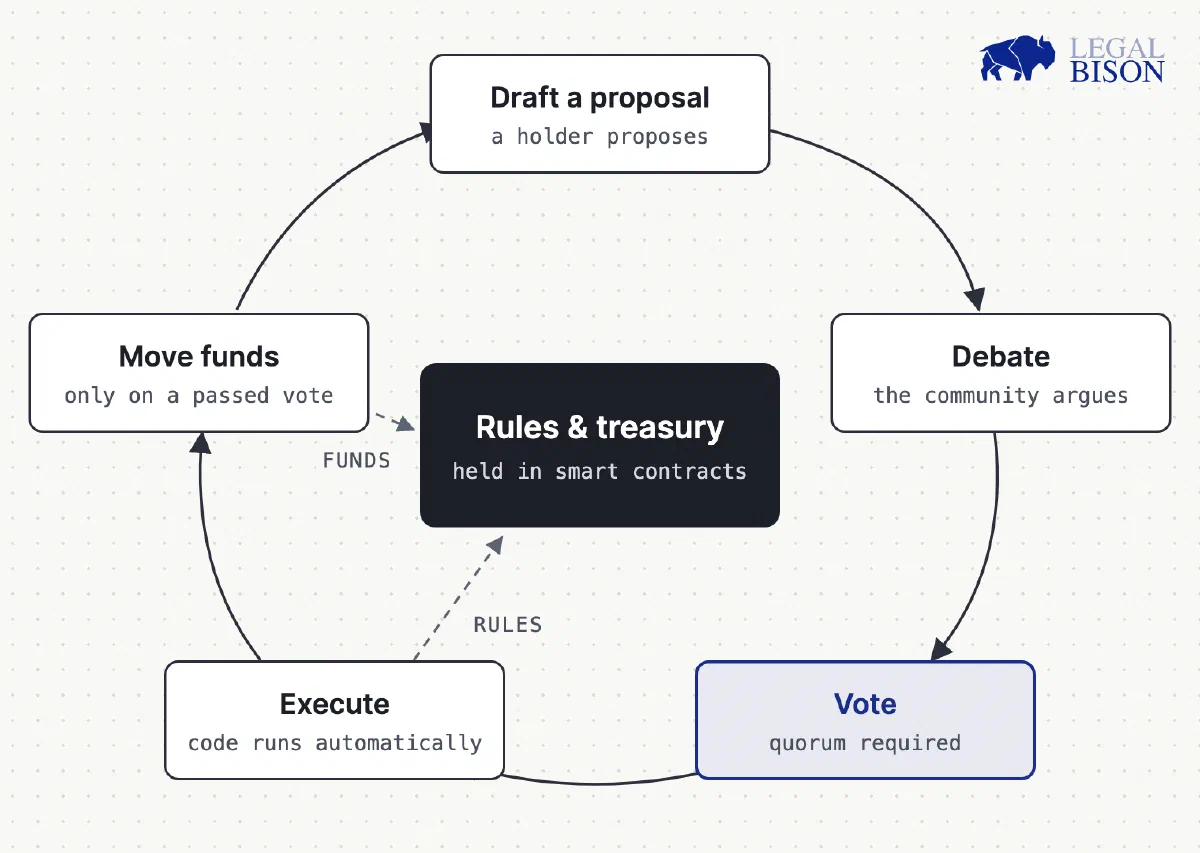 The DAO governance cycle: proposal, debate, vote, execution, and treasury movement, all governed by on-chain rules.
DAO examples
The first well-known DAO, called simply The DAO, launched in 2016 as an investment vehicle on Ethereum. It raised around 12 million ETH, about USD 150 million at the time, through token sales between April 30 and May 28, 2016. A bug in its code let an attacker drain about 3.6 million ETH on June 17, 2016, and the Ethereum community pushed through a hard fork on July 20, 2016, to get the funds back. It’s still the example people reach for when explaining what happens when a DAO’s code and its legal exposure pull in different directions.
Since then, two types have become common. A protocol-governance DAO lets token holders vote on upgrades, fees, and treasury spending for a piece of decentralized software, like a lending or trading protocol. An investment-collective DAO pools money from members and votes on where to put it, working roughly like a decentralized investment club. Both run on the same mechanics described above, but the kind of decision being voted on changes.
The legal problem with DAOs
Code by itself doesn’t shield anyone from liability. Without a legal entity behind it, a DAO can be treated as an unincorporated association, which means the people voting on its proposals can end up personally on the hook for what the DAO does.
The CFTC’s case against bZeroX and Ooki DAO shows why this matters. In September 2022, the CFTC filed an order and complaint against bZeroX and its founders after they’d handed control of the bZeroX protocol over to Ooki DAO. The agency treated Ooki DAO as an unincorporated association and went after its voting token holders as members of that association. A default judgment in June 2023 added a USD 643,542 penalty and a permanent injunction on top of the USD 250,000 penalty already levied against bZeroX and its founders. The takeaway is straightforward: handing control to a DAO doesn’t take the people behind it out of a regulator’s reach.
There was an earlier warning too. In a July 2017 investigation report on The DAO, the SEC concluded that the tokens sold in 2016 were securities under US law, even though it didn’t bring charges. The report told the industry that automating governance doesn’t get you out of securities law.
DAO legal structures that work
A legal wrapper turns a DAO from an unincorporated association into an actual entity, and that’s what protects members from personal liability. A few approaches show up most often.
Wyoming’s option, built through the state’s DAO Supplement legislation and amended in March 2022, is still the easiest starting point for a US-facing project. Offshore routes like a Marshall Islands DAO LLC or a foundation company make more sense when members or the treasury are based outside the US. Whichever route looks right on paper, it’s worth working through with counsel before filing, since the best structure depends on where members actually live and how the treasury gets used.
Do DAOs need licenses?
A wrapper deals with liability but doesn’t deal with licensing. If a DAO starts doing things that look like running an exchange, holding custody of assets, or issuing tokens, the places it operates may still require authorization no matter how it’s structured legally.
In the EU, the Markets in Crypto-Assets Regulation doesn’t directly regulate DAOs. Recital 22 carves out crypto-asset services that are provided in a fully decentralized way with no intermediary, but a DAO that issues tokens, runs something like an exchange, or holds assets for other people can still trigger Crypto-Asset Service Provider authorization requirements, depending on how centralized its actual operations turn out to be. Outside the EU, Virtual Asset Service Provider rules can reach a DAO’s treasury or issuance activity the same way, even after it has a compliant wrapper in place.
How LegalBison helps
LegalBison works with founders on DAO structuring from the ground up: figuring out which wrapper fits, whether that’s a Wyoming DAO LLC, a Marshall Islands DAO LLC, or a foundation company, and preparing the paperwork each one needs. It also looks at whether a DAO’s token issuance or treasury activity triggers licensing under frameworks like MiCA. Because LegalBison is a licensed Corporate Service Provider, it can handle company formation directly rather than just advising on it, and its licensing team can take a MiCA license application (or an equivalent) through the process where one’s needed. Founders looking into a specific DAO structure can check out LegalBison’s legal services or get in touch.
Frequently asked questions
What is an example of a DAO?
The DAO, launched in 2016 on Ethereum, is the best-known early example. It raised roughly 12 million ETH through token sales before a code bug led to the 2016 hack and the Ethereum hard fork that followed. Most DAOs today fall into one of two types: protocol-governance DAOs, which vote on upgrades and settings for decentralized software, and investment-collective DAOs, which pool member money for group investment decisions.
What is a DAO and how does it work?
A DAO, or decentralized autonomous organization, runs on smart contracts instead of a traditional management setup. Members hold governance tokens that let them propose and vote on changes; votes pass or fail based on a process that usually includes a quorum, and the treasury sits in a smart contract wallet controlled by that same voting process rather than by one person.
What does DAO mean?
DAO stands for decentralized autonomous organization. In crypto, it means an organization run by code and token-holder votes instead of a centralized management team. The same three letters also refer to an unrelated liver enzyme in biology and to the Data Access Object pattern in software engineering, so context matters.
Is Bitcoin a DAO?
No. Bitcoin doesn’t have a formal governance token, a treasury under collective member control, or a voting mechanism for changing its rules. Protocol changes happen through rough consensus among developers, miners, and node operators, which is a different process than the token-weighted voting that defines a DAO.