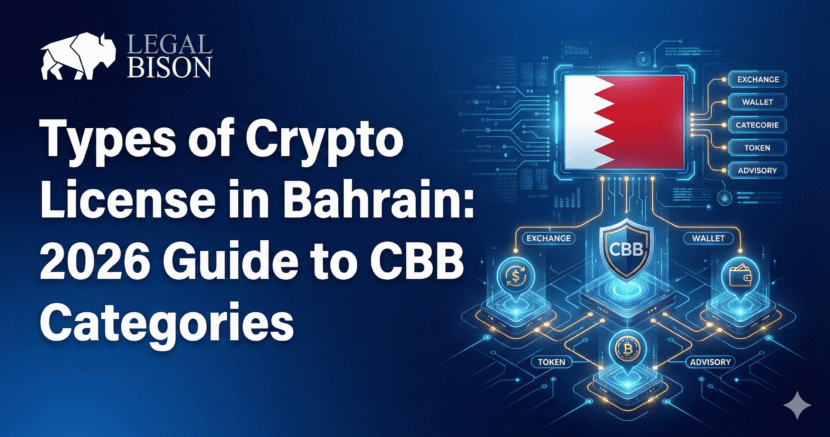
Types of Crypto License in Bahrain: A Complete 2026 Guide for Entrepreneurs
As the Middle East solidifies its position as a global centre for digital asset innovation, the Kingdom of Bahrain has emerged as a particularly attractive jurisdiction for serious crypto entrepreneurs. Knowing the differences between the license categories is a must for the proper authorisation process.
Anastasia MarchenkoLegal Researcher at LegalBison
Feb, 10 20266 minutes
Unlike the fragmented regulatory landscapes found elsewhere, Bahrain offers a cohesive and sophisticated framework under the direct oversight of the Central Bank of Bahrain (CBB). The CBB Rulebook Volume 6 (Capital Markets), specifically the Crypto-Asset (CRA) Module, serves as the “gold standard” for regulation in the region.
For crypto entrepreneurs entering the market in 2026, this structured category system provides long-term regulatory certainty, ensuring that businesses can scale without the fear of sudden policy shifts.
Whether you are launching a brokerage, a high-frequency trading desk, or a global exchange, understanding these specific license categories is the first step toward securing your footing in the Gulf. In this article, LegalBison experts will analyse the different categories of the Bahrain crypto license and explain how to choose the one that fits your business model best.
Understanding the 4 CASP License Categories
Bahrain utilises a tiered licensing system for Crypto Asset Service Providers or CASP (officially termed “licensees”). Each tier is strictly defined by the scope of permitted activities and the corresponding capital obligations, allowing businesses to apply for a crypto license that matches their actual operational model.
Category 1: Crypto Advisory & Brokerage
Scope: This category is the entry-level license designed for firms that wish to provide investment advice or handle the reception and transmission of client orders. It is strictly an intermediary role.
Restriction: The most critical limitation for Category 1 licensees is that they strictly cannot hold client assets or client money. Furthermore, they are prohibited from dealing on their own account (proprietary trading) or operating an exchange.
Best for: Investment consultants, wealth managers focusing on digital assets, and pure brokerage firms that route orders to other custodians or exchanges.
Scope: Category 2 represents a significant step up in operational capability. It permits the licensee to act as an agent for trades, offer portfolio management services, and crucially, provide crypto-asset custody services.
Key Feature: The defining feature of this category is the permission to hold or control client virtual assets and client money. This allows firms to offer wallet services and manage client funds directly, though they are still prohibited from trading as a principal (on their own account) or running an exchange.
Best for: Custodial wallet providers, asset management firms, and prime brokers who need to safeguard client funds.
Category 3: Full Trading & Principal Dealing
Scope: This license encompasses all activities permitted under Category 2 but adds a vital commercial capability: trading as a “Principal.” This means the firm can trade against its own proprietary capital, concluding transactions in crypto-assets on its own account.
Key Feature: This category is essential for firms operating Over-the-Counter (OTC) desks or acting as market makers, as it allows them to take positions and provide liquidity using their own balance sheet. Like Category 2, they can hold client assets but cannot operate a standardised exchange platform.
Best for: Professional liquidity providers, OTC trading desks, and market makers requiring the ability to hold inventory.
Category 4: Crypto Exchange Operator
Scope: This is the highest tier of licensing available in Bahrain. It permits the operation of a licensed crypto-asset exchange, where the matching of third-party buy and sell orders takes place.
Key Feature: Category 4 licensees operate the matching engine and platform where trading occurs. They are authorised to hold client assets and money to facilitate settlement. Notably, a licensed exchange must not execute client orders against its own proprietary capital (matched principal trading) to prevent conflicts of interest.
Best for: Global and regional crypto exchanges looking to serve the MENA market with full regulatory backing.
Bahrain Crypto License Cost: 2026 Capital and Legal Requirements
To ensure the financial stability of the ecosystem, the CBB enforces strict minimum capital requirements. This capital must be deposited into a retail bank licensed in Bahrain and maintained unimpaired by losses.
Capital Tiers:
Category 1: BHD 25,000 (approx. $66,000);
Category 2: BHD 100,000 (approx. $265,000);
Category 3: BHD 200,000 (approx. $530,000);
Category 4: BHD 300,000 (approx. $795,000).
Legal Entity Type: The legal structure of your entity is also dictated by the license category. Applicants for Categories 1, 2, and 3 have the flexibility to incorporate as a Bahraini company with limited liability (W.L.L.) or a Bahraini Joint Stock Company (B.S.C.). However, Category 4 licensees (Exchanges) are strictly required to incorporate as a Bahraini Joint Stock Company (B.S.C.).
Bahrain is not a jurisdiction for “shell” companies. To maintain a license in 2026, the CBB strictly enforces “Mind and Management” requirements, mandating that the core decision-making and operational management physically reside within the Kingdom.
Key Personnel: The CBB requires specific “controlled functions” to be occupied by individuals resident in Bahrain. This list is comprehensive and includes the Chief Executive Officer, Compliance Officer, Money Laundering Reporting Officer (MLRO), Chief Information Security Officer (CISO), Head of Finance, Head of Risk Management, and Head of Operations.
Physical Office: A designated, physical place of business in Bahrain is non-negotiable for all four tiers. A virtual office or P.O. Box is insufficient to meet the CBB’s substance requirements.
Digital Tokens and Stablecoin Issuance
In keeping with global trends, the 2026 regulatory environment in Bahrain has expanded to cover specific niches. The CBB provides a dedicated chapter for Digital Token Offerings (DTOs), regulating the issuance of tokens that exhibit characteristics of securities. Furthermore, licensees dealing with stablecoins must adhere to strict reporting requirements under the Stablecoin Issuance and Offering (SIO) Module, ensuring transparency regarding transaction volumes and asset backing.
How LegalBison Streamlines the Bahrain Application
Navigating the Central Bank of Bahrain’s rigorous standards requires precision and local expertise. LegalBison acts as your bridge to this prestigious jurisdiction.
Step-by-step guidance: We analyse your business model to determine exactly which of the four categories applies to you, preventing costly misclassifications;
Dossier preparation: Our team handles the preparation of the comprehensive “Form 1” application, business plans, and risk management policies required by the CBB;
Local substance: We assist in the recruitment of qualified local personnel for “Controlled Functions” and help secure compliant office space to satisfy the “Mind and Management” rules.
Which Bahraini category fits your crypto company? Get a professional assessment and turnkey setup from LegalBison. Our expert team will thoroughly analyse your project and map out the best licensing route in Bahrain.
For crypto entrepreneurs and token issuers, the white paper is now the cornerstone of compliance. It determines your ability to offer tokens to the public, trade on exchanges, and operate without facing severe penalties from National Competent Authorities (NCAs). Under the new rules, a white paper functions similarly to a prospectus in traditional finance; it must be complete, fair, clear, and not misleading.
This guide details exactly what is required to draft a compliant white paper, the technical standards you must meet, and the liabilities you face as an issuer.
The Markets in Crypto Assets has now been enforced in Europe and overrules all existing crypto licenses framework, starting in June 2024 and gradually until December 2024. LegalBison sheds light onto this new regulation, so VASPs and crypto entrepreneurs can serenely approach this regulatory evolution.
This article explores the five commercial and strategic reasons why Ireland has become the top destination for Initial Coin Offerings (ICOs) and token issuance under MiCA, and how this data should influence your decision on where to launch your project.
Adrien MarchandAssociate at LegalBison
Contact Us
LegalBisonExperts & FinTech Lawyers
LegalBison’s experts and FinTech lawyers will glady invite you to a free consultation.