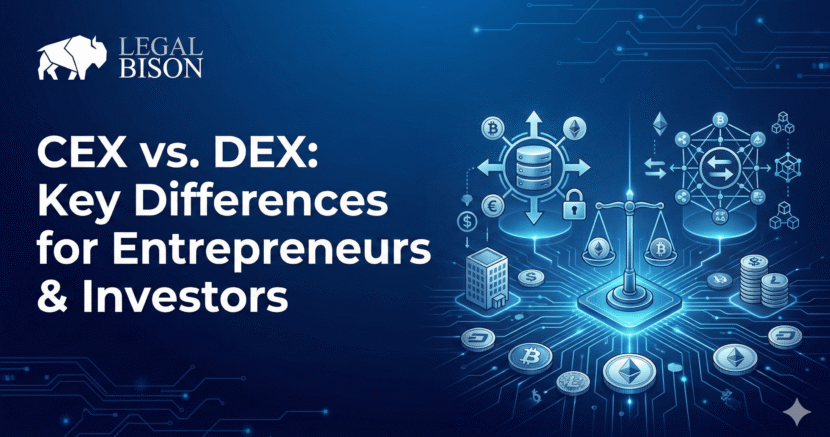
CEX vs. DEX: Key Differences for Entrepreneurs & Investors
The digital asset landscape has evolved from the dominance of centralised platforms into a sophisticated ecosystem where decentralised exchange volume recently surged to record peaks. For entrepreneurs and investors in 2026, navigating these models requires balancing the high-speed efficiency of traditional intermediaries with the non-custodial security of on-chain protocols.
Anastasia MarchenkoLegal Researcher at LegalBison
Feb, 25 202610 minutes
The digital asset landscape has shifted dramatically from the monolithic dominance of centralised platforms to a complex ecosystem where decentralisation is no longer just an ideology, but a viable market structure.
While Centralised Exchanges (CEXs) still handle the lion’s share of global trading volume, the market dynamics are undeniably changing. Notably, Decentralised Exchange (DEX) spot trade volume peaked at over 24% in June 2025, signalling a massive shift in user preference toward self-custody and on-chain transparency.
For entrepreneurs planning to launch a crypto venture and investors navigating this maturing market, understanding the structural, legal, and operational differences between these models is no longer optional. It is a fundamental requirement for risk management and strategic positioning.
CEX vs DEX core definitions: what’s under the hood?
To navigate the regulatory and operational complexities of 2026, one must first grasp the technological architecture defining these platforms.
Centralised Exchanges (CEX)
A Centralised Exchange (CEX) operates as a traditional financial intermediary. Much like a stock exchange, it facilitates trading between buyers and sellers through an order book system. The defining characteristic of a CEX is custody. The platform controls the private keys to the wallets where user funds are stored. When a user trades on a CEX, they are not exchanging assets on the blockchain in real-time; rather, the exchange updates its internal ledger to reflect the trade, settling on-chain only when a user withdraws funds.
From a regulatory perspective, CEXs are the primary focus of frameworks like MiCA. They are classified as Crypto-Asset Service Providers (CASPs) and are subject to strict requirements regarding governance, capital, and consumer protection.
Decentralised Exchanges (DEX)
A Decentralised Exchange (DEX) is a peer-to-peer marketplace where transactions occur directly between crypto traders. DEXs do not rely on an intermediary to hold funds or facilitate trades. Instead, they utilise smart contracts–self-executing code on a blockchain–to automate the transaction process.
Most DEXs employ Automated Market Maker (AMM) protocols rather than traditional order books. Users trade against a liquidity pool funded by other users, rather than matching with a specific counterparty. Crucially, DEXs use non-custodial wallets, meaning the user retains full control of their private keys and funds at all times.
The new contender: Universal/Hybrid Exchanges (UEX)
Emerging from the friction between CEX efficiency and DEX security is the Universal Exchange (UEX), or Hybrid model. These platforms attempt to combine the high-speed execution and user-friendly interfaces of centralised platforms with the non-custodial security of decentralised protocols. In a UEX model, trade matching may occur off-chain for speed, but settlement occurs on-chain, ensuring that users never surrender control of their assets to the platform operator.
The most significant distinction lies in asset ownership. On a CEX, the user deposits funds into a wallet controlled by the exchange. This “custodial” model implies that the user has a claim against the exchange, rather than direct control of the asset. If the exchange becomes insolvent or halts withdrawals, the user’s funds are at risk.
In contrast, a DEX is non-custodial. The user connects a Web3 wallet (such as MetaMask or Ledger) to the protocol. The smart contract executes the trade, but the assets never sit in a centralised wallet owned by the platform. This aligns with the “not your keys, not your coins” ethos but places the burden of security entirely on the user.
Security architecture & risk profile
Security risks differ fundamentally between the two models.
CEX Risk: The primary risk is the “honeypot” effect. Because CEXs hold billions of dollars in user funds in hot and cold wallets, they are prime targets for external hacking and internal mismanagement. To mitigate this, regulators now enforce strict ICT security requirements under frameworks like DORA (Digital Operational Resilience Act);
DEX Risk: The risk profile here is technical. DEXs are vulnerable to smart contract exploits, bugs in the code, or “rug pulls” where liquidity is drained from the pool. While the protocol cannot steal funds in the traditional sense, a flaw in the code can be catastrophic.
Liquidity & execution speed
Historically, CEXs have offered superior liquidity and execution speed. Market makers and high-frequency trading firms prefer the low-latency environment of a centralised matching engine. This allows for deep order books and minimal slippage on large trades.
DEX liquidity is often fragmented across different blockchain networks and protocols. While Automated Market Maker (AMM) models have solved the issue of finding a counterparty for illiquid tokens, large trades on a DEX can still suffer from significant slippage and “front-running” by MEV bots. However, the gap is narrowing as Layer-2 scaling solutions improve blockchain throughput.
User experience & features
CEXs prioritise user experience (UX), mimicking the interfaces of traditional banking and brokerage apps. They offer fiat on-ramps (buying crypto with credit cards), customer support, account recovery options, and advanced trading features like margin and derivatives.
DEXs have a steeper learning curve. Users must understand concepts like gas fees, wallet management, and chain bridging. There is no customer support to reverse a transaction or recover a lost password. However, DEXs offer permissionless access, allowing anyone with an internet connection to trade without an approval process.
Regulatory & governance landscape
The regulatory gap is the most critical factor for entrepreneurs.
CEX Regulation: In the EU, CEXs are fully regulated entities. Under MiCA, they must obtain authorisation as a CASP, conduct KYC/AML checks on all users, and adhere to strict capital requirements (Class 2 or Class 3 license);
DEX Regulation: The regulatory status of DeFi remains a complex grey area. While MiCA Recital 22 offers an exemption for services provided in a “fully decentralised manner,” regulators are increasingly scrutinising “decentralised” protocols that retain centralised control features (such as admin keys or centralised front-ends). Entrepreneurs launching a DEX must be wary of the “Technical Control Test” to avoid being classified as a CASP.
The rise of the hybrid model (UEX)
The Universal Exchange (UEX) represents the industry’s response to the failures of major custodial entities in the past decade. By separating the execution layer from the custody layer, UEXs offer a compelling value proposition: the speed of a CEX without the counterparty risk.
For investors, this means the ability to trade with high frequency while keeping assets in a personal Ledger. For entrepreneurs, building a Hybrid exchange can reduce the regulatory burden associated with custody (Class 2 CASP requirements) while still offering a competitive product. However, the technology is complex, and the regulatory classification of these hybrid models often requires a bespoke legal opinion to ensure compliance.
The choice between building or using a CEX, DEX, or Hybrid platform is no longer a binary decision between security and convenience. It is a strategic choice that dictates your business model, your regulatory obligations, and your target audience.
As the 2026 regulatory landscape solidifies under MiCA, the window for operating in the shadows has closed. Whether you are establishing a high-frequency CEX in Poland or engineering a novel DeFi protocol in Estonia, the legal architecture is just as vital as the software architecture.
At LegalBison, we specialise in navigating this duality. We assist centralised platforms in securing full CASP authorisation and help decentralised innovators structure their governance to remain compliant.
FAQ
Do I need a license to start a DEX in Europe?
If your DEX is “fully decentralised” with no identifiable intermediary, you may be exempt under MiCA Recital 22. However, if you control the interface, hold admin keys, or earn fees as a business, you likely require a CASP license. A legal opinion is essential to determine your status.
Is a CEX safer than a DEX?
A CEX is safer regarding user error (account recovery is possible) but riskier regarding systemic failure (insolvency). A DEX eliminates counterparty risk but exposes the user to smart contract risks and irreversible user errors.
What is the “Travel Rule”, and does it apply to DEXs?
The Travel Rule requires the collection of data on the originators and beneficiaries of transfers. It strictly applies to CEXs. Its application to DEXs involves unhosted wallets and is currently a subject of intense regulatory debate and technical implementation (e.g., self-identification).
Can I switch my CEX to a Hybrid model?
Yes, transitioning to a non-custodial model can reduce your liability regarding client funds. However, you will still likely be considered a CASP operating a trading platform, requiring a specific set of regulatory permissions.
Which jurisdiction is best for a Hybrid Exchange?
Jurisdictions with advanced crypto frameworks, such as Gibraltar, Switzerland, or MiCA-compliant EU states like the Czech Republic or Poland, are often preferred for their clarity on defining custody versus non-custodial trading.
With the implementation of the Markets in Crypto-Assets (MiCA) Regulation and the national Digital Finance Act (Act No. 31/2025 Coll.), the Czech Republic has transitioned from a simple registration-based system to a sophisticated licensing regime. The evolving regulatory landscape for crypto companies in the Czech Republic and the EU is shaping new opportunities and compliance requirements for market participants.
The passing of the Markets in Crypto Assets (MiCA) Regulation in the EU changes the classification of cryptocurrencies. European lawmakers now distinguish three categories of crypto-assets: Asset-Referenced Tokens (ART), Electronic Money Token (EMT) and a third category that includes all assets not falling into the two first classes. LegalBison's lawyers dive into details in this article.
Anastasia MarchenkoLegal Researcher at LegalBison
Contact Us
LegalBisonExperts & FinTech Lawyers
LegalBison’s experts and FinTech lawyers will glady invite you to a free consultation.