Comparison Czech CASP vs Poland CASP: Key Insights
In the rapidly evolving landscape of European digital finance, the Markets in Crypto-Assets (MiCA) Regulation has fundamentally unified how crypto-asset service providers (CASPs) operate across the Union. MiCA is the latest EU regulation governing crypto activities and licensing across member states, setting new standards for regulatory compliance and operational transparency.
Anastasia MarchenkoLegal Researcher at LegalBison
Feb, 09 20267 minutes
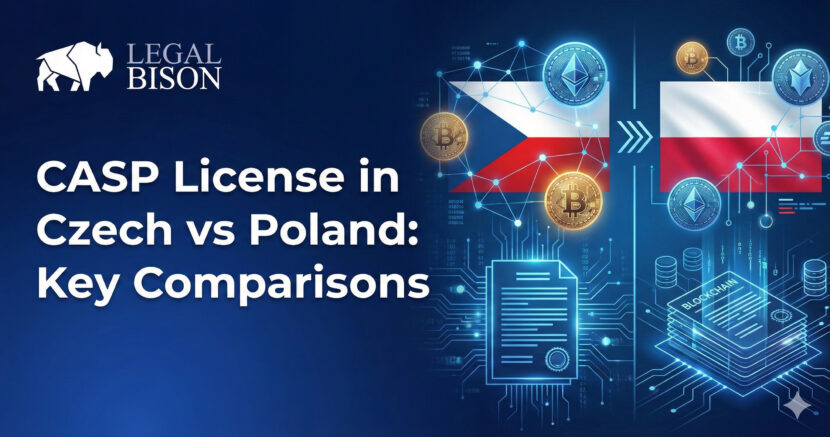
As of 2026, two of Central Europe’s most prominent fintech hubs — the Czech Republic and Poland — have transitioned from their legacy registration systems to this new, harmonised licensing regime.
While both jurisdictions now offer a MiCA “passport” — allowing a firm licensed in one country to provide services in all 27 EU member states — obtaining a crypto license or a European crypto license is essential for regulatory compliance and market access in the EU. Significant differences remain in their local implementation, regulatory rigour, and operational costs.
This article provides a comprehensive comparison to help entrepreneurs determine which “home” jurisdiction best suits their business model, as choosing the right jurisdiction can provide a significant competitive advantage for crypto businesses.
Czech Republic CASP License for Crypto Asset Service Providers
The Czech Republic crypto scene has undergone a profound regulatory transformation through the Digital Finance Act (Act No. 31/2025 Sb.), which fully integrated MiCA into national law on February 15, 2025. Establishing a compliant legal entity in Czechia is a prerequisite for applying for a CASP license.
Key Requirements:
Local Substance: Applicants must maintain a local office in Czechia, ensuring a physical presence that meets regulatory standards and operational prerequisites;
Fit and Proper: Extensive diligence procedures are conducted on shareholders and management, including background checks and compliance with anti-money laundering regulations;
Business Plan: Applicants must submit a detailed business plan as part of the application process, demonstrating comprehensive planning, governance, and financial stability.
The Czech National Bank (ČNB) is the sole competent authority responsible for licensing and supervision. The ČNB is known for its meticulous and technically demanding approach, favouring institutional-grade firms over high-volume, low-substance startups. During the licensing process, the ČNB conducts a thorough regulatory review to assess whether applicants meet all requirements, and it provides ongoing supervision of licensed entities to ensure continuous compliance with security standards, reporting obligations, and audit procedures.
Key Requirements
Local Substance: Applicants must maintain a functional physical office and have their place of effective management in Czechia;
Resident Management: At least one director must be a resident of the European Union, and the appointment of a local resident compliance officer (such as an AML compliance officer or MLRO) is strictly enforced;
Fit and Proper: All shareholders and management members must undergo extensive vetting regarding their education, professional experience, and absence of criminal records;
Timelines: The official decision period is approximately 40 to 60 working days for a complete application, but in practice, the end-to-end process typically takes 9 to 12 months;
Internal Audit: Regular internal audit procedures must be established to ensure ongoing compliance with AML/KYC requirements and regulatory standards.
Poland has emerged as a major crypto hub, ranking among the top global jurisdictions for the number of registered virtual asset firms. The transition to MiCA is governed by the Crypto-Assets Market Act (2025), which is the Polish implementation of MiCA and shapes the Polish regulatory environment for crypto businesses. Polish crypto enterprises benefit from a supportive regulatory environment and clear compliance pathways.
The Polish Financial Supervision Authority (KNF) oversees the CASP licensing process. The KNF conducts a regulatory review of all CASP applications to ensure compliance with the relevant regulatory framework. While the KNF maintains high European standards, Poland has historically offered a more streamlined entry pathway, often viewed as more accessible for growing fintech ventures.
Key Requirements
Corporate Forms: Businesses typically register as a Limited Liability Company (Sp. z o.o.);
Transition Period: Poland provides a clear “grandfathering” period for existing VASPs, allowing them to continue operations until July 1, 2026, provided a CASP application is submitted within the established timeframe;
Credentials: Directors and shareholders must obtain a PESEL (Polish ID number) and an EPUAP trusted profile for electronic signatures to interact with government systems. Directors and shareholders must also comply with AML/KYC requirements as part of the regulatory process;
Transaction Monitoring: Firms must implement robust transaction monitoring systems to comply with regulatory standards and detect suspicious activities in line with AML frameworks;
Client Assets: Client assets must be segregated and protected according to MiCA requirements to ensure user protection in case of insolvency.
What’s Possible in Czechia vs Poland
Under MiCA, the services available to a CASP are identical in both countries, categorised into three capital tiers. Authorised activities include a range of crypto asset services, such as facilitating crypto transactions and managing virtual assets.
Service Class
Examples of Authorised Activities
Capital Requirement
Class 1
Investment advice, portfolio management, order execution.
EUR 50,000
Class 2
Custody/wallet services, exchange of crypto for funds.
EUR 125,000
Class 3
Operation of a multilateral trading platform (crypto trading platform or crypto exchange).
EUR 150,000
Both jurisdictions require transparent business operations to maintain compliance.
Taxation: Czechia offers a flat 21% corporate income tax. Capital gains tax on crypto activities is generally treated as part of corporate income tax for companies, while individuals are subject to personal income tax rates. Poland offers a reduced 9% corporate tax for small companies with revenues up to €2 million, otherwise 19%. In Poland, capital gains tax applies to crypto asset transactions, with rates depending on the taxpayer’s status (individual or company);
Audits: Both jurisdictions require regular internal and external audits. However, the Czech ČNB tends to place greater emphasis on DORA (Digital Operational Resilience Act) compliance and ICT security documentation from day one. Having a CASP license in either country can facilitate establishing relationships with financial institutions, improving access to banking services and supporting operational stability;
Remote Setup: Poland allows for a fully remote setup process in many cases, whereas Czechia’s substance requirements often necessitate a more tangible local infrastructure.
Which Country Should You Choose?
The decision between a Czech or Polish CASP license depends on your firm’s maturity and long-term strategy. Under the MiCA framework, obtaining a CASP license in either country provides access to all EU countries, allowing you to operate across the European Union with a single license.
Choose the Czech Republic if:
You are an institutional-grade firm seeking the highest level of regulatory credibility in Europe;
You value a jurisdiction with a robust, centralised regulator (ČNB) that provides clear, published technical standards;
The Czech Republic permits the issuance and handling of electronic money tokens and asset-referenced tokens under specific regulatory conditions;
You already have an established physical presence in Central Europe and can easily meet substance requirements.
Choose Poland if:
You are a high-growth startup looking for a more cost-effective entry into the EU market with lower corporate tax rates;
You prefer a jurisdiction with a large local talent pool and a massive existing crypto ecosystem;
Poland allows CASPs to handle electronic money tokens and asset-referenced tokens, subject to MiCA requirements;
You require a more flexible, remote-friendly incorporation and application process.
Launch with LegalBison
Securing a CASP license is a complex legal undertaking involving over 20 distinct policy documents and strict capital verification. LegalBison provides turnkey support for both Czech and Polish licensing, managing everything from company formation to the final submission before the ČNB or KNF.
Contact LegalBison today to schedule a free consultation and determine the best home for your crypto business in 2026.
The dream for most crypto startups is simple: build a groundbreaking product, scale it across borders, and navigate the regulatory maze without exhausting their seed funding.
For years, Poland was the preferred destination for this journey because its registration process was fast, accessible, and relatively low-cost.
For years, Poland was the undisputed budget-friendly destination for crypto startups in Europe. The old VASP (Virtual Asset Service Provider) registry was famously accessible, requiring only a small administrative fee and minimal share capital.
However, with the gradual implementation of the Markets in Crypto-Assets (MiCA) regulation, the landscape has shifted from a simple registration to a sophisticated licensing regime.
Adrien MarchandAssociate at LegalBison
Contact Us
LegalBisonExperts & FinTech Lawyers
LegalBison’s experts and FinTech lawyers will glady invite you to a free consultation.



![Poland CASP Cost: Is a CASP License in Poland Expensive? A Detailed Cost and Value Analysis [UPDATED 2026] image](https://legalbison.com/wp-content/uploads/2026/02/Poland-CASP-cost-380x200.jpg)