


- Homepage /
- Blog /
- Crypto Derivatives Explained
Crypto Derivatives Explained: Definition, Types, and How to Start One
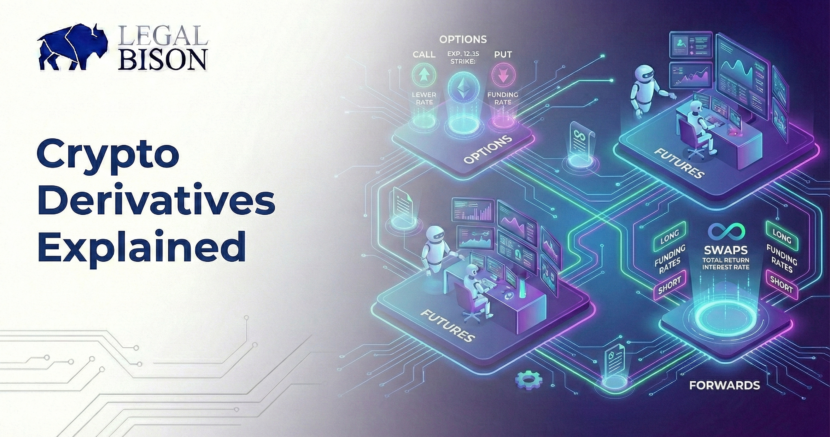
We will explore what crypto derivatives are, including common types such as futures, options, swaps, and perpetual contracts; why they are the cornerstone of modern exchange revenue, and the regulatory labyrinth you must navigate to provide them to your clients.

The crypto market has matured. Gone are the days when simple spot trading, buying Bitcoin and holding it in a wallet-dominated the volume charts.
Today, the real engine of the cryptocurrency industry, the machinery that generates the massive turnover numbers we see on CoinMarketCap, is the derivatives market.
For entrepreneurs, fintech startups, and institutional players, this distinction is critical. If you are looking to launch a crypto exchange, a brokerage, or an asset management firm, understanding derivatives isn’t just about market mechanics; it is about understanding the most profitable, high-velocity product in the digital asset space.
At LegalBison, we don’t just watch these trends; we engineer the legal frameworks that allow businesses to capitalize on them. We help fintech companies navigate the complex global web of licensing to offer these sophisticated financial products legally.
In this guide, we are shifting the focus from trading to offering.
We will explore what crypto derivatives are, including common types such as futures, options, swaps, and perpetual contracts; why they are the cornerstone of modern exchange revenue, and the regulatory labyrinth you must navigate to provide them to your clients.
Investing in digital assets is increasingly facilitated by regulated crypto derivatives, which play a key role in mainstream adoption and allow investors to manage risk and gain exposure to the evolving crypto market.
What Are Crypto Derivatives? (Operator’s Perspective)
To a retail trader, a derivative is a bet. To an exchange operator, a derivative is a contract.
Fundamentally, a crypto derivative is a financial contract whose value is derived from the price of an underlying cryptocurrency.
Unlike spot trading, where asset ownership changes hands immediately, derivatives are contracts to settle value at a later date (or perpetually). Spot prices serve as the fundamental reference point for pricing derivatives like futures and perpetual contracts.
For a business offering these services, derivatives solve a massive problem: Liquidity and Velocity.
In spot markets, capital is inefficient. To buy 100,000 USD of BTC, a user needs 100,000 USD. In derivatives markets, thanks to leverage, that same user might only need 10,000 USD to open the same position.
This efficiency encourages higher trading frequency, larger position sizes, and ultimately, significantly higher fee revenue for the platform operator.
Retail investors are actively participating in the crypto derivatives market, contributing to trading volumes alongside institutional investors on regulated trading platforms.
There are three primary products you need to understand if you plan to enter this sector:
1. Futures Contracts
These are standard agreements to buy or sell an asset at a specific price on a specific future date.
The Business Case: These are favorites of institutional clients who need to hedge. If you are building a platform targeting professional investors or miners, offering dated futures is mandatory for hedging against price drops.
2. Options
Options give the trader the right, but not the obligation, to buy or sell.
Bitcoin options, in particular, have become a significant category of crypto derivatives, with their historical development marking key milestones in the evolution of the market and their importance recognized across major trading platforms.
The Business Case: Options are complex to price and manage (requiring sophisticated risk engines), but they attract sophisticated traders and “whales” looking for insurance. They are less about high-frequency volume and more about strategic positioning. The emergence of tokenized derivatives, blockchain-based financial instruments has further enhanced the appeal of options by offering greater transparency, security, and decentralization.
3. Perpetual Swaps
This is the product that changed the crypto industry. A perpetual swap is a futures contract with no expiry date. It mimics the spot price using a Funding Rate mechanism.
The Business Case: This is likely where 70-80% of your exchange’s volume will come from. Because positions never expire, traders keep them open longer, paying funding fees and trading fees continuously. However, offering “perps” requires a robust liquidation engine to manage the risk of high leverage.
Related: Difference Between Spots vs Prop vs Perps
Why Launch a Derivatives Platform?
Why go through the trouble of obtaining a derivatives license rather than just a simple spot exchange license? The answer lies in the economics of the exchange business.
Choosing the right crypto derivatives exchange is crucial, as traders should consider factors such as fees, available products, and regulatory compliance.
Traders can choose from various crypto derivatives trading platforms, including centralized exchanges like Coinbase and CME Group, and decentralized exchanges (DEXs) like Uniswap. Crypto derivatives trading platforms often offer features such as leverage, which allows traders to amplify their potential gains or losses.
1. Revenue Multipliers
Spot exchanges charge fees on the notional value of the trade. Derivatives exchanges charge fees on the leveraged value.
If a user deposits 1,000 USD but trades with 10x leverage (a 10,000 USD position), you are earning fees on the 10,000 USD volume, not the 1,000 USD deposit. It is a multiplier effect on your revenue stream.
Related: Best Countries to Set Up Crypto Spot Trading Company
2. Bear Market Resilience
Spot markets dry up when prices crash. People simply stop buying. Derivatives markets, however, thrive on volatility regardless of direction. In a bear market, traders flock to derivatives platforms to “short” the market.
This makes a derivatives platform a more recession-proof business model than a spot-only exchange.
3. Client Retention
Sophisticated traders (the ones who generate the most fees) demand hedging tools. If you only offer spot trading, your users will eventually move their funds to a competitor like Binance or Bybit that offers them the ability to hedge their portfolio.
Offering derivatives is a defensive play to keep your users within your ecosystem. Offering such products; regulated crypto derivatives, provides trusted risk management and investment exposure for market participants.
New trading platforms are increasingly focusing on regulatory compliance and user experience to attract participants in the crypto derivatives market.
Also read: The Best Smart Contract Platforms of Today and How to Launch Yours
Derivatives Market Trends and Analysis
The derivatives market has witnessed remarkable growth in recent years, fueled by the rising demand for crypto derivatives and the integration of traditional futures concepts into the digital asset space.
As more traders seek to gain exposure to the cryptocurrency market, the landscape has evolved to support increasingly sophisticated trading strategies.
Futures trading, once the domain of commodities and equities, now plays a central role in crypto, allowing market participants to manage risk and speculate on future price movements with greater flexibility.
The Commodity Futures Trading Commission (CFTC) has become a pivotal regulator, setting the standards for how crypto derivatives exchanges operate and ensuring that these platforms adhere to established guidelines.
This regulatory oversight has contributed to a more robust and transparent environment, encouraging both institutional and retail traders to participate in derivatives markets.
As the market matures, traders are adopting advanced strategies to navigate volatility and optimize their trading decisions. Whether hedging against adverse price movements or leveraging futures contracts to amplify returns, understanding current market trends and analysis is essential.
Staying informed about shifts in trading volume, open interest, and regulatory developments enables traders to make smarter, more strategic moves in the fast-paced world of crypto derivatives.
Deep dive: Best Countries to Establish a Crypto Derivatives Company
Traditional Futures and Crypto Comparison
While traditional futures and crypto derivatives share the core concept of allowing traders to speculate on the future price of an underlying asset, their structures and mechanisms differ in important ways.
Traditional futures contracts require two parties to agree to buy or sell an asset, such as commodities, currencies, or equities at a specified price on a predetermined date. These contracts are standardized and traded on regulated exchanges, providing a clear framework for buyers and sellers.
Crypto derivatives, particularly perpetual futures, introduce new dynamics to the market. Unlike traditional futures, perpetual contracts do not have an expiration date, allowing traders to hold positions indefinitely.
The funding rate mechanism is a unique feature of perpetual futures, designed to keep the contract price closely aligned with the spot price of the underlying cryptocurrency. This system incentivizes traders to balance long and short positions, ensuring that the contract price reflects the true value of the asset.
For traders, understanding these differences is crucial when developing trading strategies and managing risk. While traditional futures offer predictability and a fixed settlement date, perpetual futures provide flexibility and continuous exposure to the underlying cryptocurrency.
By leveraging these instruments appropriately, traders can tailor their approach to suit their risk tolerance, market outlook, and investment goals.
The Regulatory Landscape: Walking the Minefield
This is where LegalBison steps in. While the business case for derivatives is obvious, the regulatory path is steep.
Regulators view derivatives very differently from spot trading. Spot trading is often classified as “buying a commodity.” Derivatives trading is classified as “dealing in financial instruments” or securities.
This distinction triggers a much stricter set of laws regarding capital requirements, reporting, and investor protection.
Here is what you need to know about the current licensing environment:
The European Union (MiCA and MiFID II)
Europe is tightening the screws. Under the new Markets in Crypto-Assets (MiCA) regulation, there is a clear distinction between utility tokens and financial instruments.
- The Challenge: If your derivative behaves like a financial instrument (which most do), it may fall under MiFID II (Markets in Financial Instruments Directive). This is the same regulation that governs traditional stock brokerages. It requires substantial capital, local presence, and rigorous reporting.
- The Strategy: We often advise clients to start with a standard VASP (Virtual Asset Service Provider) registration for spot trading in jurisdictions like Poland or Lithuania to build a user base, while simultaneously working on the more complex investment firm licenses required for derivatives.
Offshore Jurisdictions
For many startups, the capital requirements of a Tier-1 jurisdiction (like the UK or Singapore) are prohibitive. This is why many derivatives platforms look offshore.
- Popular Hubs: Jurisdictions like Seychelles, St. Vincent & the Grenadines (SVG), or Comoros offer a faster entry to market.
- The Trade-off: While these licenses are faster and cheaper to obtain, they come with banking challenges. Tier-1 banks are hesitant to open fiat accounts for offshore derivatives platforms. You may need to rely heavily on crypto-rails (USDT/USDC) for deposits and withdrawals, which, frankly, is the industry standard for derivatives anyway.
The “Forex” Crossover
Interestingly, many of our clients come from the Forex world. They already have licenses to offer CFDs (Contract for Differences) on commodities and currencies.
In many jurisdictions, Crypto CFDs fit under your existing Forex/Securities dealer license. If you already operate a Forex brokerage, adding Crypto CFDs might be a simple extension of your current permissions rather than a brand-new regulatory hurdle.
Operational Requirements: It’s Not Just a License
Obtaining the piece of paper from the regulator is step one. Running the business is step two. At LegalBison, we ensure our clients understand the operational weight of offering derivatives.
1. The Liquidation Engine
You are acting as the counterparty or the facilitator of highly leveraged bets. If the market moves 20% in a minute (a “flash crash”), your system must be able to liquidate losing positions instantly to prevent the user from going into negative equity.
If your engine fails, you cover the loss. This requires top-tier technology. Crypto exchanges often offer significantly higher leverage than traditional markets, sometimes up to 100x or more.
2. Risk Management & Insurance Funds
Regulators will ask: “What happens if the system fails?” You need an insurance fund. This is a pool of capital set aside to cover losses in extreme market conditions. We help clients structure these funds to satisfy both regulatory requirements and user trust.
Leverage can enhance profit potential but also increases risk, including the possibility of losses exceeding the initial investment. It is crucial to implement risk management strategies to protect the initial investment and ensure users understand the capital at risk.
3. KYC/AML Compliance
Because derivatives are high-risk financial instruments, the Know Your Customer (KYC) requirements are strict.
You cannot offer these products to anonymous wallets. You must have a robust identity verification partner and a clear AML (Anti-Money Laundering) policy. This is the first thing a regulator will audit.
Volatility and Risk Management
Market volatility is a defining characteristic of the cryptocurrency market, and trading crypto derivatives amplifies both the risks and rewards associated with price movements.
The high-risk nature of these complex instruments means that traders must be proactive in managing volatility to avoid significant potential losses.
Effective risk management starts with understanding the underlying asset and its historical price movements. Traders can employ a variety of strategies to manage volatility, such as adjusting position sizes, setting stop-loss orders to limit downside risk, and diversifying across multiple assets or contract types.
Staying updated on market trends and analysis is also essential, as sudden shifts in sentiment or macroeconomic events can trigger rapid price swings.
By implementing robust risk management techniques, traders can better navigate the challenges of trading crypto derivatives. The goal is not to eliminate risk entirely, but to manage it in a way that aligns with individual trading objectives and risk tolerance.
In a market where fortunes can change in seconds, disciplined risk management is the key to long-term success.
Structuring Your Corporate Entity
One common mistake we see is businesses trying to do everything under one company. This is a liability nightmare.
We typically recommend a multi-entity structure:
- The IP Company: Holds the software, the brand, and the technology. usually in a tax-efficient jurisdiction.
- The Operating Entity: Holds the license and the user user agreement. This entity takes the regulatory risk.
- The Payment Agent: Handles fiat processing (if applicable), usually located in the EU or a banking-friendly zone.
This structure protects your technology and intellectual property. If the operating entity faces a regulatory fine or a lawsuit, your IP remains safe in a separate holding company. This is the “fortress” approach to corporate structuring.
Consult your corporate structure to establish your crypto derivatives company with LegalBison experts.
Technology and Infrastructure
The rapid advancement of technology and infrastructure has transformed the way derivatives markets operate, particularly in the realm of crypto derivatives.
Modern crypto derivatives exchanges, including those regulated by the Malta Financial Services Authority, offer secure and efficient platforms for trading financial contracts tied to digital assets. These exchanges leverage cutting-edge technology to facilitate high-speed trading, real-time risk monitoring, and seamless user experiences.
Blockchain technology and smart contracts have further enhanced the transparency and reliability of derivatives markets. By automating contract execution and settlement, smart contracts reduce the risk of counterparty default and ensure that trades are executed exactly as agreed.
This innovation not only increases trust among market participants but also streamlines the entire trading process.
The development of advanced trading platforms and analytical tools has empowered traders to make more informed decisions and gain greater exposure to the cryptocurrency market.
As technology continues to evolve, we can expect derivatives markets to become even more sophisticated, offering new opportunities for both traders and operators to manage risk, access liquidity, and capitalize on the dynamic world of digital assets.
The Future: Decentralized Derivatives (DeFi) vs. CeFi
We must address the elephant in the room: DeFi. Protocols like dYdX or GMX are offering derivatives on-chain, seemingly bypassing KYC and regulation.
Do not be fooled into thinking this is a safe haven for business. Regulators are increasingly targeting the developers and governance token holders of DeFi protocols. The era of “code is law” is ending; the era of “law is law” is returning.
For a sustainable business, a centralized, licensed approach (CeFi) offers something DeFi cannot: Legal Recourse and Institutional Trust.
Big money, family offices, hedge funds, corporate treasuries, will not trade on a platform where they cannot sue if things go wrong. They need a licensed counterparty. That is your competitive advantage.
Also read: Difference Between DeFi, CeFi, and TradFi
Conclusion
Crypto derivatives are no longer just a casino for retail speculators; they are the fundamental financial plumbing of the digital asset economy. For a fintech entrepreneur, offering these products represents the highest tier of profitability in the crypto space.
However, the barrier to entry is no longer technology, it is compliance.
The ability to distinguish between a “security” and a “utility,” the capability to navigate MiCA in Europe while leveraging offshore opportunities for global reach, and the foresight to structure your corporate entities correctly; these are the factors that determine success or failure.
At LegalBison, we turn these regulatory hurdles into stepping stones. We don’t just get you a license; we help you build a sustainable, bankable, and legally robust business.
The market is waiting for the next generation of professional derivatives platforms. Are you ready to build it?
FAQ
Do I need a specific license to offer leverage (margin trading)?
Yes. In almost every jurisdiction, offering leverage classifies your activity as dealing in “Securities” or “CFDs” (Contracts for Difference) rather than simple spot crypto trading.
A standard VASP (Virtual Asset Service Provider) license is often insufficient for derivatives. You will likely need a Securities Dealer License or a specialized Forex/Brokerage license depending on the country.
Can I offer crypto derivatives to customers in the USA?
This is extremely difficult and generally not recommended for offshore or startup entities. The US has strict regulations enforced by the CFTC (Commodity Futures Trading Commission).
Unless you are prepared to register as a Futures Commission Merchant (FCM) and comply with rigorous US federal laws, you must strictly block US IP addresses and perform KYC to ensure no US persons trade on your platform.
What is the difference between a “Market Maker” and a “Matching Engine” model for my exchange?
In a Matching Engine model (ECN), you simply connect buyers and sellers and take a fee; you take no market risk. In a Market Maker model (B-Book), you act as the counterparty to your client’s trades.
If they lose, you win. The Market Maker model is more profitable but carries significantly higher financial risk and regulatory scrutiny. Most regulators prefer the Matching Engine model for transparency.
How much capital do I need to start a derivatives exchange?
This varies wildly by jurisdiction. An offshore license in Comoros or St. Vincent might require minimal paid-up capital (sometimes as low as 0 – 50,000 USD).
However, a full MiFID II investment firm license in Europe could require anywhere from 125,000 EUR to 730,000 EUR in locked capital, plus substantial operational costs for compliance staff and software.
Can I use a White Label solution to offer derivatives?
Yes, and this is often the smartest way to enter the market. A White Label provider gives you the tested trading software, the liquidity, and the matching engine.
You focus on marketing and the license. At LegalBison, we often assist clients in pairing the right White Label technology with the correct legal wrapper (license) to ensure the entire package is compliant.
