What is the New MiCA Regulation for Crypto Company in European Union?
The Markets in Crypto Assets has now been enforced in Europe and overrules all existing crypto licenses framework, starting in June 2024 and gradually until December 2024. LegalBison sheds light onto this new regulation, so VASPs and crypto entrepreneurs can serenely approach this regulatory evolution.
Adrien MarchandAssociate at LegalBison
Anastasia MarchenkoLegal Researcher at LegalBison
Mar, 16 202610 minutes
If your crypto-company is registered in the European Union, the new MiCA regulation will drastically change how you run your business. However, this is not something to be afraid of: while the new set of rules can seem perplexing, in reality, MiCA aims to streamline and, in some regards, simplify the regulation of the entire EU crypto market.
LegalBison is here to sort out the key points of MiCA: what the CASP (Crypto Asset Service Provider) status is and how it will differ from VASP (Virtual Asset Service Provider). We will also explore the new asset classification, the licensing criteria under MiCA, and other newly introduced legal implications.
February 2026: Poland is currently navigating the final phase of its regulatory transition from the VASP (Virtual Asset Service Provider) registration system to the more rigorous CASP (Crypto-Asset Service Provider) licensing framework under the EU’s MiCA regulation.
This shift moves oversight from tax authorities to the Polish Financial Supervision Authority (KNF), requiring firms to meet much higher standards for capital, cybersecurity, and consumer protection. While existing Polish VASPs can benefit from a “grandfathering” period until July 1, 2026, they must secure a full CASP license before that deadline to continue operating and to gain the “passporting” rights necessary to offer their services across the entire European Union.
History of the Markets in Crypto Assets (MiCA) regulation
MiCA emerged in Europe following unequal and uncoordinated efforts from different member states, in their attempt to regulate and develop the crypto industry. Its goal is to provide a standardized framework for the whole political area and an EU-wide passport for entities that register under MiCA, providing safety to clients and guarantees to third parties, by imposing certain rules to crypto asset service providers without making their operation too difficult or costly.
From the Estonian crypto license of 2017 to MiCA in 2024
The first successful attempt at regulating crypto companies in Europe dates back to 2017, with the then-famous Estonian crypto license. This framework imposed minimum regulation on companies that were allowed to operate 100% remotely, provided that they complied with the basic Anti-Money Laundering (AML) and Countering Terrorism Financing (CTF) obligations.
The framework was overhauled first in 2020 and once again in 2022, each time reinforcing the requirements for economic substance. The 2020 amendment made it mandatory to operate physically from Estonia, the 2022 amendment did impose a significantly higher share capital to be held by the VASP.
In parallel, the European Securities and Markets Authority (ESMA), encouraged by the European Commission, started working on a European regulatory framework in 2019. Though the Estonian license didn’t directly inspire the MiCA regulation, it makes no doubt that the experience gathered in Estonia, as well as in France with the DASP license framework, participated in putting MiCA together.
The drafting of the Markets in Crypto Assets regulation began in 2019, following reports from the European Banking Association and the European Securities and Markets Authority. Other institutional bodies have contributed to the conversation, starting from September 2020.
It took two and a half years to design the final version of the regulation, in April of 2023. The text was then presented to the European Parliament and widely voted with a result of 517 votes in favor of MiCA, 38 against, and 18 abstentions.
The regulation then received final approval from the European Council and was published in the Official Journal of the European Union on June 9th of 2023. Progressive enforcement was then to be applied, in June 2024 and December 2024.
Asset classification enforcement: June 2024
The first leg of the Markets in Crypto Assets Regulation was enforced on June 30th of 2024. This first part changes the crypto asset classification under the EU, and most notably changes the regulation in regards to virtual assets formerly known as ‘stablecoins’.
As it broke down this category of assets into a pair of subcategories (read below for more details), the MiCA regulation notably made it mandatory to operate under an Electronic Money Institution license in order to legally operate with crypto assets whose value derives from an official currency (such as world-famous USDT or USDC).
In a relatively parallel timeframe, USDC creator and managing company Circle announced its successful registration as an EMI in France, thanks to the legal assistance of the law firm De Gaulle-Fleurance, notoriously founded by a relative of former French president Charles de Gaulle.
On December 30th, 2024, the Markets in Crypto Assets regulation will apply to all European Union member states and replace all existing national regulations.
In concrete terms, this means the overhauling of licensing processes, current requirements set by the national regulators, and the obligation to comply with all the provisions set within the MiCA regulation. This is a deadline to be met by all crypto companies, in order to qualify as “CASP” under MiCA (see next part).
The businesses that provided their services in accordance with applicable law before 30 December 2024, may continue to do so until 1 July 2026 or until they are granted or refused authorization. At the same time, Member States hold the discretion to shorten this period, a right that was already used by Austria.
LegalBison is actively working with its clients in Europe to serenely meet this deadline with full compliance. If you are operating a virtual asset service provider in Europe (or planning to), we will gladly inform and assist you with the necessary steps to ensure the meeting of the set requirements in due time.
Implications for European VASPs and the new status of CASP
As a completely new regulation, MiCA embraces activities and services that were previously excluded from the European legal framework. As a result, it has introduced a new term, CASP (Crypto Asset Service Provider), which will fully replace VASP in referring to crypto-related companies.
The new set of implications for CASPs includes a whole new asset classification, licensing criteria, and the classification of crypto activities.
Asset classification (EMT, ART and other crypto assets)
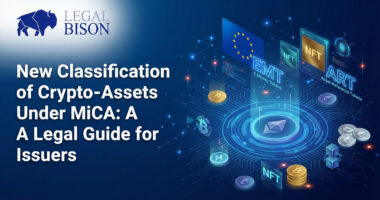
MiCAR is set to introduce a new asset classification for tokens used in crypto-related activities. All assets will be divided into EMTs, ARTs, and other crypto assets not falling under either of the previous categories.
The first group, EMT (E-Money Tokens), refers to the assets deriving their values from a single official currency issued by the bank, like USDC or USDT. Under MiCAR, they will cease being virtual currencies and be deemed e-money instead. Only banks and EMIs will be allowed to provide EMT-related services.
ARTs (Asset-Referenced Tokens) are tokens other than EMTs that reference another value or right, though with the possibility of referencing one or several official currencies. Such tokens as MakerDAO, Ampleforth, and Synthetix will be considered ARTs under MiCAR. In regard to MakerDAO or DAI, it is worth mentioning that algorithmic coins, due to their underlying mechanism, are considered a grey area under MiCA, which deems their classification as ARTs likely but not yet confirmed.
Finally, all crypto assets that do not fall under the umbrella of EMT or ART form a third category under MiCAR. For instance, such tokens as DogeCoin or ShibaInu.
Changes in licensing criteria
Before the implementation of MiCAR, such jurisdictions as Poland, Estonia, and France shared a number of licensing requirements for VASPs. These obligations varied from one framework to another and will now be unified under the European MiCA rules.
The VASP License in Poland required company formation with a legal address, identity documents of the founders, shareholders, and key employees, a responsible AML Officer, a description of the business activities, a certificate of incorporation, AML-CFT policies, and a corporate bank account. The most part could be remote.
The requirements for the Crypto license in Estonia included a detailed business plan, AML-CFT policies, a local office in Estonia, a domestic director and a compliance officer, and a corporate bank account to deposit the necessary share capital.
The DASP (PSAN) license in France was advertised as the closest to what MiCA would become. Most notably, it enforced the requirement for numerous audits on the financial, technical, cybersecurity, and even physical security sides. The French framework notoriously embedded the possibility of providing investment services to final clients.
MiCAR will integrate general rules for licensing applications that will be relevant for all countries of the European Union. All companies offering crypto-related services that fall within the scope of MiCA will have to comply with the AML-CFT rules of the Union. Entities that are not banks or credit institutions will be prohibited from issuing or offering services with e-money tokens. Companies offering services with ARTs will have to fulfill certain licensing requirements before obtaining CASP authorization. This scope includes but is not limited to:
Registered office within the EU;
Detailed business plan with a program of operations;
For emitters of crypto assets: a legal opinion stipulating that the asset-referenced token does not qualify as an e-money token or any other CA excluded from the scope of MiCA;
Identity documents of all key management members, along with their certificates of non-criminal record;
Crypto-asset white paper containing general information on the project, offeror, raised capital, rights and obligations attached to provided services, underlying technology, and related risks;
Description of contractual agreements with third parties;
Business continuity policy, internal control mechanisms, and risk management procedures;
Data protection measures and guidelines;
Complaint-handling procedures and guidelines.
We invite crypto entrepreneurs interested in the MiCA framework, whether due to existing operations in Europe or in the perspective of expanding their operations there, to get in touch with our consulting team for a more detailed assessment of the applicable requirements.
The two main types of companies included in the scope of MiCA are CASPs (Crypto Asset Providers) and CAs (Issuers of Crypto Assets), although the latter status only covers the crypto assets that are not qualified as financial instruments.
CASP refers to companies providing services related to cryptocurrencies, such as:
Issuers of Crypto Assets (CAs) are companies that issue crypto assets, which are not considered securities or financial instruments. In case such a company decides to launch a new cryptocurrency, it will have to comply with MiCAR, unless the new asset has the characteristics of a security or a financial instrument.
Different jurisdictions have different timelines for enforcement, and different spans of time for grandfathering existing companies. But eventually, all European member states will enforce MiCA.
European instances have explicitly communicated the fact that not meeting the MiCA regulations and improperly running a crypto asset service provider in the EU with failing compliance with the new framework will lead to severe sanctions.
Our FinTech lawyers have focused their efforts on mastering every concept and hook of the Markets in Crypto Assets and are now advising dozens of VASPs on how to ensure their successful requalification as CASP, or providing them with solutions in case they want to jump from the European ship.
LegalBison provides tailored consultation to crypto entrepreneurs, on request. Contact us describing your current situation with licensing and corporate structure, our legal team will provide you with the necessary guidance to assist with the regulatory changes.
The passing of the Markets in Crypto Assets (MiCA) Regulation in the EU changes the classification of cryptocurrencies. European lawmakers now distinguish three categories of crypto-assets: Asset-Referenced Tokens (ART), Electronic Money Token (EMT) and a third category that includes all assets not falling into the two first classes. LegalBison's lawyers dive into details in this article.
Closely following on the development of the enforcement of MiCA in Poland, LegalBison lawyer Krystian Lapka provides insights on the latest amendments made to the Draft Act.
Krystian LapkaLawyer at LegalBison
Contact Us
LegalBisonExperts & FinTech Lawyers
LegalBison’s experts and FinTech lawyers will glady invite you to a free consultation.