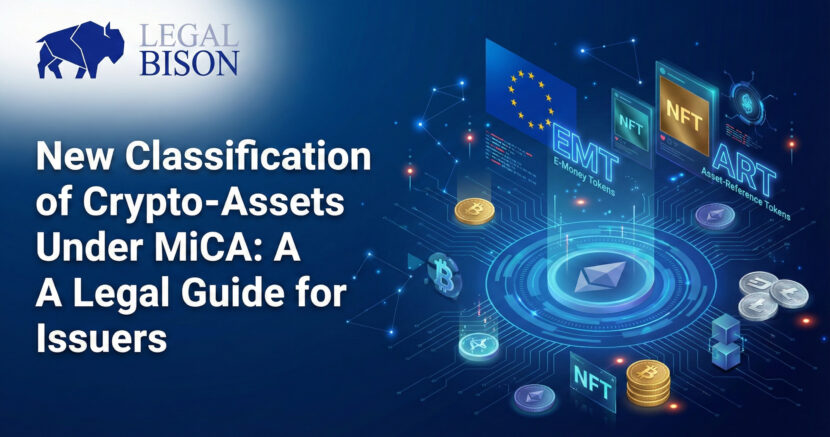
New Classification of Crypto-Assets Under MiCA: A Legal Guide for Issuers
The passing of the Markets in Crypto Assets (MiCA) Regulation in the EU changes the classification of cryptocurrencies. European lawmakers now distinguish three categories of crypto-assets: Asset-Referenced Tokens (ART), Electronic Money Token (EMT) and a third category that includes all assets not falling into the two first classes. LegalBison’s lawyers dive into details in this article.
Anastasia MarchenkoLegal Researcher at LegalBison
Feb, 23 20266 minutes
The new MiCA regulation of the European Union sets out a new classification guideline for different types of crypto assets. Determining the correct regulatory characterization is the critical preliminary step before drafting a white paper or applying for a license.
LegalBison digs deeper into the new rules and highlights the influence they will have on your crypto-business.
Electronic Money Tokens
Electronic Money Tokens, EMT in short, are defined by MiCAR as crypto assets that maintain their stability by referencing a single official currency, which deems them neither virtual currencies nor legal tender: instead, they are considered e-money. Only credit and electronic money institutions are now allowed to provide services with EMTs. The authorization requirements include maintaining and disclosing reserves, assuring full redemption rights to token holders, and drawing up recovery and redemption plans.
Example 1: Circle (USDC)
A prominent example of a P2P payments company managing USDC is Circle. The company allows redeeming services between USDC and US dollars at a 1:1 ratio. Apart from the Money Transmitter Licenses in the US, Circle holds a Bermuda Digital Asset Business (DAB) License, an Electronic Money Institution License in France, a Major Payment Institution License in Singapore, and a Financial Conduct Authority E-Money Issuer License in the UK.
Tether is an American company issuing the crypto asset USDT, which is classified as a stablecoin in non-EU jurisdictions and as EMT within the MiCA framework. The value of USDT derives from the US dollar, on the basis of collateralized dollars held in reserve by the Tether organization.
The compliance of Tether and the legality of its crypto asset USDT are then currently subject to discussion, as Tether hasn’t yet secured an electronic money institution license in Europe.
Asset Referenced Tokens
Asset-Referenced Tokens (ARTs), unlike EMTs, are the ones that derive and maintain their stable value from referencing:
A single value or right;
A combination of values, rights and/or currencies;
Two or more official currencies.
Any legal person registered in the EU will be able to apply for a license to issue ARTs. Every ART issuer must comply with such requirements as maintaining deep liquidity, providing initial share capital, a business plan, information on key persons, other governance arrangements, and recovery and redemption plans.
Example 1: MakerDAO (DAI)
MakerDAO is an American decentralized exchange that powers a decentralized stablecoin called DAI on the Ethereum blockchain. Though DAI aims at tracking the value of the US dollar, its mechanism implies a bag of crypto-assets such as ETH, and an algorithmic programmation to maintain its value. Thereby, MiCA classifies the DAI as an ART.
Algorithmic coins, due to their underlying mechanism, are considered a grey area under MiCA. Their classification as ARTs is likely but has not been officially confirmed yet.
Example 2: Synthetix
Synthetix is an open-source derivatives liquidity protocol operating on the Ethereum blockchain. It allows customers to create and trade the so-called Synths (synthetic assets) that reference the value of real-world assets (RWAs). As these assets derive their value from multiple collateralized assets, which are not official currencies, they classify as ART under the MiCA framework.
MiCA and decentralized protocols
MakerDAO and Synthetix are decentralized finance platforms that won’t be influenced by MiCA’s stipulations except for the new classification of tokens, which shall be officially deemed ARTs since June 2024.
According to the MiCAR, virtually every DeFi projects that are fully decentralized will be excluded from the scope of its influence, which means that MakerDAO and Synthetix didn’t experience any changes yet in their business model and policies once the new regulation was enforced.
Other crypto assets under MiCA
All assets that don’t fall under the umbrella of EMTs or ARTs shall be classified by MiCAR as the third group, other crypto assets. The tokens in this category do not reference any official currencies, nor do they derive any specific values from other values, rights, or combinations.
Example 1: Bitcoin (BTC)
Bitcoin is the perfect example of a crypto asset that is neither regulated nor regulable under the MiCA framework:
Its value is not derived from any other asset;
It is fully decentralized;
It does not serve any other purpose than transacting.
As such, BTC is neither an Electronic Money Token (EMT) nor an Asset Referenced Token (ART) and isn’t subject to regulations applicable to these classes of crypto assets.
Example 2: DogeCoin (DOGE)
DogeCoin is very comparable to Bitcoin, with the difference that the DOGE token is less decentralized than BTC. Its value is determined by the market and its technical simplicity excludes it from classification as another type of financial or crypto asset.
Example 3: Ether (ETH)
As for BTC and DOGE, ETH’s value is not derived from any other asset. While BTC and DOGE are classified as payment tokens, ETH is arguably classified as a utility token in Europe, as American regulators formally stated that ETH wasn’t a security. This fact does not change the classification of Ether within the new MiCA framework, where it is simply designed as a crypto asset and neither an EMT nor ART.
Regarding security tokens and crypto assets classified as financial instruments
Any token or cryptocurrency that would legally qualify as a security or financial instrument is excluded from the MiCA framework. It then falls under the much heavier frameworks applicable to EU financial market participants and should be compliant with the subsequent regulations.
MiCA only applies to assets that are not already covered by existing EU laws like MiFID II. If a token acts like a share or bond (transferable security), it is regulated under MiFID II, not MiCA. You may need an investment firm license rather than a CASP license if your token grants voting rights on corporate decisions or dividends.
The MiCA classification of crypto assets has been active since June 2024. Issuers of crypto assets formerly known as stablecoins are directly under the scope of the EU regulators.
This framework further completes the previous existing distinction between payment tokens, utility tokens, and security tokens, the latter being subject to securities laws and regulations.
If you are an active company with a crypto license in Europe, or planning to form a company licensed within the MiCA framework, understanding this new asset classification is a must.
LegalBison’s consulting team is now providing tailored advice to entrepreneurs and aspiring projects, on the topic of MiCA regulations and their implications for business. Reach out now, the first consultation is free, no matter the current stage of your project.
For crypto entrepreneurs and token issuers, the white paper is now the cornerstone of compliance. It determines your ability to offer tokens to the public, trade on exchanges, and operate without facing severe penalties from National Competent Authorities (NCAs). Under the new rules, a white paper functions similarly to a prospectus in traditional finance; it must be complete, fair, clear, and not misleading.
This guide details exactly what is required to draft a compliant white paper, the technical standards you must meet, and the liabilities you face as an issuer.
With the full application of Regulation (EU) 2023/1114, known as the Markets in Crypto-Assets Regulation (MiCA), the European Union has transitioned from an unregulated environment to a comprehensive legal framework. For crypto entrepreneurs and token issuers, the most pressing question is often about speed to market: can you simply publish your white paper and launch, or must you wait for a regulator to sign off?
In the pre-regulation era of 2017, a mistake in a crypto white paper was often fixed with a quick website edit and a tweet. Those days are over. Under the full application of the Markets in Crypto-Assets Regulation (MiCA), your white paper is more than a marketing deck, it's now a binding legal prospectus.
Adrien MarchandAssociate at LegalBison
Contact Us
LegalBisonExperts & FinTech Lawyers
LegalBison’s experts and FinTech lawyers will glady invite you to a free consultation.