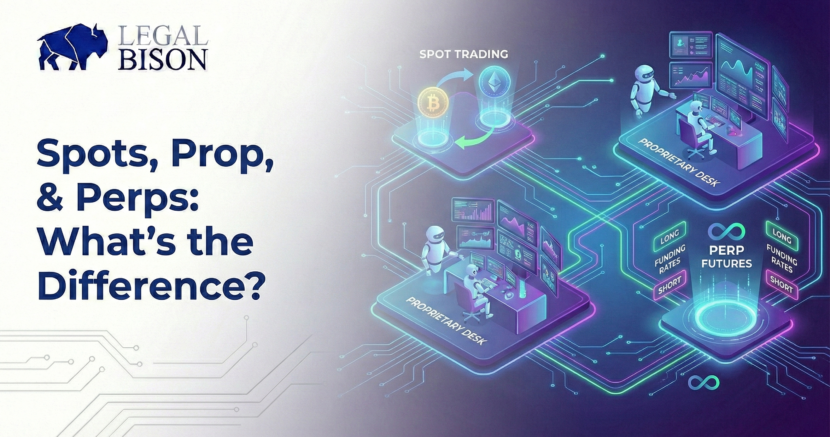
Difference Between Spots vs Prop vs Perps: A Guide to Your Modern Finance Business Model
This article explores the three pillars of contemporary trading: Spot, Prop (Proprietary) Trading, and Perps (Perpetual Futures). By comparing these from the perspective of both the user and the platform provider, we aim to clarify the operational and legal complexities of the fintech world.
Adrien MarchandAssociate at LegalBison
Feb, 09 202614 minutes
In the rapidly evolving landscape of modern finance, the terminology can often feel technical and reserved to a form of educated elite.
For both the ambitious investor and the visionary financial service provider as well as crypto traders and modern traders who are key participants in these markets, understanding the mechanics of different trading instruments is not just a matter of academic interest; it is a fundamental requirement for risk management, strategic positioning, and regulatory compliance.
Recognizing the key differences between spot, prop, and perps is essential for making informed decisions.
At LegalBison, we work at the intersection of technology and law. We understand that before a company can apply for the right license, it must first define its product offering.
This article explores the three pillars of contemporary trading: Spot, Prop (Proprietary) Trading, and Perps (Perpetual Futures). By comparing these from the perspective of both the user and the platform provider, we aim to clarify the operational and legal complexities of the fintech world.
Spot Trading: The Foundation of Ownership
Spot trading is the most straightforward form of exchange.
It involves the immediate purchase or sale of a financial instrument, such as a cryptocurrency, a fiat currency, or a commodity, for “on-the-spot” delivery. When you buy Bitcoin on a spot market, you own the Bitcoin.
In spot trading, you own the actual crypto asset, unlike in derivatives trading where you do not own the underlying asset. This is often referred to as the ‘crypto spot’ market, which serves as the foundational market for buying and selling actual cryptocurrencies, playing a crucial role in price discovery and reflecting genuine demand.
It can be moved to a private wallet, used for payments, or held long-term. Unlike perpetual and futures contracts, spot trading lacks short-selling capabilities.
The Investor’s Perspective
For the investor, spot trading is the “safest” entry point into any market.
Ownership: The primary advantage is direct ownership of the asset.
No Leverage Risks: Unlike derivatives, spot trading does not inherently involve leverage. You cannot lose more than your initial investment.
Simplicity: It is easy to understand; buy low, sell high.
Trend Following: Spot traders often follow trends in the market, making trend-following behavior a key aspect of spot trading strategies.
The Service Provider’s Perspective
From the viewpoint of an exchange or brokerage, offering spot trading is about building a robust infrastructure for custody and liquidity.
Custody Management: A spot provider must manage the actual storage of assets (e.g., cold and hot wallets for crypto).
Liquidity Ratios: Providers must ensure they have enough of the actual asset to fulfill withdrawal requests.
Revenue Model: Profit is primarily generated through trading fees (maker/taker) and withdrawal fees.
Proprietary (Prop) trading occurs when a financial institution or a specialized “prop firm” trades financial assets using its own capital rather than its clients’ money.
However, in the modern retail context, “Prop Firms” have emerged that provide “funded accounts” to skilled traders who pass an evaluation.
The Investor’s (Trader’s) Perspective
In the modern “retail prop” model, the individual is technically a service provider to the firm.
Capital Access: Traders can access large amounts of capital without risking their own savings.
Profit Split: The trader keeps a significant percentage of the profits (often 70-90%).
Strict Rules: Traders must follow rigid risk management rules (drawdown limits), or they lose access to the account.
The Service Provider’s Perspective
For a company, running a prop firm is a different business model than an exchange.
Risk Retention: The firm is often “b-booking” the trades or using simulated environments. The primary risk is the performance of the traders and the cost of capital.
Technology Stack: Providers need sophisticated “dashboard” software to track trader performance and enforce automated risk parameters.
Data Monetization: Some firms use the data generated by their best traders to inform their own institutional market moves.
Perps (Perpetual Futures): The High-Octane Derivative
Perpetual Futures or “Perps” are a type of derivative contract unique to the crypto industry, though they share similarities with traditional CFDs (Contracts for Difference).
Unlike standard futures, Perps have no expiry date. Traders can hold positions indefinitely as long as they pay the funding fees and maintain sufficient margin. Most exchanges are the primary venues for perp trading, attracting large-scale traders and high trading volumes.
Hedge funds, along with prop firms and large individual traders, are major participants in the perpetual futures market and can significantly influence crypto prices and liquidity. In contrast, regular futures and dated futures have fixed expiration dates and different margin requirements, making them more suitable for strategies with a defined maturity.
Traditional futures allow for hedging but require rolling over positions due to their fixed expiration dates.
To keep the price of the Perp close to the “Spot” price, a mechanism called the Funding Rate is used. If the Perp price is higher than the Spot price, those who are “long” pay those who are “short,” and vice versa. Long positions in perps may pay or receive funding fees depending on market conditions.
Market Condition
Funding Rate
Who Pays Whom?
Market Sentiment
Perp Price > Spot Price
Positive (+)
Longs pay Shorts
Bullish
Perp Price < Spot Price
Negative (-)
Shorts pay Longs
Bearish
When trading perps, traders must meet margin requirements, which include an initial margin (the upfront deposit needed to open a position) and a maintenance margin (the minimum balance required to keep the position active).
If the account balance falls below the maintenance margin due to market fluctuations, the position may be liquidated. Liquidation bots automatically close leveraged positions to prevent further losses when margin balances drop.
Position size, or the amount of the asset controlled using leverage, directly impacts potential profits, losses, and associated fees.
Perpetual futures can provide high leverage, allowing traders to control larger positions with less capital. Price movements affect the unrealized profit or loss of open positions, which remains unbooked until the trade is closed.
Perps now dominate trading volume in the crypto derivatives market. Perpetual future contracts have become a leading indicator of market sentiment and price discovery due to their massive trading volume.
Traders use perpetual futures for speculative trading, hedging, and arbitrage strategies. Many trading strategies are trade based, meaning traders analyze whether to trade based on spot or perpetual contract activity to align with the dominant market flow.
Due to the risks and complexities involved, active monitoring and a solid plan are essential for managing perpetual futures positions effectively.
In these strategies, traders often use price action analysis to identify arbitrage opportunities and follow trends, especially during market fluctuations between spot and futures prices.
The Investor’s Perspective
High Leverage: Perps allow traders to trade with 10x, 50x, or even 100x leverage. This magnifies both profits and losses.
Hedging: Investors use Perps to hedge their spot holdings against market downturns.
Speculative and Modern Traders: Perps are primarily used by speculative traders and modern traders who seek versatile trading tools with advanced features like leverage, no expiration, and funding rates for both long-term and speculative strategies.
DeFi Integration: Perpetual futures are increasingly integrated into decentralized finance, allowing for dynamic risk management.
Complex Risk: The risk of liquidation (losing the entire margin) is high, making this a tool for experienced participants.
The Service Provider’s Perspective
Offering Perps is one of the most profitable yet operationally complex ventures for a fintech company.
The Engine: You need a high-performance matching engine and a robust “Liquidation Engine” to automatically close positions before they go into negative equity.
Insurance Funds: Providers usually maintain an insurance fund to cover “socialized losses” if a position cannot be closed at the bankruptcy price.
Revenue Model: In addition to trading fees, providers may benefit from the spread and, in some models, the funding dynamics.
Equity Perps: Equity perps are an emerging product that enables 24/7, fractional trading of global equities on digital platforms, bridging traditional stock markets and decentralized finance.
The funding rate is a cornerstone of perpetual futures contracts, ensuring that the price of these contracts stays closely tethered to the value of the underlying asset in the spot market.
Unlike traditional futures contracts with a set expiration date, perpetual futures have no expiry, so the funding rate acts as a balancing mechanism between the perpetual futures market and the underlying spot market.
In practice, the funding rate is a periodic payment exchanged between traders holding long and short positions, depending on prevailing market conditions. When the price of a perpetual futures contract trades above the spot price of the underlying asset, long position holders pay a funding fee to short position holders.
Conversely, if the contract price falls below the spot price, short position holders pay funding fees to those who are long. These payments are typically settled at regular intervals; often every eight hours on most major exchanges, and are calculated as a percentage of the contract’s notional value.
This mechanism incentivizes traders to take positions that help bring the perpetual futures price back in line with the spot price, promoting market efficiency and reducing price discrepancies. For traders, especially those engaged in leveraged trading, the funding rate is a critical factor in overall trading costs.
Over time, funding fees can significantly impact profit and loss, particularly during volatile periods or when holding positions for extended durations.
Understanding the funding rate is essential for effective risk management in trading perpetual futures. Retail traders need to be aware that funding payments can erode profits or add to losses, depending on market sentiment and the direction of their positions.
Experienced traders often monitor funding rates closely, using them as signals for market sentiment sustained positive rates may indicate bullish momentum, while negative rates can signal bearish trends.
In the fast-moving world of crypto markets, where perpetual futures dominate trading volume, being mindful of the funding rate is crucial. It not only affects trading costs but also provides insights into the collective positioning of market participants.
Whether you are a speculative trader seeking to capitalize on price movements or a hedge fund managing large leveraged positions, incorporating funding rate analysis into your trading strategy can make a significant difference in navigating the futures market successfully.
Dated futures contracts are a cornerstone of the traditional futures market, offering traders and investors a fixed-term alternative to perpetual futures.
Unlike perpetual contracts, which allow traders to hold positions indefinitely, dated futures contracts come with a clearly defined expiration date or expiry date. This means that each contract is valid only until a specific point in time, after which it is settled based on the price of the underlying asset.
The presence of an expiration date fundamentally shapes how dated futures are used in the market. Traders often turn to these contracts to hedge against potential losses or to speculate on price movements within a set time frame.
For example, a trader might use a dated futures contract to lock in the price of Bitcoin or another asset for delivery or settlement at a future date, providing a measure of certainty in volatile markets.
Because dated futures contracts are tied to a specific expiry date, they require active management and strategic planning. As the contract approaches its expiration, the price of the futures contract typically converges with the spot price of the underlying asset.
This process, known as convergence, is a key feature that distinguishes dated futures from perpetual futures, where the absence of an expiry date means traders must rely on mechanisms like the funding rate to keep contract prices in line with the spot market.
Dated futures are widely used by both institutional and retail traders for a variety of purposes. Hedgers use them to protect against adverse price movements in the underlying asset, while speculative traders seek to profit from anticipated changes in price over the contract’s lifespan.
The fixed-term nature of these contracts also allows for more precise risk management, as traders know exactly when their positions will be settled.
In summary, dated futures contracts provide a structured, time-bound approach to trading futures, making them an essential tool for those who need to manage risk or capitalize on price movements within a specific period.
Their clear expiration date sets them apart from perpetual contracts, offering a different set of opportunities and challenges for market participants in the ever-evolving world of futures trading.
Comparative Summary: Spot vs. Prop vs. Perps
Feature
Spot Trading
Prop Trading
Perps (Perpetual Futures)
Asset Ownership
Yes, full ownership.
No, trading firm’s capital.
No, contract-based.
Expiry Date
None.
Based on firm’s rules.
None (Perpetual).
Leverage
Usually 1:1.
High (provided by firm).
Very High (up to 100x).
Primary Risk
Asset price depreciation.
Violating firm rules.
Liquidation due to leverage.
Provider Goal
Custody & Volume.
Identifying talent/Data.
Yield & Liquidations.
The Regulatory Landscape: Why Licensing is Non-Negotiable
Whether you are launching a platform for spot crypto exchange, a prop trading firm, or a derivatives desk for Perps, you are entering one of the most strictly monitored sectors in the world.
Operating without a license is not just a risk to your reputation; it is a legal liability that can lead to heavy fines, geoblocking, and even criminal charges.
The type of activity you choose determines your regulatory path:
Prop Trading and the offering of complex financial instruments often fall under the umbrella of investment services.
Depending on the jurisdiction, if you are managing capital or providing a platform where “contracts for difference” are traded, you may need a full Investment Firm license. This requires significant capital adequacy and high-level corporate governance.
Offering Perps or any form of leveraged trading often puts a company in the same category as a Forex broker.
Because Perps are essentially derivatives, many countries including offshore forex jurisdiction (such as Labuan, Mauritius, or Cyprus) require a specific Forex or Securities Dealer license to offer these to the public.
These licenses ensure that the provider has the financial “cushion” to handle market volatility.
Navigating the differences between Spot, Prop, and Perps is a business challenge. Navigating the laws that govern them is a legal marathon.
At LegalBison, we are more than just consultants; we are your strategic partners in the FinTech industry. We specialize in helping entrepreneurs and established companies identify exactly which licenses they need based on their specific product offering.
Our services include:
Jurisdiction Selection: Analyzing where your business model fits best, balancing cost, reputation, and speed to market.
Company Registration: Setting up the corporate structure required for financial licensing.
Licensing Applications: Managing the entire communication with regulators, from the initial application to the final approval.
Compliance & AML: Drafting the necessary internal policies to ensure you stay compliant long after your license is granted.
The world of financial services offers immense opportunities for those who understand the products they offer and the laws that protect the participants.
Whether you are building a spot exchange for the masses or a high-leverage Perps platform for professional traders, the first step is always the same: ensuring a solid legal foundation.
Contact LegalBison today to start your journey toward a fully regulated and successful financial enterprise.
Planning to launch a perps platform? It’s crucial to look at crypto friendly countries. These jurisdictions offer supportive legal frameworks, tax policies, and regulatory clarity, making them attractive for crypto trading and innovation.
Thinking of opening a crypto spot trading company? This guide compares the top jurisdictions for establishing a spot trading company, ranging from established Asian powerhouses to tax-efficient offshore hubs.
LegalBison will break down and explain the main differences between the variety of crypto licensing frameworks, such as VASP, DASP, and CASP, so you won’t lag behind competitors in the cryptocurrency industry.
LegalBison have compiled a comprehensive guide to demystifying perpetual futures, exploring their mechanics, their fascinating history, and the strategic roadmap for businesses looking to enter this high-yield arena.
For those looking to establish a proprietary trading firm or for traders seeking to understand the mechanics of the platforms they use, understanding the legal, historical, and operational framework is essential.
Adrien MarchandAssociate at LegalBison
Contact Us
LegalBisonExperts & FinTech Lawyers
LegalBison’s experts and FinTech lawyers will glady invite you to a free consultation.