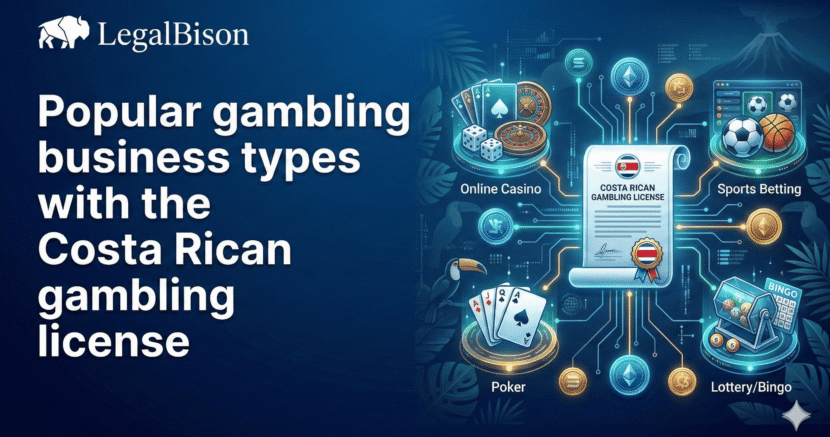
4 Types of Popular Gambling Business With the Costa Rican Gambling License
Costa Rica has emerged as a premier global destination for the online gaming industry due to its flexible regulatory framework and favorable territorial tax system. Entrepreneurs frequently choose this jurisdiction to launch innovative platforms quickly while benefiting from a supportive environment for both traditional betting and modern blockchain projects.
Anastasia MarchenkoLegal Researcher at LegalBison
Mar, 03 202610 minutes
Costa Rica has established itself as one of the most significant and enduring hubs for the international online gambling industry. Since the early days of the internet, this Central American nation has attracted entrepreneurs from around the globe due to its progressive approach to digital business and its welcoming stance toward offshore operators. For many investors, finding the rightoffshore gambling license represents the perfect balance between operational freedom and a reputable jurisdiction for global transactions.
The country is particularly well known for being a premier hub for offshore gambling companies. Unlike many other jurisdictions that impose heavy bureaucratic burdens and high entry costs, Costa Rica offers a remarkably rapid speed to market. This allows operators to launch their platforms in a matter of weeks rather than months. Furthermore, the environment is exceptionally crypto-friendly, making it a natural choice for the next generation of blockchain-based gaming projects.
One of the most compelling reasons for choosing this jurisdiction is the favorable territorial tax regime. Under Costa Rican law, income generated outside of the country is not subject to local corporate income tax. For a gambling business that serves an international audience, this creates a highly efficient financial structure. When combined with the country’s stable political climate and skilled workforce, it becomes clear why thousands of platforms call Costa Rica their corporate home.
The legal reality: the data processing license
When discussing agambling license in Costa Rica, it is vital to understand the unique legal framework that governs this activity. It is a common misconception that Costa Rica issues a traditional federal gaming license similar to those found in Malta or Curacao. In reality, there is no specific federal legislation that regulates or prohibits online gambling conducted from within the country, provided the services are offered to players abroad.
Instead of a centralized gaming permit, offshore operators obtain a data processing license at the municipal level. This license essentially authorizes the company to manage data, host servers, and conduct administrative tasks related to an international gambling platform from a physical office in Costa Rica. Because the government does not view online gambling as a local activity when the players are outside the country, this commercial license serves as the legal basis for operations.
There is a strict and absolute prohibition against offering any gambling services to residents of Costa Rica. Operators must implement robust geo-blocking technology to ensure that no local IP addresses can access the betting features of their sites. As long as this rule is respected, the data processing license provides a stable and legal foundation for managing a global empire. LegalBison helps clients navigate these nuances to ensure that their corporate structure is fully compliant with municipal requirements while maintaining the necessary distance from the local market.
Popular gambling business types in Costa Rica
The flexibility of the Costa Rican framework allows for a wide variety of business models. Because the license is not limited to specific categories of games, entrepreneurs can innovate and expand their offerings without needing to apply for multiple sub-licenses. This is a primary reason why many entrepreneurs seek agambling license in this region to test new gaming mechanics.
1. Crypto casinos and GameFi
Costa Rica has become a magnet for the burgeoning sector of crypto casinos and GameFi projects. The country maintains a lenient stance on play-to-earn models and blockchain-based gaming. This makes it an ideal jurisdiction for startups that want to integrate smart contracts and decentralized finance into their gaming mechanics. Establishing acrypto casino here allows founders to stay ahead of the fast-moving market trends.
There is a crucial legal consideration for those operating in this space. While the data processing license covers the management of the games themselves, any operator that offers fiat to crypto on-ramp or off-ramp services must adhere to additional regulations. In such cases, the company is required to obtain a Costa Rica crypto license, often referred to as a VASP or CASP registration. LegalBison specializes in these dual setups, ensuring that your crypto casino can legally handle both gaming activities and virtual asset exchanges.
2. Sports betting and eSports
Historically, Costa Rica was the original home of the online sportsbook. Global bookmakers continue to operate safely from San Jose and other major hubs by focusing exclusively on international prediction markets. The infrastructure in the country is perfectly suited for the high volume of data and real-time updates required for live sports betting.
The rise of eSports has further solidified Costa Rica’s position. Operators can host platforms for competitive gaming, skins gambling, and tournament betting under the same corporate structure used for traditional sportsbooks. By not taking local bets, these bookmakers remain within the legal boundaries of their data processing permits while serving millions of fans in Europe, Asia, and North America.
3. Online casinos and slots
The most common business type remains the traditional online casino. This includes platforms offering a full suite of random number generator (RNG) games, such as virtual slot machines, table games, and video poker. The Costa Rican setup is also highly popular for live dealer studios. Many companies choose to host their physical studios and streaming infrastructure in Costa Rica due to the availability of high-speed fibre optic internet and a workforce that is fluent in multiple languages.
4. Online poker and lotteries
Online poker networks benefit from the Costa Rican jurisdiction because it allows them to aggregate players from various international pools. Whether the games are classified as games of skill or games of chance, they are managed under the same municipal license. Similarly, international online lotteries find a home here. These platforms can legally sell digital tickets for global draws or operate their own proprietary lottery systems, provided they maintain the strict prohibition on local sales.
Top Costa Rican gambling companies list
The following list represents some of the most prominent players in the hospitality and gaming sector currently operating from Costa Rica. These companies vary from large-scale sportsbooks to resort-based gaming operations that maintain a significant digital presence:
Betcris
Sam
The Bookmaker.eu
Unafut
Croc’s Casino Resort
Americas Cardroom
WagerWeb
Grand Casino Escaz
Betmania
Price Per
These organizations demonstrate the scale of the industry within the country. Many of them employ hundreds of local staff for customer support, technical development, and marketing, contributing significantly to the local economy while serving a global clientele.
Types of company formation for gambling business in Costa Rica
To operate a gambling business legally, you must first establish a formal corporate presence. The first step for any serious operator iscompany registration in Costa Rica. The process is relatively straightforward, but it requires careful attention to local administrative rules. The two most common legal entities are:
Sociedad Anónima (S.A.): This is a standard corporation that requires at least two founders and a board of directors;
Sociedad de Responsabilidad Limitada (S.R.L.): This is similar to a limited liability company and is often preferred for smaller operations or subsidiaries because it has a simpler management structure.
The legal prerequisites for obtaining the data processing license include:
Incorporating a local legal entity;
Appointing a local director or a resident agent;
Securing a physical office space that meets municipal health and safety standards;
Obtaining a workers’ compensation insurance policy (INS);
Registering with the local tax authorities (Hacienda), even if you only generate offshore income.
LegalBison acts as a turnkey provider for global company formation. We handle the entire process from the initial drafting of the articles of incorporation to the final acquisition of the municipal permit. This allows you to focus on developing your gaming platform while we manage the local bureaucracy.
The challenge of banking and payments
While the corporate and licensing side of Costa Rica is efficient, the financial aspect presents a common hurdle. Local Costa Rican banks are notoriously hesitant to process payments for gambling businesses. Due to strict international anti-money laundering (AML) guidelines and the risk appetite of local financial institutions, it is nearly impossible to open a local corporate account for direct gambling transactions.
This is where the expertise of a specialized legal partner becomes indispensable. To ensure smooth financial operations, operators must look toward international solutions. The necessity of offshore banking, payment service providers (PSPs), and Electronic Money Institution (EMI) fintech licenses cannot be overstated.
LegalBison assists clients in securing robust payment rails by:
Identifying offshore banks that are friendly to the iGaming industry;
Assisting with the application for EMI and PSP accounts in jurisdictions like Lithuania or the United Kingdom;
Structuring the company to meet the high compliance standards required by international payment processors;
Integrating crypto payment gateways to bypass the traditional banking bottlenecks.
Without a proper payment strategy, even the best licensed platform will struggle to survive. Our team ensures that your financial flow is as compliant and efficient as your corporate structure.
Conclusion
Costa Rica remains a top-tier destination for anyone looking to enter the online gambling market quickly and cost-effectively. The combination of a territorial tax system, a flexible data processing legal framework, and a crypto-friendly atmosphere makes it an unparalleled hub for innovation. While the path to a fully operational business involves navigating municipal licenses and complex international banking requirements, the rewards of a Costa Rican setup are significant.
The ease and profitability of setting up in Costa Rica are within reach when you work with the right legal partner. At LegalBison, we provide the expertise needed to handle everything from company formation to the acquisition of secondary crypto licenses and the establishment of global banking relations.
FAQ
Does Costa Rica issue online gambling licenses?
No, Costa Rica does not issue a specific federal license for online gambling. Instead, companies obtain a municipal data processing license, which permits them to conduct the technical and administrative operations of an offshore gaming business from within the country.
Can I open a crypto casino or GameFi project in Costa Rica?
Yes, Costa Rica is a highly popular destination for crypto casinos and GameFi projects due to its lenient regulatory environment. The country’s legal framework allows for easy integration of blockchain technology and play-to-earn mechanics.
What are the legal requirements for a Costa Rica gambling company?
The primary requirements include incorporating a local legal entity (such as an S.A. or S.R.L.), appointing a local director or resident agent, securing a registered physical office, and obtaining a municipal data processing permit.
Do I need a crypto license to run an online casino in Costa Rica?
If your online casino only uses cryptocurrency for internal gaming mechanics, the standard data processing license is usually sufficient. However, if you provide fiat to crypto exchange services (on/off-ramping) to your users, you are legally required to obtain a Costa Rica VASP/CASP registration.
With the implementation of the Markets in Crypto-Assets (MiCA) Regulation and the national Digital Finance Act (Act No. 31/2025 Coll.), the Czech Republic has transitioned from a simple registration-based system to a sophisticated licensing regime. The evolving regulatory landscape for crypto companies in the Czech Republic and the EU is shaping new opportunities and compliance requirements for market participants.
The passing of the Markets in Crypto Assets (MiCA) Regulation in the EU changes the classification of cryptocurrencies. European lawmakers now distinguish three categories of crypto-assets: Asset-Referenced Tokens (ART), Electronic Money Token (EMT) and a third category that includes all assets not falling into the two first classes. LegalBison's lawyers dive into details in this article.
Anastasia MarchenkoLegal Researcher at LegalBison
Contact Us
LegalBisonExperts & FinTech Lawyers
LegalBison’s experts and FinTech lawyers will glady invite you to a free consultation.