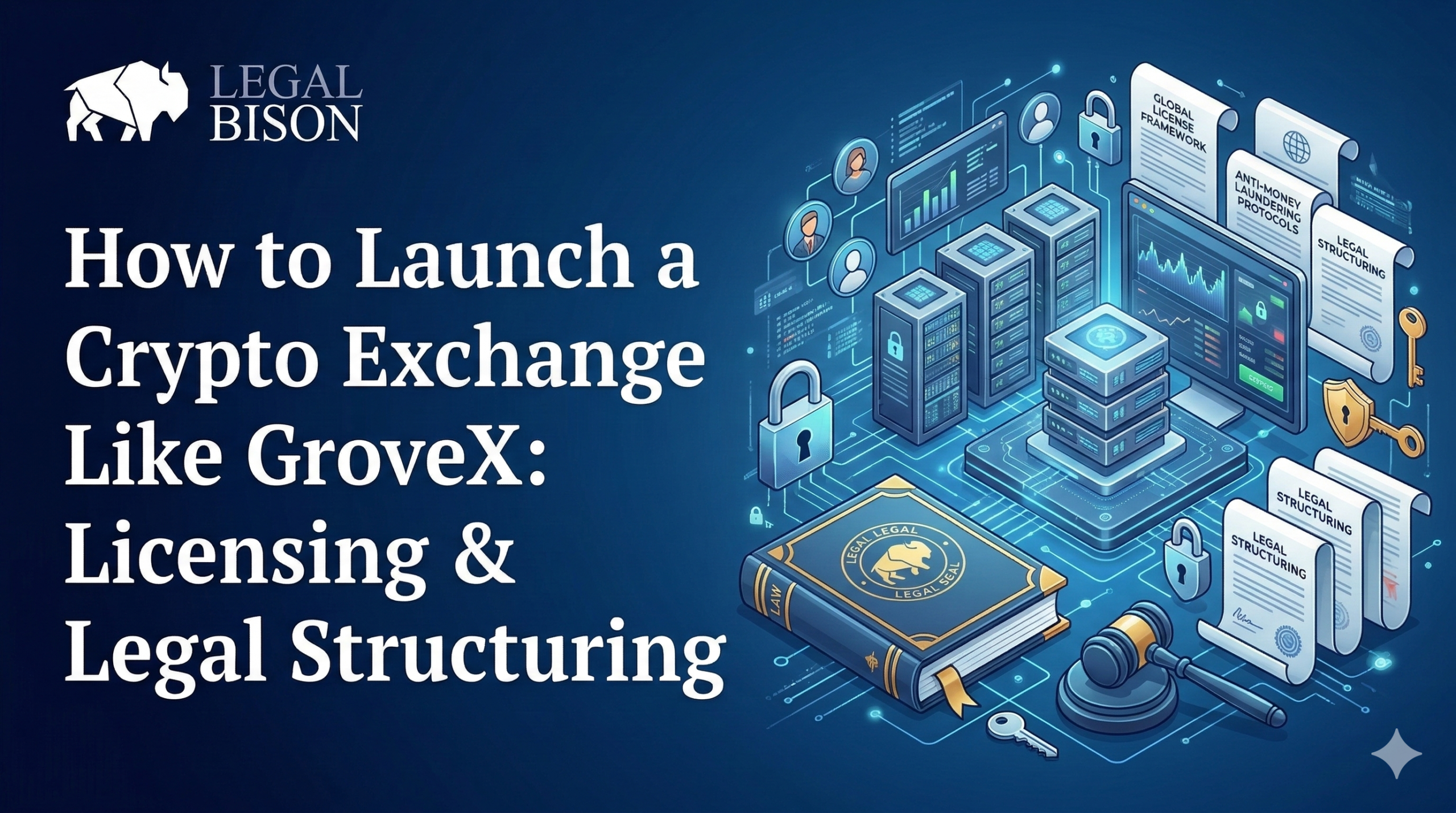
How to Launch a Crypto Exchange Like GroveX: Licensing and Legal Structuring
In this guide, LegalBison uses GroveX, an Australian centralized cryptocurrency exchange, as a reference point to walk through the licensing decisions, compliance frameworks, and jurisdiction choices that every crypto exchange founder needs to get right before going live.
Anastasia MarchenkoLegal Researcher at LegalBison
Mar, 09 20267 minutes
GroveX is a centralized cryptocurrency exchange (CEX) incorporated in Australia and registered with AUSTRAC. Launched in 2022, it supports over 130 trading pairs across more than 10 blockchain networks, charges trading fees of 0.1%, and has built its positioning around fast execution and privacy-conscious account tiers.
For founders researching how a compliant crypto exchange operates at scale, GroveX offers a concrete reference point. The legal architecture behind it is as instructive as the product itself.
The regulatory model of GroveX: balancing privacy and compliance
GroveX holds registration with AUSTRAC, Australia’s financial intelligence agency and the body responsible for anti-money laundering and counter-terrorism financing (AML/CTF) regulation. Every digital currency exchange operating in Australia is required to register with AUSTRAC, maintain an AML/CTF program, and file suspicious matter reports. GroveX’s ABN registration places it squarely within that framework.
One of the more discussed aspects of GroveX’s model is its approach to KYC thresholds. The exchange allows crypto-to-crypto deposits and withdrawals of up to USD 10,000 without requiring full identity verification. This is not a loophole; it reflects Australia’s risk-based AML/CTF framework, which allows exchanges to calibrate verification requirements based on transaction type and value. Fiat-to-crypto and crypto-to-fiat transactions trigger mandatory KYC regardless of amount, consistent with AUSTRAC requirements for higher-risk fund flows.
This kind of tiered compliance model is increasingly common among exchanges seeking to balance user experience with regulatory obligations. Getting the thresholds right requires precise legal analysis, because what is permissible under one jurisdiction’s risk-based framework may be treated very differently by regulators elsewhere.
Navigating public trust and exchange legitimacy
New exchanges face a structural trust deficit. GroveX carries a Trust Score of 7/10 on CoinGecko, which is creditable for a platform launched in 2022. Community forums tend to scrutinize volume figures and security credentials of younger exchanges, and that scrutiny is not irrational: the crypto sector has a documented history of platforms that went live without adequate legal or technical foundations.
The most reliable way to address this is not through marketing but through verifiable legal and technical credentials. AUSTRAC registration provides one layer of assurance. Smart contract audits from firms like CertiK provide another. Together, they signal to users and institutional counterparties that the exchange is subject to real obligations and has invited external review.
Obtaining a recognized VASP (Virtual Asset Service Provider) license or registration is, for this reason, one of the most commercially significant decisions a founding team will make. It shapes the exchange’s addressable market, its ability to access banking, and its exposure to regulatory enforcement.
Key legal requirements for launching a crypto exchange like GroveX
Building a compliant centralized exchange requires decisions across three interconnected areas: corporate structure, licensing, and ongoing compliance. Each depends on the others.
Global company formation and jurisdiction selection
The first decision is where to incorporate. This is not purely a tax question. Jurisdiction determines which regulatory framework applies, which licenses are available, how local authorities approach crypto asset businesses, and which banking relationships are accessible.
Australia offers a straightforward VASP registration pathway through AUSTRAC and has a well-developed legal infrastructure. European jurisdictions covered by MiCA (the EU’s Markets in Crypto-Assets Regulation) offer passporting rights across EU member states for authorized Crypto-Asset Service Providers (CASPs), making them attractive for exchanges targeting European users. Offshore jurisdictions in the Caribbean, Latin America, and Southeast Asia provide alternative pathways, each with its own licensing cost, processing timeline, and risk profile.
The correct jurisdiction is not the cheapest or the fastest; it is the one that aligns with the exchange’s business model, target user base, banking requirements, and growth trajectory. International corporate structuring for a crypto exchange typically involves a parent holding company in one jurisdiction, an operating entity in another, and potentially separate entities to isolate intellectual property, custody functions, or specific geographic markets.
Obtaining a crypto exchange license (VASP registration)
A crypto exchange license (or VASP registration) authorizes the business to operate legally in a given market. Without it, the exchange operates at permanent regulatory risk, regardless of the quality of its technology or team. Regulators in the EU, UK, Singapore, UAE, Australia, and across many other markets now actively enforce against unlicensed crypto trading operations.
The application process varies by jurisdiction. It typically requires a fully formed legal entity with a local directorship or management presence, a documented AML/CTF program, policies for transaction monitoring and suspicious activity reporting, proof of adequate financial resources, and, in some cases, a minimum capital requirement. Processing times range from a few weeks for AUSTRAC registration to twelve months or more for MiCA CASP authorization in some EU member states.
A well-prepared application is not simply a documentation exercise. It requires the business model to be translated into the regulator’s framework, which means demonstrating that every function of the exchange, from order matching to custody to settlement, has been analysed against the licensing triggers of the target jurisdiction.
AML/KYC compliance frameworks
An AML/CTF compliance program is both a legal requirement and an operational necessity. Most jurisdictions require the program to be maintained by a designated compliance officer (or MLRO, Money Laundering Reporting Officer) who takes personal accountability for its adequacy. The program must cover customer due diligence procedures, transaction monitoring rules, record-keeping obligations, and staff training.
KYC (Know Your Customer) is the client-facing component of this framework. It governs how the exchange identifies and verifies its users, assesses their risk profile, and monitors their activity over time. The design of a KYC program involves real trade-offs: overly aggressive verification flows increase user drop-off; insufficient controls create regulatory exposure. FATF (Financial Action Task Force) standards provide the international baseline, but each jurisdiction’s AML/CTF rules contain jurisdiction-specific requirements that may be more demanding.
Getting these frameworks right from the start avoids the significant cost and disruption of remediating a deficient compliance program after launch, particularly one already scrutinized by a regulator.
Looking to launch your own compliant crypto exchange?Contact LegalBison for a consultation on crypto licensing and company formation.
How LegalBison can help build your crypto exchange company
LegalBison is a global boutique legal and business services firm and licensed Corporate Service Provider, advising FinTech and digital asset companies across more than 50 jurisdictions. The firm’s work on crypto exchange projects spans every stage of the regulatory and corporate lifecycle, from initial business model analysis through company formation, VASP licensing, compliance program design, and post-launch regulatory support.
On jurisdiction selection, LegalBison’s team assesses the exchange’s specific model against the regulatory, operational, and banking environment of candidate jurisdictions. This is not a generic comparison matrix; it is applied analysis that draws on direct experience with AUSTRAC registration, MiCA CASP authorization in EU markets, VASP licensing in jurisdictions across Southeast Asia, the Caribbean, and the Middle East, and the practical realities of what each registration process requires. The firm’s dedicated pages cover the fullcrypto license offering, with specific guidance onAustralia AUSTRAC registration andAsia regional licensing.
On compliance, LegalBison’s legal and compliance teams design AML/KYC programs aligned with FATF standards and jurisdiction-specific requirements, prepare the documentation that regulators require, and support the exchange’s compliance officer in building systems that are both defensible and operationally workable.
Company formation is the foundation. LegalBison holds direct registrar status in multiple jurisdictions and manages the full incorporation and corporate administration lifecycle, including registered address provision, director appointments, and annual compliance. For high-risk business models such as crypto exchanges, the firm also provides account opening assistance to support access to appropriate banking and payment processing infrastructure.
The parallel that GroveX provides is useful precisely because it is recent and concrete. It shows what a properly structured exchange looks like at the licensing and compliance level. What it does not show is the path to get there: the decisions on entity structure, the AUSTRAC registration process, the compliance program design, and the ongoing obligations that come with operating a regulated digital asset business. Those decisions, made well at the outset, are what separate exchanges that grow from those that face regulatory intervention.
Start your FinTech journey today. Let LegalBison handle your globalcompany formation and regulatory compliance.
With the implementation of the Markets in Crypto-Assets (MiCA) Regulation and the national Digital Finance Act (Act No. 31/2025 Coll.), the Czech Republic has transitioned from a simple registration-based system to a sophisticated licensing regime. The evolving regulatory landscape for crypto companies in the Czech Republic and the EU is shaping new opportunities and compliance requirements for market participants.
The passing of the Markets in Crypto Assets (MiCA) Regulation in the EU changes the classification of cryptocurrencies. European lawmakers now distinguish three categories of crypto-assets: Asset-Referenced Tokens (ART), Electronic Money Token (EMT) and a third category that includes all assets not falling into the two first classes. LegalBison's lawyers dive into details in this article.
Anastasia MarchenkoLegal Researcher at LegalBison
Contact Us
LegalBisonExperts & FinTech Lawyers
LegalBison’s experts and FinTech lawyers will glady invite you to a free consultation.