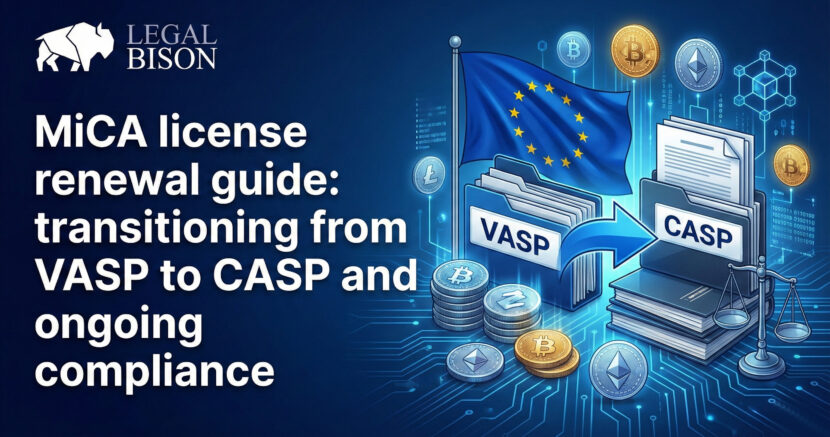
MiCA License Renewal Guide: How to Transition From VASP to CASP and Ongoing Compliance
Navigating the transition to the new European regulatory framework for crypto-assets is a priority for every existing operator. The Markets in Crypto-Assets (MiCA) Regulation introduces a unified system that replaces diverse national regimes. This guide clarifies how to move from your current registration to full authorization as a Crypto-Asset Service Provider (CASP).
Adrien MarchandAssociate at LegalBison
Mar, 18 20265 minutes
The renewal misconception
Many business owners believe that their current Virtual Asset Service Provider (VASP) registration will automatically renew into a MiCA license. This is a significant misconception that could lead to operational disruptions. In reality, MiCA does not provide a simple paperwork renewal for existing entities.
Firms must undergo a comprehensive authorization process to become a CASP. While your previous experience is valuable, the new requirements are much broader than existing anti-money laundering (AML) focused rules. Early preparation is the only way to ensure your business remains compliant after the transition period.
The grandfathering period: your renewal window
The regulation includes transitional measures, often called a grandfathering period, to prevent market disruption. Existing VASPs that provided services in accordance with applicable local laws before 30 December 2024 may continue to operate under those rules. In many member states, this period lasts until 1 July 2026.
It is critical to understand that this is a limited window for transitioning, not a permanent extension. You must use this time to prepare and submit your application for a new CASP license. If you miss this deadline and do not have an approved authorization, you must cease operations immediately.
How to renew your status (VASP to CASP transition)
Gap analysis: compare your current AML-focused registration with the broader MiCA requirements. This includes assessing your governance, prudential safeguards, and client protection protocols;
Full application: prepare a complete dossier as required by Article 62 of the regulation. This application must include detailed programmes of operations, technical documentation, and proof of repute for management;
Submission timeline: submit your application well before the 2026 deadline. Regulatory reviews typically take between 6 to 12 months, and waiting until the last moment creates significant risk.
LegalBison provides expert assistance to help you navigate this complex authorization process. Obtain your crypto license with the help of our experienced consultants.
Maintaining your license: annual obligations
Once authorized, a CASP must comply with rigorous ongoing supervision requirements to keep its license valid. These obligations ensure market integrity and a high level of consumer protection across the Union.
Prudential safeguards: maintain own funds or an insurance policy at the required levels at all times;
Governance reviews: the management body must periodically review the effectiveness of policy arrangements;
Audit requirements: ensure regular audits by independent auditors to verify compliance with operational standards;
Record keeping: maintain detailed records of all transactions and services for at least five years.
Failure to meet these ongoing standards can lead to administrative penalties or the withdrawal of your authorization.
Risks of non-renewal (non-compliance)
Operating without a valid CASP authorization after the transitional period carries severe consequences. National competent authorities have been granted extensive powers to enforce the new rules.
Immediate cessation: authorities can order the immediate stop of any unauthorized activity;
Financial penalties: legal persons can face fines up to 12.5% of their total annual turnover or EUR 5 000 000;
Management bans: natural persons may be temporarily banned from exercising management functions;
Public statements: the identity of the infringing person and the nature of the violation will be published on official websites.
How can LegalBison help you now?
The shift from VASP to CASP represents a fundamental change in the European crypto landscape. While the transitional period provides a temporary buffer, the move to a MiCA license is a significant regulatory hurdle that requires expert guidance. Early action is essential to secure your place in the regulated market.
LegalBison offers professional support for your CASP license application. Contact LegalBison experts for a free consultation regarding your company setup.
FAQ
Does my VASP license renew automatically?
No, existing VASP registrations do not automatically transition into MiCA licenses. You must apply for a full CASP authorization before the end of the transitional period.
What is the deadline for the VASP to CASP transition?
While member states may set different dates, the general deadline for the transitional regime is 1 July 2026.
What are the minimum capital requirements for a CASP?
Requirements vary based on service type. For example, Class 1 providers need EUR 50 000, Class 2 need EUR 125 000, and Class 3 need EUR 150 000.
LegalBison will break down and explain the main differences between the variety of crypto licensing frameworks, such as VASP, DASP, and CASP, so you won’t lag behind competitors in the cryptocurrency industry.
As the MiCA transitional window closes in 2026, crypto entrepreneurs must distinguish between regulated services and those falling outside the mandatory licensing perimeter. Understanding these specific exemptions is essential for maintaining operational agility and avoiding the heavy compliance burden of a full Crypto-Asset Service Provider (CASP) authorization.
For crypto entrepreneurs entering the European Union, the Markets in Crypto-Assets Regulation (MiCA) introduces a rigorous authorization framework. A critical first step in your compliance journey is determining which "class" of license applies to your business model. This classification dictates your initial capital requirements, your governance obligations, and the complexity of your application.
Adrien MarchandAssociate at LegalBison
Contact Us
LegalBisonExperts & FinTech Lawyers
LegalBison’s experts and FinTech lawyers will glady invite you to a free consultation.