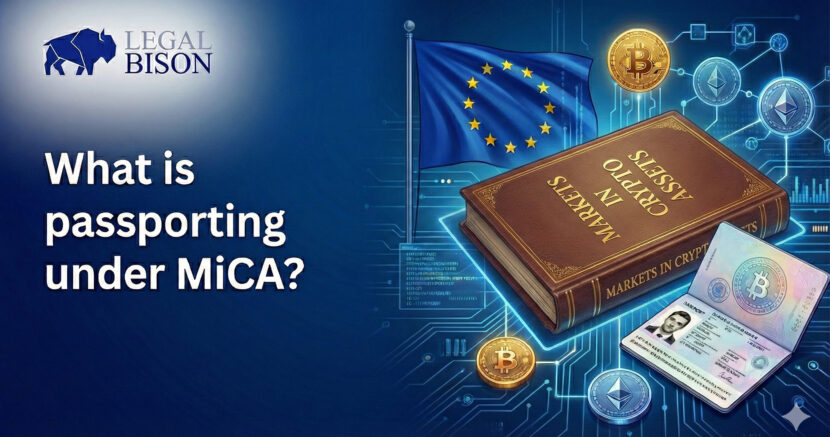
What Is Passporting Under MiCA? EU Crypto License Explained
The concept of passporting is the “holy grail” for crypto entrepreneurs looking to scale. In the 2026 regulatory landscape, understanding this mechanism is the difference between a fragmented, high-cost operation and a streamlined European powerhouse.
Adrien MarchandAssociate at LegalBison
Mar, 18 20266 minutes
For years, Virtual Asset Service Providers (VASPs) had to navigate a patchwork of national registrations. A registration in France did not allow you to solicit clients in Germany, and a license in Lithuania was valid only within its borders. With the full application of the Markets in Crypto-Assets Regulation (MiCA), this barriers-to-entry model has been dismantled.
MiCA passporting enables a licensed entity to offer its services across the entire European Economic Area (EEA) without establishing a physical presence or obtaining a new license in each country.
This guide details how this mechanism works, the specific notification procedures, and the strategic advantages for your crypto business.
Before MiCA, a crypto company needed to collect national registrations one by one. Now, the logic is simple: you obtain a Crypto-Asset Service Provider (CASP) license in one EU country (your home member state), and that license acts as a passport to the entire European Economic Area.
Under Article 59 of MiCA, once a legal person is authorised as a CASP in accordance with Article 63, they are allowed to provide crypto-asset services throughout the Union. This can be done either through the right of establishment (opening a branch) or, more importantly for digital businesses, through the freedom to provide services.
Crucially, the regulation explicitly states that CASPs providing services on a cross-border basis “shall not be required to have a physical presence in the territory of a host Member State”. This removes the immense capital expenditure previously required to set up local offices and hire local directors in every jurisdiction where you wanted to onboard users.
How it actually works: the notification process
Passporting is not an automatic right you exercise in silence. It follows a specific legal procedure outlined in Article 65 of the regulation. You cannot simply start marketing to Germans the day after you get your Polish license. You must follow the notification protocol.
The application
First, you must successfully obtain CASP authorization from the National Competent Authority (NCA) in your chosen EU country (e.g., Malta, Estonia, or Poland). This involves meeting the governance, prudential, and operational requirements of Title V of MiCA.
The notification
Once authorized, or when you decide to expand, you must submit specific information to the competent authority of your home Member State. According to Article 65(1), this submission must include:
A list of the Member States where you intend to provide cross-border crypto services EU;
The specific crypto-asset services you intend to provide on a cross-border basis;
The starting date of the intended provision of services;
A list of all other activities provided by your company not covered by MiCA.
The communication window
You do not send this information to the 27 other regulators yourself. Your home regulator does it for you. Within 10 working days of receiving your information, your home competent authority must communicate it to:
The single points of contact of the host Member States;
The European Securities and Markets Authority (ESMA);
The European Banking Authority (EBA).
The green light
You do not need to wait for a “stamp of approval” from the host regulators. Under Article 65(4), you may begin to provide crypto-asset services in the host Member State from the date you receive confirmation that the communication has been made, or at the latest, from the 15th calendar day after you submitted the information to your home regulator.
This strict timeline prevents host regulators from “pocket vetoing” your entry by delaying their review. If you have filed correctly, you can launch in 15 days.
The “access” is not just about geography; it is about infrastructure and trust. By securing a single EU crypto license and utilizing passporting, you unlock significant operational advantages.
450 million consumers
You gain legal access to one of the largest retail and institutional markets in the world. Marketing communications can be legally targeted at residents in France, Germany, Italy, and beyond, provided they are fair, clear, and not misleading.
Institutional credibility
Upon successful notification, your CASP will be listed on the centralized ESMA register. Article 109 mandates that ESMA establishes a public register of all crypto-asset service providers, including the list of host Member States where they provide services;.
Being on the ESMA register is a signal to traditional banks and partners that you are a fully regulated entity under EU law. This makes opening corporate accounts, integrating fiat rails, and securing lines of credit significantly easier than for offshore entities.
Zero local substance requirements
As noted in Article 59(7), passporting into a second or third country typically does not require you to open a local office or hire local directors in those host states. This allows you to centralize your compliance, legal, and technical teams in your home Member State, creating massive economies of scale.
Regulatory peace of mind
You largely answer to your home regulator for your core business operations. While host Member States have some powers to intervene in emergencies or regarding specific marketing infringements, the primary supervision remains with the authority that granted your license. This eliminates the complexity of juggling 27 different sets of supervisory expectations.
The strategic value of MiCA passporting becomes clear when looking at the costs. While a MiCA license may have an upfront cost ranging from 60,000 EUR to 150,000 EUR depending on the complexity and jurisdiction, the marginal cost of “adding a country” via passporting is nearly zero.
Compare this to the pre-MiCA regime, where accessing the French market required a PSAN registration, accessing Italy required an OAM registration, and accessing Germany required a BaFin license—each coming with its own legal fees, application fees, and local staffing requirements. Under MiCA, one investment opens the entire continent.
The window to prepare is narrowing. With Titles III and IV already applicable and the full regulation coming into force by December 2024, the race to secure a home Member State authorization is underway.
Contact LegalBison today to identify the best EU jurisdiction for your CASP license and start your journey to 27 markets.
Selecting the ideal home for a MiCA license often comes down to a choice between Malta’s specialized speed and Ireland’s institutional prestige. This comparison examines how Malta’s mature ecosystem and tax efficiency stack up against Ireland’s high-tier regulatory reputation to help you determine the best launchpad for your pan-European operations.
The passing of the Markets in Crypto Assets (MiCA) Regulation in the EU changes the classification of cryptocurrencies. European lawmakers now distinguish three categories of crypto-assets: Asset-Referenced Tokens (ART), Electronic Money Token (EMT) and a third category that includes all assets not falling into the two first classes. LegalBison's lawyers dive into details in this article.
Anastasia MarchenkoLegal Researcher at LegalBison
Contact Us
LegalBisonExperts & FinTech Lawyers
LegalBison’s experts and FinTech lawyers will glady invite you to a free consultation.