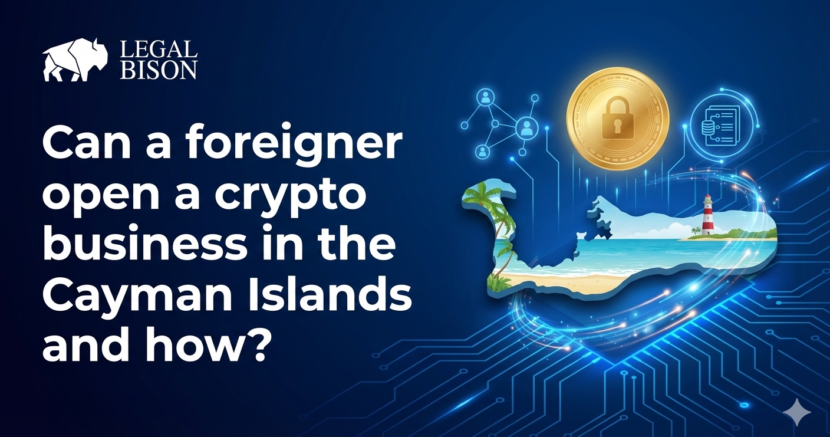
Can a Foreigner Open a Crypto Business in the Cayman Islands and How?
The Cayman Islands offers a premier offshore environment where foreign entrepreneurs can establish and manage a regulated crypto business entirely from abroad. This guide explores how the updated legal framework for 2026 provides tax neutrality and a structured path for virtual asset service providers to operate globally.
Anastasia MarchenkoLegal Researcher at LegalBison
Feb, 20 20267 minutes
The definite answer is: yes. Foreigners can seamlessly open a crypto business in the Cayman Islands without the need to be a resident or physically visit the territory. The jurisdiction is specifically structured to support international business through entities known as Exempted Companies, which are designed for operations conducted mainly outside the Islands.
The legal framework actively supports remote management, permitting electronic business and the electronic filing of documents. The Cayman Islands remains a globally recognised premium offshore financial centre for digital assets. The primary hooks drawing blockchain entrepreneurs to the region include an environment of political stability, a highly favourable business landscape, and the recent removal of the jurisdiction from the Financial Action Task Force (FATF) grey list.
Furthermore, the jurisdiction is renowned for its tax neutrality, offering 0% corporate tax for international businesses.
LegalBison is your expert navigator for complex offshore licensing. We handle the heavy lifting of compliance and corporate structuring, ensuring your Cayman Islands crypto business operates flawlessly from day one.
Understanding the legal framework (VASP Act 2024 to 2026)
The primary watchdog regulating the financial services sector is the Cayman Islands Monetary Authority, commonly referred to as CIMA. It is responsible for issuing guidance and monitoring compliance to prevent financial businesses from being used for money laundering, terrorist financing, or the proliferation of weapons of mass destruction.
All virtual asset services are strictly regulated under the Virtual Asset (Service Providers) Act, which defines the entities that fall under the scope of a virtual asset service provider. Any entity that wishes to issue tokens, operate an exchange, or provide custody services must comply with this comprehensive regime.
As of April 1, 2025, trading platforms and custodians must hold a full crypto license, not just a registration. This is a major compliance shift that impacts how digital asset businesses scale and operate.
Step-by-step: How to open a crypto business in the Cayman Islands
Step 1: Company formation
You must incorporate a local legal entity because foreigners cannot operate as individuals in this regulated space. An Exempted Company is the most common vehicle, as it is prohibited from carrying on a trade or business locally except in furtherance of its international operations.
When forming the company, you must file a memorandum of association containing the company name, the proposed registered office in the Islands, and the amount of capital divided into shares. DAOs can utilise a Cayman Foundation Company as a legal wrapper for Decentralised Autonomous Organisations, providing an ownerless structure with no shareholders;
You may register as a Segregated Portfolio Company (SPC). An SPC is highly beneficial for managing multiple strategies because the assets and liabilities of one segregated portfolio are legally protected from the liabilities of another. The proceeds from the issue of shares within a specific segregated portfolio are accounted for solely within that portfolio;
Step 2: Determining your license type
Registered Person: This pathway is typically required for token issuers or businesses engaging in lower-risk virtual asset activities;
VASP License (Full): This comprehensive authorisation is mandatory for centralised exchanges and custodians;
Sandbox License: This flexible license is designed for cutting-edge innovators needing a 12-month testing ground under regulatory supervision;
Step 3: Meeting CIMA requirements
3-Director Rule: You must have at least three directors, one of whom must be independent.
Key Personnel: You must designate a person at the managerial level as the Anti-Money Laundering Compliance Officer (AMLCO) to ensure adherence to compliance programs. You must appoint a Money Laundering Reporting Officer (MLRO) and a Deputy MLRO to consider internal reports of suspicious activity and report them to the Financial Reporting Authority.
The “Fit and Proper” Test: All connected persons, directors, and beneficial owners will face strict background checks by CIMA to assess their probity, competence, and soundness of judgment. The regulator will review past conduct to ensure no involvement in fraud, deceitful business practices, or previous breaches of financial regulations.
Your governing body must demonstrate independence from management and exercise oversight over the development and performance of internal controls. Management must implement three lines of defence, which include front-line personnel handling day-to-day activities, business-enabling functions evaluating adherence, and internal auditors assessing the controls.
On average, the process of forming and authorising a crypto company in the Cayman Islands takes 4 to 10 months. Registration is generally faster at 2 to 4 months, while full licensing takes longer.
Government Fees
Application Fee: Approximately KYD 1,000 to 5,000;
License Grant Fee: KYD 100,000 for trading platforms;
Annual Renewal: Depends on your specific revenue and business model;
Extra costs will include maintaining a registered office (address) in the Cayman Islands to which all communications and notices may be addressed. You will also need to account for professional fees.
Regulated entities must conduct an effective and comprehensive audit of their internal control systems using operationally independent staff. Furthermore, exempted companies must pay an annual registry fee based on their registered capital.
As of January 1, 2026, the Crypto-Asset Reporting Framework will require Cayman entities to report crypto exchanges and transfers to the Department for International Tax Cooperation annually. Pure holding companies or intellectual property businesses must show substance through local presence and expenditure in the Cayman Islands.
There is also mandatory compliance for transfers of virtual assets as per the Travel Rule:
Originating virtual asset service providers must collect, record, and verify the name and account number of both the originator and the beneficiary;
This highly sensitive information must be kept secure and retained for a period of at least five years;
Intermediary virtual asset service providers must ensure that all collected information remains with the transfer across the payment chain;
Beneficiary service providers must have robust systems in place to detect missing information and must adopt risk-based procedures to execute, reject, or suspend non-compliant transfers;
If a batch file transfer is utilised, the batch must contain the originator’s name, account number, and address, along with traceable details for every beneficiary involved;
Technical limitations cannot be used as an excuse to bypass these rules. If a system prevents information from accompanying the transfer, the intermediary must keep a manual record of all received information for at least five years.
Banking and tax implications
The Cayman Islands offers an incredibly attractive environment, commonly celebrated for 0% corporate, capital gains, and withholding tax. Exempted companies enjoy freedom from direct taxation on profits, allowing digital asset businesses to scale globally with highly optimised capital efficiency.
Opening a corporate bank account is entirely possible but requires a rigorous explanation of your Source of Wealth. Anti-money laundering regulations require financial businesses to take reasonable measures to establish the source of wealth and the source of funds of the persons involved in the business relationship. If you are onboarding clients through an eligible introducer, that introducer must provide a written assurance confirming that they have identified the source of the applicant’s funds.
You must scrutinise transactions throughout the course of a business relationship to ensure they are consistent with your knowledge of the customer’s risk profile and source of funds. If you are unable to satisfy these rigorous due diligence measures, you must refuse the transaction, terminate the business relationship, and consider filing a suspicious activity report.
Why LegalBison?
The Cayman Islands remains a premium jurisdiction for cryptocurrency and blockchain projects. However, the bar for entry and ongoing compliance has been raised significantly from 2025 and 2026. Regulatory obligations surrounding the Travel Rule, internal controls, and corporate structuring require precise execution.
Do not navigate CIMA applications and the Virtual Asset Service Providers regime alone. Contact LegalBison to structure your Cayman VASP license or DAO Foundation today. Our legal experts are fully equipped to guide your project to international success.
With the implementation of the Markets in Crypto-Assets (MiCA) Regulation and the national Digital Finance Act (Act No. 31/2025 Coll.), the Czech Republic has transitioned from a simple registration-based system to a sophisticated licensing regime. The evolving regulatory landscape for crypto companies in the Czech Republic and the EU is shaping new opportunities and compliance requirements for market participants.
The passing of the Markets in Crypto Assets (MiCA) Regulation in the EU changes the classification of cryptocurrencies. European lawmakers now distinguish three categories of crypto-assets: Asset-Referenced Tokens (ART), Electronic Money Token (EMT) and a third category that includes all assets not falling into the two first classes. LegalBison's lawyers dive into details in this article.
Anastasia MarchenkoLegal Researcher at LegalBison
Contact Us
LegalBisonExperts & FinTech Lawyers
LegalBison’s experts and FinTech lawyers will glady invite you to a free consultation.