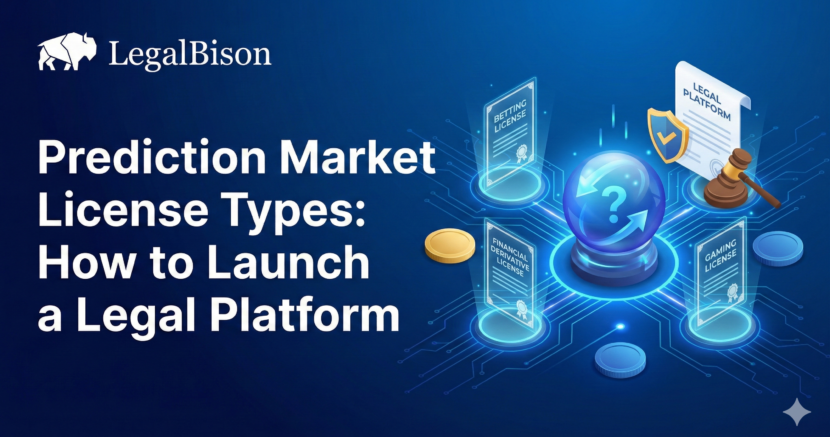
Prediction Market License Types: How to Launch a Platform Legally
Prediction markets have transformed from experimental tools into regulated financial engines that define the global landscape of 2026. Launching a successful platform requires a strategic approach to licensing to ensure compliance across various international jurisdictions.
Anastasia MarchenkoLegal Researcher at LegalBison
Mar, 02 20269 minutes
The year 2026 has officially marked the era of the event contract. Prediction markets have shed their image as niche experiments for political enthusiasts and moved into the center of the global financial stage. Future prediction platforms like Kalshi and Polymarket are no longer just applications: they have become the primary sources of truth for everything from central bank interest rate hikes to the outcome of international awards and sporting events.
The boom of 2026 is driven by a fundamental shift in how the world views information. Prediction markets provide a real-time, capital-weighted consensus that traditional polling and punditry simply cannot match. However, with billions of dollars in volume comes intense regulatory scrutiny. The industry is currently bifurcating into two distinct legal paths: regulated financial exchanges overseen by federal authorities and decentralized, offshore crypto protocols.
To capture this growing market, choosing the right legal vehicle is the most critical decision an operator will make. At LegalBison, we provide the specializedlegal services required to handle the complex world of licensing and corporate structuring so you can focus on building the technology that powers the next generation of truth.
The gold standard: US federal regulation (CFTC)
For many operators, the ultimate goal is the legitimacy and scale that comes with US federal approval. This path has a high barrier to entry, but it offers the highest level of protection and the widest possible market reach.
Designated contract markets (DCM)
The primary license type for a prediction market in the US is the Designated Contract Market (DCM) license, issued by the Commodity Futures Trading Commission (CFTC). By obtaining this license, a platform is classified as a financial derivatives exchange rather than a sportsbook. This distinction is vital because it allows the platform to operate legally in almost all 50 states by preempting state-level gambling laws that otherwise restrict sports wagering.
Platforms like Kalshi and Interactive Brokers’ ForecastEx have led this charge. They treat every market, whether it is a yes/no on an inflation report or a sports result, as a binary option contract. This classification moves the activity from the world of betting into the world of hedging and risk management.
The PredictIt and Polymarket precedents
The landscape changed significantly in September 2025 when PredictIt transitioned from its long-standing no action letter status as an academic project to receiving full DCM and DCO (Derivatives Clearing Organization) approval. This move proved that the CFTC is willing to formalize even the most complex, politically oriented markets under a standard regulatory framework.
Perhaps more interesting for new entrants is the Trojan Horse strategy employed by Polymarket. After being blocked from the US for years, Polymarket successfully re-entered the market in late 2025 by acquiring QCEX, an existing CFTC-licensed exchange. This proved that mergers and acquisitions are a viable shortcut to licensure for well-funded platforms looking to bypass the lengthy application process.
If the DCM path represents the marathon, the sweepstakes model is the sprint. For many startups in 2026, this has become the preferred way to achieve rapid speed to market without the immediate burden of federal financial licenses or the need for a traditionalgambling license.
How the dual-currency model works
The sweepstakes model relies on a legal framework that has supported social casinos for decades. Instead of betting real money directly, users interact with two different currencies. The first is a Gold Coin used for fun or practice with no monetary value. The second is a Sweeps Coin or Prize Credit that is provided for free as a bonus when purchasing Gold Coins or via a mail-in entry.
Platforms like Novig and ProphetX have successfully used this model to offer peer-to-peer sports and event trading. Because the Sweeps Coins are technically provided for free, the activity does not meet the three-pronged legal definition of gambling: prize, chance, and consideration. By removing consideration, these platforms operate as promotional sweepstakes rather than betting houses.
Jurisdiction and compliance
Currently, the sweepstakes model is considered legal in more than 40 US states. This allows platforms to bypass the need for individual state-by-state sports betting licenses, which are notoriously expensive and restricted to a few dozen operators.
However, this requires incredibly precise corporate structuring to ensure the free-to-play element holds up against scrutiny. Regulators in states like New York and California have begun looking closer at social sportsbooks in early 2026. To survive, your terms of service must be bulletproof against claims that the coins are a disguised form of currency.
The crypto-native route: Global VASP and offshore structuring
For platforms that want to leverage the speed of blockchain and global liquidity, the crypto-native route remains the most innovative path. This approach often combines offshore corporate hubs with modern European crypto licenses.
MiCA and the CASP revolution
In Europe, the Markets in Crypto-Assets (MiCA) regulation is now fully operational. As of 2025, the old VASP (Virtual Asset Service Provider) designations have been largely replaced by the CASP (Crypto-Asset Service Provider) designation. Obtaining acrypto license under MiCA is the most efficient way to access the European market.
The primary advantage of a CASP license is passporting. If you obtain your license in a tech-friendly member state like Poland, Lithuania, or France, you are legally authorized to offer your services across all 27 EU member states. For a prediction market, this provides a massive, unified audience under a single regulatory umbrella.
The Polymarket model and GameFi
Many decentralized protocols utilize offshore foundations in jurisdictions like Panama or the Cayman Islands. These foundations often hold the intellectual property or act as the steward for the protocol’s DAO (Decentralized Autonomous Organization). This structure is frequently used by projects that blur the lines between prediction markets andGameFi, where users are rewarded with tokens for providing accurate predictions or oracling real-world data.
In this model, the legal argument is often that the developers are merely writing open-source software, while the users interact with autonomous smart contracts. However, to provide a bridge to the real world, these platforms usually register a separate entity as a VASP to handle stablecoin (USDC) on-ramps and off-ramps.
Decentralized protocols: Azuro and Drift
Newer protocols like Azuro and Drift (BET) have automated the house role entirely. Instead of an operator taking the other side of a bet, liquidity is provided by decentralized pools. This shifts the legal burden away from being an operator to being a software developer in some jurisdictions, though this area remains a high-focus zone for international regulators in 2026.
State-level sports betting licenses (the hybrid approach)
While federal and crypto paths dominate the headlines, the traditional gambling industry is not standing still. Major sportsbooks are attempting to incorporate prediction markets into their existing ecosystems using standard state-level licensing.
The predicts products
DraftKings and FanDuel have launched Predictions verticals under their existing state-level sports wagering licenses. These allow users to bet on non-sports outcomes (like the Oscars or weather) alongside their usual NFL bets.
However, this route is plagued by market fragmentation. Because these platforms operate under state licenses, their prediction markets are only available in the specific states where they are licensed. This prevents the massive, national liquidity pools that make platforms like Kalshi so effective.
The Nevada vs. CFTC battle
There is also a significant legal conflict brewing. State regulators, particularly in Nevada, are fighting the rise of prediction markets. They argue that if a prediction market offers sports-related contracts, it should be taxed and regulated as a sportsbook.
Some operators find that securing anoffshore gambling license in a jurisdiction like Anjouan or Curacao provides a more flexible middle ground for international users, though it does not solve the entry requirements for the US market. This state vs. federal showdown is expected to reach the US Supreme Court by the end of 2026.
How to start a prediction market platform
Launching a platform in 2026 requires a multi-layered strategy that addresses corporate law, financial licensing, and technical architecture.
Corporate formation
The first step is deciding where your brain will live. Yourcompany registration choice will dictate your regulatory ceiling.
For a DCM path: You almost certainly need a US-based C-Corp to interface with the CFTC and US banking institutions;
For a Crypto path: An EU-based entity (for CASP/MiCA) or a dual structure involving an offshore foundation (Panama/Cayman) and an operational subsidiary is the standard;
For a Sweepstakes path: A US LLC or C-Corp with a complex structure involving separate entities for coin sales and prize fulfillment is required.
Licensing strategy
The licensing choice dictates your product roadmap. A strategic evaluation of the following factors is necessary:
VASP vs. Gambling license: Determining if your asset is a virtual asset or a wager;
Passporting capabilities: Evaluating if one license can serve multiple markets;
Reporting obligations: Assessing the cost of ongoing compliance and audit requirements.
Banking and payments
Liquidity is the lifeblood of any market. You must decide how your users will settle their contracts:
Fiat rails: Requires a partnership with a bank or an Electronic Money Institution (EMI). This is standard for DCM and Sweepstakes models;
Stablecoin settlement: Utilising USDC or EURC allows for instant settlement and global access, but requires a CASP license to handle the custody of these assets;
P2P settlement: Using smart contracts to automate the flow of funds without the operator ever touching the assets.
Conclusion
The prediction market industry in 2026 is no longer a gray area. It has matured into a complex, multi-jurisdictional financial sector. Whether you choose the high-legitimacy route of a US DCM, the agile sweepstakes model, or the borderless potential of a MiCA-authorized crypto platform, the legal foundation you build today will determine your ability to scale tomorrow.
The window for entering the market is wide open, but the regulatory perimeters are closing. Professional guidance is the difference between a successful launch and a regulatory shutdown.
With the implementation of the Markets in Crypto-Assets (MiCA) Regulation and the national Digital Finance Act (Act No. 31/2025 Coll.), the Czech Republic has transitioned from a simple registration-based system to a sophisticated licensing regime. The evolving regulatory landscape for crypto companies in the Czech Republic and the EU is shaping new opportunities and compliance requirements for market participants.
The passing of the Markets in Crypto Assets (MiCA) Regulation in the EU changes the classification of cryptocurrencies. European lawmakers now distinguish three categories of crypto-assets: Asset-Referenced Tokens (ART), Electronic Money Token (EMT) and a third category that includes all assets not falling into the two first classes. LegalBison's lawyers dive into details in this article.
Anastasia MarchenkoLegal Researcher at LegalBison
Contact Us
LegalBisonExperts & FinTech Lawyers
LegalBison’s experts and FinTech lawyers will glady invite you to a free consultation.