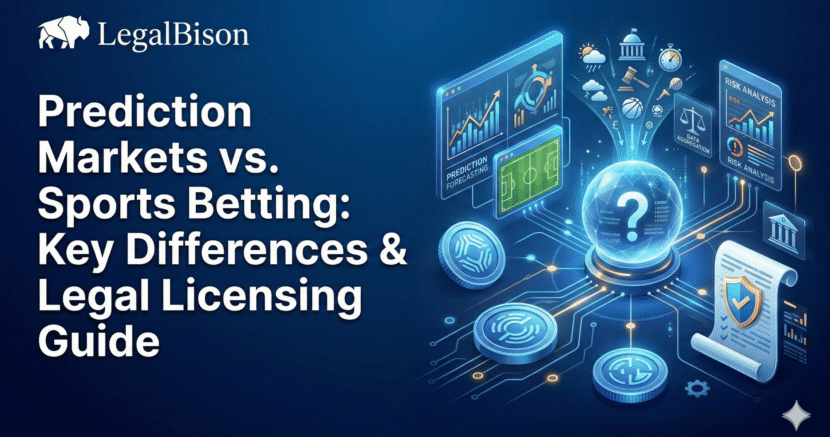
As platforms like Polymarket and Kalshi gain mainstream traction, the line between financial trading and traditional sports betting is becoming increasingly blurred. Understanding the structural, legal, and licensing differences between prediction markets and sportsbooks is essential for founders and investors who want to launch compliant, scalable, and legally sound platforms.
Anastasia MarchenkoLegal Researcher at LegalBison
Mar, 02 20269 minutes
The global landscape of digital wagering and event forecasting is currently undergoing a radical transformation. The explosion of prediction market platforms like Polymarket and Kalshi has blurred the lines between what the public perceives as financial trading and what has traditionally been classified as gambling. During major global events, such as elections or economic shifts, these platforms often see billions of dollars in volume, drawing users who might never step foot in a casino or open a traditional sportsbook app.
While these platforms look remarkably similar to the end-user, they operate on fundamentally different economic and legal rails. For an entrepreneur or an institutional investor, confusing the two is a high-stakes error. Choosing the wrong business structure or applying for an unsuitable license can lead to regulatory shutdowns, heavy fines, or even criminal charges.
At LegalBison, we emphasize that the distinction between a prediction market and a sportsbook is not just a matter of branding: it is a matter of law. Propercompany registration is the foundation, but the license you build upon that foundation determines your entire operational trajectory.
The core mechanics: how they work
To understand the regulatory divide, one must first look at the mathematical and economic engines driving these platforms. Although both allow a user to profit from a future event, the way that profit is generated follows two distinct paths.
Sports betting (the house model)
Sports betting is built on the House Model, where the operator acts as the counterparty to every transaction. When a user places a bet on a football match, they are effectively entering into a contract with the bookmaker.
Users bet against the House or bookmaker;
Odds are fixed at the time of the bet and are set by the operator based on statistical models and risk management;
The house includes a built-in margin called the vig or juice, which typically ranges from 4% to 10%;
The primary focus is on entertainment and consumption;
The operator takes on market risk, meaning that if many users win, the house loses money.
In this model, the bookmaker is incentivized to balance their books so they can profit from the margin regardless of the outcome. It is a service-based model where the product is the opportunity to wager. To do this legally, an operator must secure agambling license that covers fixed-odds betting.
Prediction markets (the market model)
Prediction markets operate on the Market Model or a peer-to-peer structure. These platforms do not act as the bookmaker. Instead, they provide the infrastructure for users to trade against one another.
Users trade contracts against other users in a decentralized or centralized exchange environment;
Prices function like shares (0 to 100 cents), representing the market consensus probability;
No vig is present: platforms charge explicit trading or withdrawal fees;
The focus is on price discovery and information gathering.
Mathematically, the price of a contract represents the aggregate probability perceived by the market. For instance, if a contract for Inflation hits 3% is trading at 60 cents, the market believes there is a 60% chance of that outcome. In this scenario, the platform operator carries no market risk. They are a neutral venue, much like a stock exchange, where the value of a contract is determined solely by supply and demand.
The legal and regulatory divide
The distinction in mechanics leads directly to a divergence in how these businesses are governed. This is the most critical hurdle for any platform founder.
Sports betting regulation
In almost every jurisdiction, sports betting is classified explicitly as gambling. This classification brings with it a specific set of rigorous requirements. In the United States, regulation happens state-by-state. Globally, countries like Malta, Curacao, or the United Kingdom have established gambling commissions. Many operators seeking global reach without the friction of multiple local licenses opt for anoffshore gambling license to centralize their operations.
These regulators focus heavily on:
Strict requirements for responsible gambling tools, such as self-exclusion lists and deposit limits;
Anti-money laundering (AML) and know your customer (KYC) protocols tailored to high-velocity betting;
Technical audits of the Random Number Generators or the fairness of the odds-making process;
High taxation rates on Gross Gaming Revenue (GGR).
Prediction market regulation
Prediction markets are rarely governed by gambling boards. Instead, they are often classified as derivatives, event contracts, or swaps. This moves the regulatory oversight from gaming commissions to financial conduct authorities.
In the United States, prediction markets fall under the jurisdiction of theCFTC (Commodity Futures Trading Commission), not state gaming boards. This was evidenced by the landmark legal battles involving Kalshi and PredictIt. The CFTC views these contracts as financial instruments that allow for hedging and economic forecasting.
LegalBison insight: The compliance burden for a financial exchange is often higher in terms of capital requirements and reporting, but it avoids the stigma and certain restrictive taxes associated with gambling. For crypto-based prediction markets, such as those built on DeFi protocols, obtaining acrypto license is often required to operate globally while managing liability and ensuring access to banking rails.
Financial implications for operators and users
The choice between these two models changes the entire financial profile of the business. This affects everything from how the company is taxed to how it maintains liquidity.
Taxation and reporting
For the end-user, the difference is felt most acutely during tax season. In many jurisdictions, sports betting winnings are treated as gambling income. In the US, this is reported via Form W-2G. Gambling losses can often only be deducted up to the amount of winnings, and the rules are generally less favorable than those for investments.
Prediction market profits, conversely, are often treated as Capital Gains and reported via Form 1099-B. This allows users to treat their activity as professional trading, potentially benefiting from different tax rates and the ability to carry over losses. For the operator, managing these different reporting requirements is a significant operational task that must be automated from day one.
Liquidity and market making
A sportsbook must have deep pockets to cover successful bets. They hire oddsmakers and risk managers to ensure that the house is not exposed to too much liability on a single event.
Prediction markets rely on a different mechanism: market makers. Because the platform is an exchange, it needs liquidity so that users can enter and exit positions at fair prices. Operators often have to incentivize liquidity providers to remain on the platform. If there are no buyers for a contract, the market stalls, which can be fatal for a new platform.
Launching your platform: fintech or gambling?
When you approach LegalBison to start your journey, the first question we will help you answer is: Are you building an entertainment product or a financial instrument?
The fintech path
If you are building a Kalshi-style app where users trade on the outcome of the Federal Reserve’s interest rate decisions or the release date of a new movie, you are building a fintech financial exchange. Your path involves:
Securing a derivatives or exchange license;
Implementing institutional-grade KYC/AML;
Ensuring your platform can handle high-frequency trading data;
Establishing a legal framework that defines your event contracts as financial products;
The gambling path
If you are building a DraftKings-style app focused on the NBA, NFL, or horse racing, you are building a digital casino. Your path involves:
Applying for gambling licenses in specific target jurisdictions;
Partnering with data providers like Sportradar for official league data;
Setting up Responsible Gambling infrastructure;
Paying gaming-specific taxes on your revenue.
The crypto and DeFi evolution
The rise of Web3 has introduced a third path. Many prediction markets now operate on-chain, using stablecoins for liquidity and decentralized oracles to settle results. This often falls into the burgeoning category ofgamefi, where financial incentives meet game-like mechanics.
While unregulated crypto markets exist, they are increasingly targeted by regulators. Sustainable growth in the crypto space requires a legal wrapper. This allows a crypto prediction market to maintain its decentralized nature while providing the legal protection necessary to partner with payment processors and traditional marketing agencies.
Beyond the legalities, the classification dictates your marketing strategy. Gambling platforms are often restricted from advertising on certain social media channels or in specific regions. They must include prominent warnings about addiction and are subject to geofencing requirements.
Prediction markets, marketed as information markets or hedging tools, can often access a broader range of advertising channels. They appeal to a demographic of traders rather than gamblers. This distinction can be the difference between being perceived as a high-tech financial tool or a digital bookie.
Operational risks and compliance
Regardless of the model chosen, the operational risks are high. For prediction markets, Oracle risk is a primary concern. If the source of truth for an event outcome is compromised, the market settlements could be invalidated, leading to massive user disputes. For sportsbooks, the risk is mathematical: a single black swan sporting event could wipe out the operator’s reserves if the books are not balanced correctly.
Ourlegal services at LegalBison are designed to mitigate these risks through structural planning. We assist in drafting terms of service that clearly define the settlement process and help establish dispute resolution mechanisms that satisfy regulators and users alike.
Conclusion
The decision to launch a prediction market versus a sports betting platform is one of the most consequential choices a founder can make. While the end goal of allowing users to profit from their knowledge of future events is the same, the paths to compliance are worlds apart.
One path leads to the world of gambling commissions, state-by-state licensing, and entertainment-focused regulation. The other leads to the world of financial derivatives, exchange licenses, and capital gains taxation. Failing to recognize which category your platform falls into can result in years of legal battles and the potential loss of your business.
At LegalBison, we specialize in helping innovators navigate these complex regulatory waters. Whether you are looking to disrupt the sports betting industry or build the next great information exchange, we provide the legal expertise to ensure your platform is built on a solid foundation.
Unsure if your platform is a sportsbook or a prediction market?
With the implementation of the Markets in Crypto-Assets (MiCA) Regulation and the national Digital Finance Act (Act No. 31/2025 Coll.), the Czech Republic has transitioned from a simple registration-based system to a sophisticated licensing regime. The evolving regulatory landscape for crypto companies in the Czech Republic and the EU is shaping new opportunities and compliance requirements for market participants.
The passing of the Markets in Crypto Assets (MiCA) Regulation in the EU changes the classification of cryptocurrencies. European lawmakers now distinguish three categories of crypto-assets: Asset-Referenced Tokens (ART), Electronic Money Token (EMT) and a third category that includes all assets not falling into the two first classes. LegalBison's lawyers dive into details in this article.
Anastasia MarchenkoLegal Researcher at LegalBison
Contact Us
LegalBisonExperts & FinTech Lawyers
LegalBison’s experts and FinTech lawyers will glady invite you to a free consultation.