Tokenomics Explained: The Basics of Crypto Economics 101 & Legal Compliance
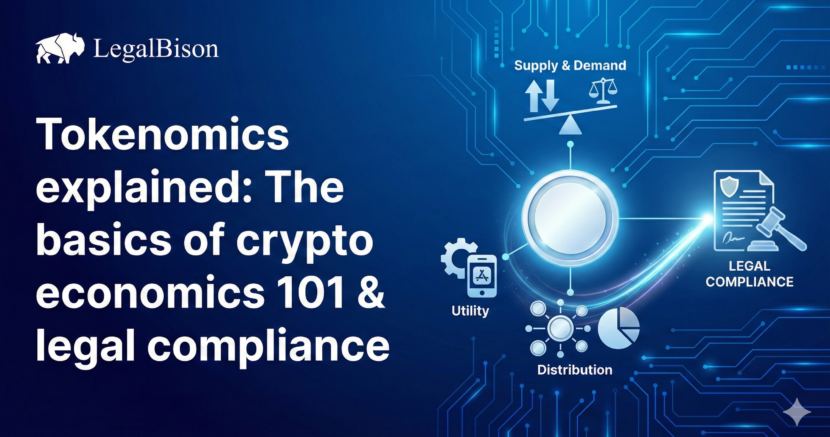
Tokenomics serves as the essential architectural blueprint for decentralized protocols by defining how value is created and distributed among participants. This guide explores the fundamental principles of crypto economics alongside the legal frameworks necessary to ensure long term project sustainability.
Anastasia MarchenkoLegal Researcher at LegalBison
Mar, 10 20269 minutes
In the traditional world of finance, a company is judged by its balance sheet, its revenue growth, and its cash flow.
In the decentralised world of Web3, these metrics are often replaced or augmented by a complex framework known as tokenomics.
If you are building a decentralised protocol, tokenomics is your business model. It is the architectural blueprint that determines how value is created, captured, and distributed among participants.
Tokenomics is a portmanteau of token and economics. It refers to the study of the mathematical and behavioural factors that govern a crypto asset. This includes the total supply of the asset, how it is distributed to the community, and what incentives exist to encourage users to hold or use the token. Without a robust economic design, even the most innovative technology is likely to fail.
The stakes for getting this right are incredibly high. Data suggests that approximately 80% of newly listed tokens experience a significant decline in value shortly after their market debut. This is often the result of low float, high FDV structures, where only a tiny fraction of the supply is available for trading while the fully diluted valuation remains artificially inflated. When early investors or team members finally unlock their holdings, the market is flooded, and the price collapses.
However, good tokenomics is not just about clever math or market timing. It is fundamentally about legal sustainability. A token that functions like a dividend-paying share but lacks the necessary financial licenses is not an innovative asset; it is a regulatory liability.
At LegalBison, we see many founders overlook the fact that their economic incentives might inadvertently classify their project as a security, leading to severe legal consequences.
The supply side: Scarcity, inflation, and emissions
Every economic system begins with the management of supply. In crypto, we primarily distinguish between the maximum supply and the circulating supply. The maximum supply is the hard cap on how many tokens will ever exist. Bitcoin is the gold standard here, with a fixed limit of 21 million coins. This creates a predictable scarcity that appeals to those looking for a store of value asset.
In contrast, platforms like Ethereum use a dynamic supply model. Ethereum does not have a hard cap on its total supply; instead, it relies on an issuance rate to secure the network. This leads us to the debate between inflationary and deflationary models. An inflationary model continuously adds new tokens to the ecosystem, which can dilute the value for existing holders if demand does not keep pace.
To counter this, many projects implement burn mechanisms. For example, Ethereum’s EIP-1559 upgrade introduced a system where a portion of the transaction fees is permanently removed from circulation. This burning of tokens can make an asset deflationary during periods of high network activity, theoretically increasing the value of the remaining tokens.
From a legal perspective, these supply-side mechanics are not neutral. If a project performs buybacks or burns using its own revenue to specifically drive up the token price, it may begin to mimic the behaviour of a stock buyback or a dividend. Regulators often look at these actions as evidence of an expectation of profit derived from the efforts of the management team. This can trigger the application of securities laws, requiring the project to register with financial authorities or face enforcement actions.
The distribution phase: Allocation and fundraising
How a token enters the market is just as important as how many exist. In the early days of crypto, Initial Coin Offerings (ICOs) were the primary method of distribution. Today, the landscape is more varied, featuring Initial DEX Offerings (IDOs), private sales, and community-driven models like airdrops or mining rewards.
Paid models, such as private sales to venture capitalists, often utilise a SAFT (Simple Agreement for Future Tokens). This is a legal contract where investors provide capital today in exchange for tokens to be delivered once the network is functional. While efficient for raising capital, this method introduces significant risks if not managed correctly.
The risks of poor distribution
One of the most common pitfalls is the mismanagement of vesting cliffs. A cliff is a period during which tokens cannot be sold, followed by a gradual release. If a project allows a massive unlock of tokens for early investors without sufficient market demand, a price crash is inevitable. We have seen this with several high-profile projects where the sudden increase in circulating supply overwhelmed the market’s ability to absorb it.
Furthermore, free distribution models like airdrops are increasingly vulnerable to Sybil attacks. Research indicates that nearly 48% of airdropped tokens are often captured by farmers using fake wallets or automated scripts. This undermines the intent of building a real community and leaves the project with a high concentration of holders who have no long-term interest in the protocol.
Navigating these raises requires a high degree of compliance. Founders need robust SAFT agreements that are tailored to their specific jurisdiction. Additionally, obtaining a Token Legal Opinion is essential. This document, prepared by specialised lawyers, analyses the token’s features and distribution method to determine its likely regulatory status. This is often a requirement for listing on reputable exchanges.
Demand drivers: Utility and game theory
Supply is only one half of the equation; for a token to have value, there must be a reason for people to want it. We categorise these reasons into utility and speculation. Utility refers to the functional use cases of the token within its ecosystem.
Gas fees: Users must pay in the native token to process transactions (e.g., ETH on Ethereum);
Governance: Token holders can vote on protocol changes or treasury management (e.g., UNI for Uniswap);
Access: The token acts as a key to unlock specific services or premium features.
To move beyond simple utility, many projects employ game theory to align user behaviour with the health of the protocol. A popular example is the ve-model (voter-escrowed) pioneered by Curve Finance. In this system, users lock their tokens for a set period – sometimes up to four years – in exchange for higher rewards and increased voting power. This removes tokens from the liquid market and incentivises long-term thinking.
The regulatory check on demand
However, there is a fine line between game theory and regulated financial activity. If the primary driver for demand is the promise of passive income or staking rewards generated by the efforts of a centralised team, the token risks being classified as a security.
The SEC and other regional bodies frequently apply the Howey Test to see if there is an investment of money in a common enterprise with a reasonable expectation of profits to be derived from the efforts of others. If your tokenomics relies heavily on yield that looks like interest, you may be crossing into regulated territory.
Governance and corporate structure
Many Web3 projects aim for decentralisation through a DAO (Decentralised Autonomous Organisation). While the ideal is a community-led protocol, the reality is often different. Statistics show that in many major DAOs, the top 10% of holders control roughly 76% of the voting power. This concentration of power can lead to governance capture and centralised decision-making.
More importantly, a DAO is not a legal entity in its own right in most countries. This creates a significant problem: a DAO cannot sign a contract, it cannot legally hire employees, and it cannot easily pay taxes. Perhaps most dangerously, the members of an unwrapped DAO might be held personally liable for the organisation’s debts or legal mishaps.
The wrapper solution
The solution is a Legal Wrapper. This involves forming a traditional legal entity – such as a Foundation in Switzerland, a Limited Purpose Association in the Cayman Islands, or an LLC in Panama – to act on behalf of the DAO. This entity serves as the bridge between the digital world and the physical legal system. It holds the protocol’s treasury, pays for development, and provides a layer of limited liability protection for the participants.
At LegalBison, we specialise in helping founders select the right crypto-friendly jurisdiction. Whether it is the stability of Switzerland, the tax efficiency of the UAE, or the flexibility of Panama, housing your governance and treasury functions in a clear legal structure is a prerequisite for long-term survival.
Conclusion
Sustainable tokenomics is a balancing act between three pillars: Math, Community, and Law. The math ensures the system is economically viable and resistant to inflation. The community distribution ensures fairness and long-term alignment. The law ensures that the entire project does not come crashing down due to a regulatory intervention.
Designing a token economy is one of the most complex tasks a founder will face. Don’t guess on compliance. If you are preparing to launch a project, ensure you have the right foundations in place. Contact LegalBison today for a Token Legal Opinion and expert guidance on global entity formation strategies.
FAQ
What is the difference between a token and a coin?
A coin, like Bitcoin or Ether, is the native asset of its own blockchain. A token is built on top of an existing blockchain, such as an ERC-20 token on the Ethereum network.
How do I know if my token is a security?
This depends on the laws of the jurisdictions where you operate. Generally, if there is an investment of money with an expectation of profit from the work of a third party, it may be a security. A professional Token Legal Opinion is needed to clarify this.
Why do I need a legal entity for a DAO?
A legal entity, or wrapper, provides limited liability to the participants and allows the DAO to interact with the traditional financial and legal systems, such as opening a bank account or signing software licenses.
What is a SAFT?
A SAFT stands for Simple Agreement for Future Tokens. It is a legal contract used by developers to raise capital from accredited investors before the actual launching of a token.
Which country is best for a crypto project?
There is no single best country. The choice depends on your project’s goals, target market, and budget. Popular jurisdictions include Switzerland, the Cayman Islands, the UAE, and Panama.
With the implementation of the Markets in Crypto-Assets (MiCA) Regulation and the national Digital Finance Act (Act No. 31/2025 Coll.), the Czech Republic has transitioned from a simple registration-based system to a sophisticated licensing regime. The evolving regulatory landscape for crypto companies in the Czech Republic and the EU is shaping new opportunities and compliance requirements for market participants.
The passing of the Markets in Crypto Assets (MiCA) Regulation in the EU changes the classification of cryptocurrencies. European lawmakers now distinguish three categories of crypto-assets: Asset-Referenced Tokens (ART), Electronic Money Token (EMT) and a third category that includes all assets not falling into the two first classes. LegalBison's lawyers dive into details in this article.
Anastasia MarchenkoLegal Researcher at LegalBison
Contact Us
LegalBisonExperts & FinTech Lawyers
LegalBison’s experts and FinTech lawyers will glady invite you to a free consultation.