How Big Is the Gambling Industry?
Global online gambling market valuations for 2025 range from USD 85.31 billion to USD 130.20 billion. This global gambling industry revenue gap shows a methodological disagreement among analysts: some include grey-market volumes and unregulated channels, others do not. Either way, the growth trajectory is consistent: projections place the market at USD 212.44 billion by 2030 and up to USD 279.29 billion by 2034.
Online gambling holds approximately 63% of the total global market share. Land-based establishments hold the remaining 37%. The combination of mobile-first consumer behavior, expanding payment infrastructure, and new market licensing in jurisdictions like Brazil, the United States, and parts of Southeast Asia continues to push the online segment higher each year.
To founders, it means that the gambling market opportunities are countless, and they keep growing. The regulatory architecture required to access it legally is equally real and considerably more complex.
Related: Global Mobile Gambling Market Size by Region, Country, to Licensing
Sportsbook Revenue vs. Online Casino Profits
Online casino games are the largest vertical by participation, accounting for 37% of global engagement. Within that vertical, interactive slots (iSlots) dominate, capturing over 65% of casino revenue share. In Europe, online casinos represent 45% of online gross gaming revenue (GGR).
Sports betting follows at 31% of global participation, yet in major commercial markets, it can account for over 50% of total GGR. The driver is live in-play wagering, which now represents a significant portion of transactions globally (44%), though pre-match betting actually still represents the majority (63%) of sportsbook revenue in mature regulated markets like Europe. The Ontario regulated market illustrates the scale of this dynamic: in 2025, the province generated CAD 4.04 billion (approximately USD 2.98 billion USD) in total revenue, with online casinos contributing roughly 75% of that total and year-over-year growth running at 34%.
The Ontario figure is particularly instructive because it comes from a single Canadian province operating under a structured licensing regime (iGaming Ontario). It demonstrates what happens when regulatory clarity meets established consumer demand. The implication for market entry decisions is direct: jurisdictions that offer clear, enforceable licensing frameworks produce measurable commercial outcomes. Jurisdictions without them produce legal exposure.
Related: Prediction Market License Types: How to Launch a Platform Legally
Mobile Dominance and Payment Ecosystems
Mobile and tablet devices account for 58% to 74.5% of online gambling transactions globally (though this share reaches as high as 80.13% within the United States market). Despite this, desktop platforms retain a meaningful segment: they generate between 25.5% and 42% of total digital GGR, largely attributed to high-value players who prefer the interface for multi-table poker, complex live dealer environments, and extended session gaming.
Payment infrastructure is now a primary competitive variable. Seventy-six percent of all online players use cashless, digital payment pathways, relying on e-wallet integrations for rapid deposits and withdrawals. Platforms that cannot support frictionless payment flows, whether fiat or crypto, face a measurable drop-off at the deposit stage regardless of the quality of their gaming product.
This payment layer intersects directly with regulatory requirements. Anti-money laundering (AML) compliance, transaction monitoring obligations, and know-your-customer (KYC) protocols all attach to the payment infrastructure operators build. Licensing in most regulated markets requires documented compliance programs covering these areas before launch.
The Intersection of iGaming and Crypto: Why and When Do You Need a Crypto License
Approximately 18% of global online gambling operators currently accept cryptocurrency transactions. The commercial rationale is documented: blockchain integration supports faster payment processing, reduces transaction errors, and enables provably fair gaming mechanisms where players can cryptographically verify that outcomes have not been manipulated. The protection against payment fraud is an operationally significant benefit.
The legal question is where many operators underestimate their exposure. Accepting cryptocurrency deposits on a gambling platform triggers licensing requirements across multiple regulatory frameworks simultaneously. A platform operating under a gaming license in one jurisdiction may still require a separate virtual asset service provider (VASP) authorization, a crypto-asset service provider (CASP) registration under MiCA, or an equivalent digital asset license, depending on the jurisdictions it serves.
Related: How Does Bitcoin Casino Work? Exploring the Mechanic Behind This GameFi Industry
LegalBison’s crypto casino licensing practice and crypto license services address exactly this intersection. The firm’s approach treats crypto integration as a structural question, analyzed at the level of fund flows, custody arrangements, and jurisdictional triggers, before any application is filed.
Ready to tap into the billion-dollar iGaming market? Contact LegalBison to explore the best jurisdictions for your online casino company formation.
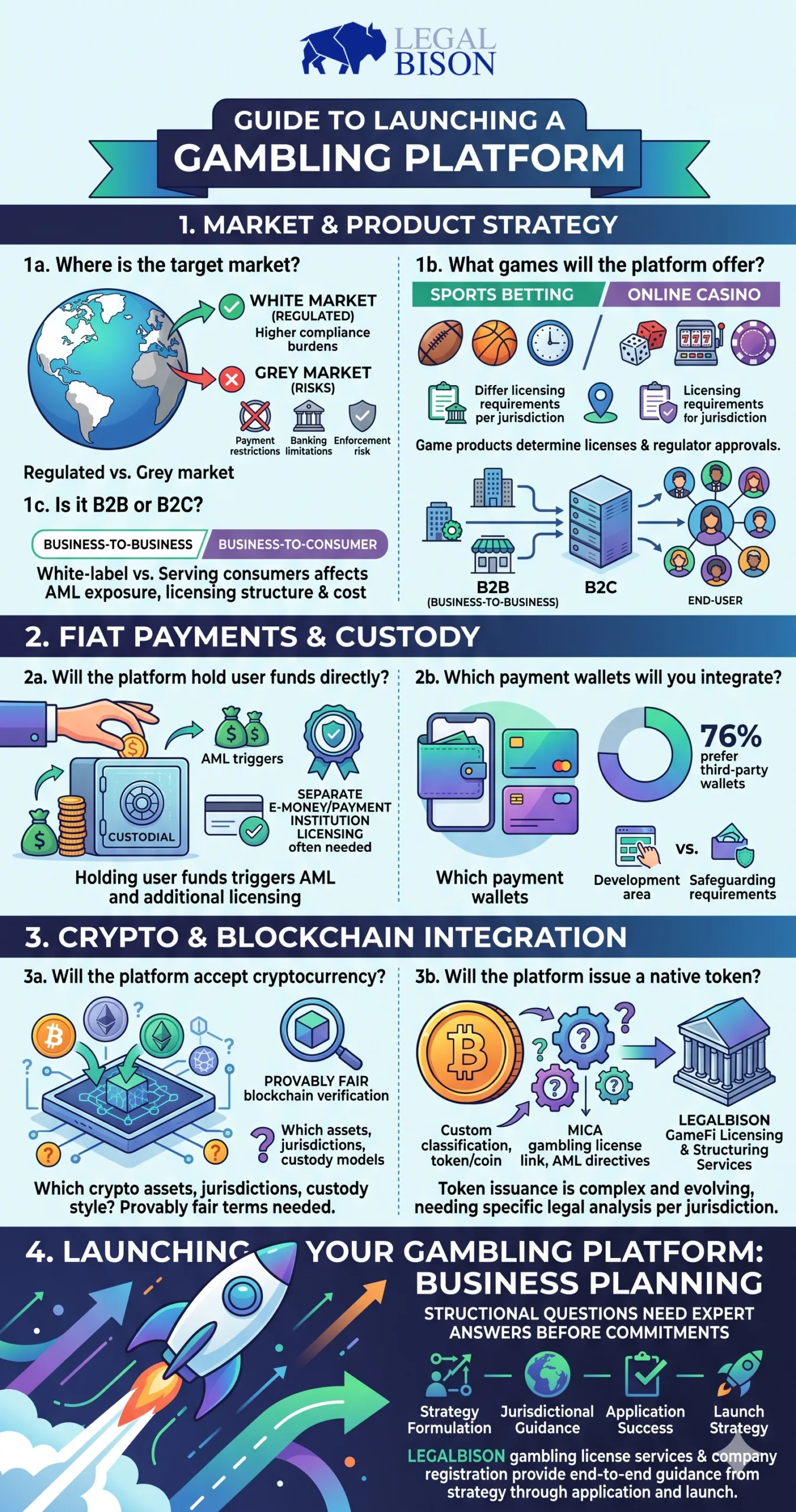
The Route to Getting Licensed: Important Questions to Ask
Getting licensed in online gambling is a sequence of decisions that compound: each one shapes the options available at the next stage.
The questions below reflect the actual decision points operators face before filing any application.
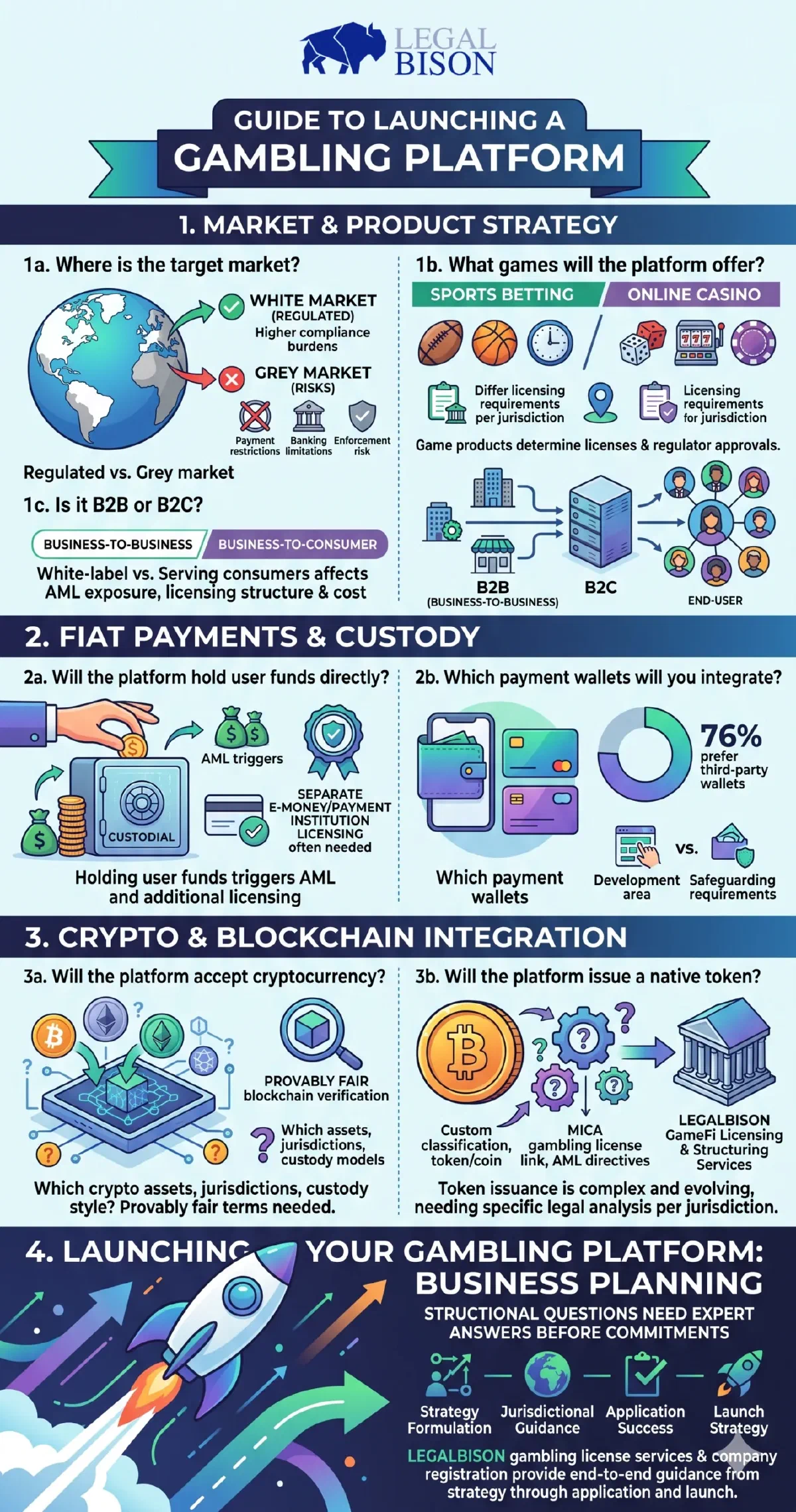
An illustrative example of how the launch stage usually goes is LegalBison’s assistance to watch.fun in structuring and launching a luxury watch raffle system. The engagement required analyzing the applicable gaming and consumer protection frameworks across target jurisdictions, determining the triggered licensing requirements, and building the corporate structure to support compliant operations from day one.
For every founder at this stage, the structural questions above need expert answers before commitments are made. LegalBison’s gambling license services and company registration practice provide end-to-end guidance from jurisdictional strategy through application and launch.
Also read: How to Obtain a Gambling License and How Much It Costs
Global Gambling Markets and Regulatory Friction
Online betting is legal in some form across 72 countries. The variation in what legal means across those jurisdictions is the challenge that makes regulatory expertise crucial for market entry decisions.
Europe is the most mature market, generating EUR 47.9 billion in online revenue in 2024 and moving heavily toward multi-licensing frameworks. Operating in Germany, Sweden, and the Netherlands simultaneously requires separate licenses in each. MiCA, which applies across EU member states, adds a parallel compliance layer for any operator accepting crypto. The European Gaming and Betting Association publishes market data that is useful for comparative analysis.
The United States operates on a state-by-state model where legal sports betting is now live in a growing number of jurisdictions following the 2018 repeal of the Professional and Amateur Sports Protection Act (PASPA). The regulatory overhead reflects this fragmentation: each state has its own licensing authority, tax regime, and product restrictions. New York’s 51% gross gaming revenue tax on mobile sports betting is among the highest in any regulated market globally. Margin management in high-tax US states requires careful structural planning.
Brazil is an instructive case study in the risks of rapid liberalization without structural preparation. The market exceeded initial projections by generating R$37 billion in GGR after regulated sports betting launched, then attracted severe political scrutiny due to consumer debt concerns. Operators who entered early without documented responsible gambling frameworks built into their compliance programs found themselves exposed when the regulatory environment shifted quickly. The lesson is applicable globally: ongoing compliance, particularly around consumer protection, determines whether an operation survives regulatory turbulence.
For founders evaluating any of these markets, the path from market analysis to licensed operations requires a structured advisory process. LegalBison’s approach to international company formation and business bank account access for gaming operators addresses both the entity structuring and banking access dimensions that determine whether a licensed operation can actually function in practice.
Don’t let regulatory struggles slow down your platform. Secure your crypto casino license and fintech infrastructure with LegalBison today.
FAQ
How much is the gambling industry worth?
Global gambling industry revenue for 2026 is estimated to reach US$655.31 billion, depending on methodology. Online gambling accounts for approximately 63% of that total. Projections for 2030 range upward from USD 212.44 billion.
What state has no casinos?
Hawaii and Utah are the only US states with no legal commercial casino gambling. Both have historically maintained strict anti-gambling positions across all forms of wagering. Several other states permit limited forms of gambling (lottery, horse racing) but prohibit commercial casino operations.
Is gambling a billion-dollar industry?
By any measure, yes. Global gambling revenue has exceeded USD 100 billion annually and is projected to double by 2034. Online gambling alone, at USD 85 billion or more in 2025, is many times larger than a single billion-dollar figure.
How big is the online casino market?
Online casinos are the largest vertical in digital gambling, accounting for 37% of global player participation and 45% of online GGR in Europe. Ontario’s regulated online casino market alone generated approximately USD 2.24 billion in 2025.
What percentage of online gambling is crypto?
Approximately 18% of global online gambling operators currently accept cryptocurrency. The figure is growing as operators recognize the payment efficiency and fraud-reduction benefits of blockchain integration, though it varies significantly by jurisdiction and operator type.
How do you get a license for an online casino?
Obtaining an online casino license requires selecting the appropriate jurisdiction, preparing a full licensing application (including corporate documents, AML compliance program, technical certification of the gaming platform, and key personnel documentation), and managing the regulator relationship through the application process and post-authorization. Timelines range from several weeks for offshore registrations to 12 to 18 months for major regulated markets. The full process is covered in LegalBison’s gambling license guidance.
How to start an online casino that accepts real money?
Starting a real-money online casino requires corporate formation in a suitable jurisdiction, obtaining the relevant gambling license (and crypto license if accepting digital assets), integrating certified gaming software and payment providers, establishing AML and KYC compliance programs, and securing banking or payment processing access. This is a topic LegalBison covers in detail.