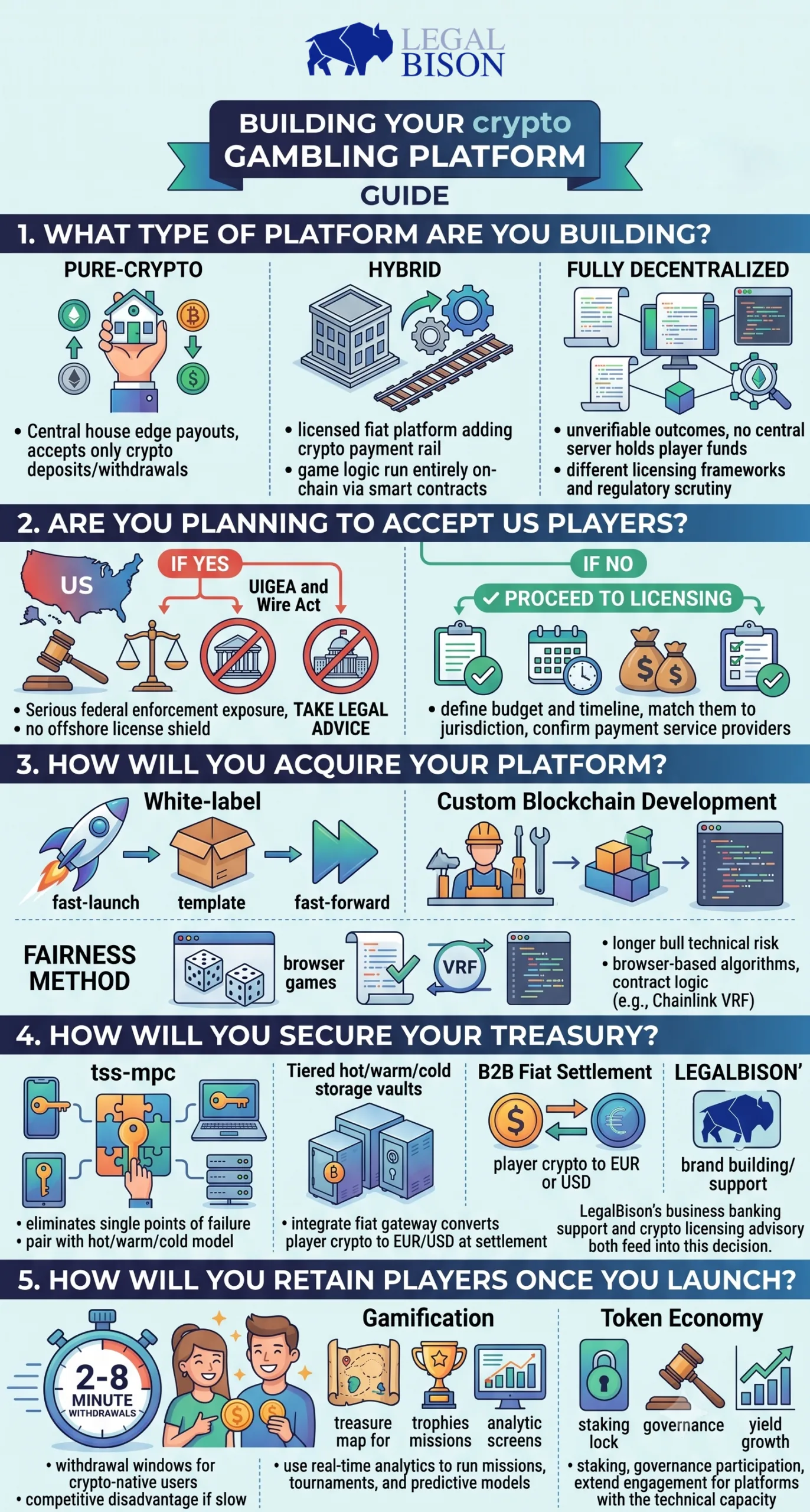
The gambling industry is one of the most resilient markets in the global economy. Global gambling industry revenue is projected to reach 655.31 billion USD in 2026, growing at a compound annual growth rate of 2.28% through 2030 to reach 717.06 billion USD, with 1.1 billion users expected by the end of that period. Within this, Bitcoin casinos represent one of the fastest-moving corners of the iGaming sector. For founders entering this space, understanding how these platforms work (technically, operationally, and legally) is the prerequisite for building something that lasts.
Note: this article is a founder’s guide and not a player’s guide. It covers the mechanics, the compliance requirements, and the decisions that determine whether a crypto casino launch succeeds or stalls.
Also, it is important to accept the expression “Bitcoin casino” as a lingo for crypto gaming platforms. The Bitcoin blockchain isn’t suitable for games, and wrapped BTC (Bitcoin on other blockchains than its own) is not commonly found in web3 gaming platforms. In this guide, we use the expression Bitcoin casino as a proxy for gaming platforms making use of crypto assets.
The GameFi and crypto casinos boom
Bitcoin casinos are platforms that use cryptocurrencies such as BTC, ETH, stablecoins, and altcoins as their primary payment rails. They differ from traditional online casinos that have added crypto as a supplementary payment option. In a Bitcoin casino, the digital asset is at the center of the platform’s deposit, withdrawal, game logic, and custody architecture, as the games are generally making use of smart contracts and decentralized applications to run.
The market numbers reflect a genuine shift. The global crypto casino market grew from approximately 50 million USD in 2019 to 250 million USD in 2024. That trajectory is driven by a specific type of user: crypto-native players who expect blockchain-level transparency, withdrawal speeds measured in minutes, and verifiable proof that the games are not rigged.
GameFi extends this further. Where a Bitcoin casino uses blockchain for payments, a GameFi platform uses it for game logic itself: outcomes recorded on-chain, assets owned by players, and governance sometimes handled by DAOs. The distinction matters for founders because it determines which licensing frameworks apply, which tech stack is viable, and which jurisdictions will accept the application.
Also read: Things to Consider When Buying a Turnkey Online Casino From a Legal Standpoint
How does a Bitcoin casino work?
Bitcoin casinos operate on three interdependent technical layers: blockchain infrastructure, payment processing, and custody. Each one introduces both capabilities and obligations that founders need to understand before they build.
Blockchain infrastructure and smart contracts
Smart contracts automate the core functions of a crypto casino (game logic, wager settlement, and payout) without requiring a human intermediary to process each transaction. The contract executes when predefined conditions are met: a player bets, the outcome is generated, the result is settled, and funds move. All of this happens on a decentralized ledger that any party can audit.
For founders, this changes the trust model. Players do not need to trust the operator to pay out correctly. The contract pays out by default. That is the theoretical baseline. In practice, most Bitcoin casinos are not fully decentralized. Most run a centralized back-office with crypto payment rails, and the smart contract architecture sits beneath a licensed, operated platform.
Payment processing and speed
Peer-to-peer crypto transactions bypass the correspondent banking network that slows fiat casino payments. Where a fiat withdrawal takes 24 to 72 hours, a crypto withdrawal typically settles in 2 to 8 minutes. For players accustomed to blockchain transaction speeds, anything slower reads as a red flag.
This speed advantage comes with a compliance obligation. Operators accepting crypto payments must screen wallet addresses, identify sanctioned counterparties, and, critically, restrict access from prohibited jurisdictions. Failing to block US players, for example, creates direct exposure under the Unlawful Internet Gambling Enforcement Act. That topic is covered in the legal section below.
Wallet security and custody
Custody is where most crypto casino failures originate. A single-key wallet means a single point of failure: one compromised credential, one rogue employee, or one exploit can drain the entire treasury.
The industry standard for serious operators is Threshold Signature Scheme (TSS) with Multi-Party Computation (MPC). MPC splits the private key into encrypted shares distributed across multiple independent devices. No single device holds the complete key. A transaction requires a threshold of those shares to sign. No individual actor, internal or external, can unilaterally move funds.
Alongside MPC, operators use a tiered storage model:
- Hot wallets (internet-connected, automated payouts): 1-5% of total funds
- Warm wallets (multi-sig, semi-accessible): 5-15% of total funds
- Cold wallets (air-gapped, manual multi-person authorization required): 80-90%+ of total funds
This architecture keeps liquidity available for player withdrawals while protecting the bulk of the treasury from online attack vectors.
Provably fair gaming and oracles
Provably fair algorithms replace blind trust with verifiable mathematics. That is the defining technical claim of the Bitcoin casino model, and it is what separates credible platforms from black-box operations.
The mechanism works through a commitment-reveal scheme. Before a game round begins, the server generates a server seed and hashes it, publishing the hash publicly so it cannot be changed after the fact. The player provides a client seed. A nonce tracks the round count. The outcome is derived by combining all three inputs through HMAC-SHA256 hashing. After the round, the server reveals the original seed. The player can independently verify that the outcome matches the published hash. No one, operator or developer, can manipulate the result without that hash mismatch being immediately visible.
This approach works well for browser-based single-player games: Dice, Crash, Plinko, and similar formats. For complex smart contract environments, decentralized oracles provide a different solution. Chainlink VRF (Verifiable Random Function) fetches off-chain randomness accompanied by a cryptographic proof. The proof is verifiable on-chain, confirming that the random number was generated before the request was made and was not influenced by the requesting contract, miners, or any other party.
Choosing between these two methods is a product decision: provably fair algorithms for lightweight browser games, Chainlink VRF for on-chain contract logic.
Are crypto casinos legal?
The legal status of crypto casinos is jurisdiction-specific and, in several major markets, genuinely ambiguous. Founders who treat compliance as a post-launch task are building on sand.
The United States is the clearest example of high-reward, high-risk. The Unlawful Internet Gambling Enforcement Act (UIGEA) prohibits operators from knowingly accepting payments for unlawful internet gambling. The Federal Wire Act restricts interstate wagers on sporting events. Several states, Washington and Utah among them, outlaw online gambling outright, and using cryptocurrency provides no legal immunity. Crypto is a payment method, not a regulatory exemption.
The 2026 GENIUS Act adds a further layer. Operators allowing US users to purchase stablecoins directly via credit card or bank transfer may be required to register as stablecoin issuers, with accompanying KYC and AML reserve requirements. For platforms using stablecoins as settlement currency (which many do) this is a live compliance question, not a theoretical one.
Outside the US, the compliance floor for any licensed operator includes three things: a KYC program that verifies player identity, an AML framework for transaction monitoring, and geoblocking technology that restricts access from jurisdictions where the platform does not hold a valid license. These are not optional features. They are conditions of any valid operating license in virtually every regulated market.
If you are at the stage of assessing your compliance structure, LegalBison’s gaming license advisory covers the full spectrum of jurisdictional requirements across the firm’s 50+ jurisdiction service scope.
Ready to enter the GameFi industry? Contact LegalBison today to find out which offshore gaming license is right for your Bitcoin casino.
How to start a Bitcoin casino
Building a compliant Bitcoin casino requires decisions across four domains: tech stack, corporate structure, licensing jurisdiction, and treasury architecture. Each decision constrains the next.
Most founders start with a white-label or turnkey solution rather than building from scratch. Providers supply the core platform, game aggregation, back-office, and payment integrations. For founders who want full on-chain architecture, the blockchain choice matters: Ethereum (EVM) offers the largest developer ecosystem but carries high gas fees and slower throughput; Solana (SVM) enables parallel execution, sub-second finality, and economically viable micro-transactions.
Jurisdiction selection is the most consequential early decision. The four options most used by crypto casino operators in 2026:
All figures are approximate. Actual costs depend on corporate structure, compliance build-out, and ongoing regulatory requirements. Confirm with a licensing specialist before committing to a jurisdiction.
The corporate structure matters as much as the license itself. Most operators run an offshore holding entity combined with a licensed operating company. LegalBison handles company registration and on/off-ramp integration in parallel with licensing applications, reducing the total time to operational status. For MGA-specific requirements, the Malta Gaming Authority publishes its licensing framework and crypto-specific guidance directly. For a broader introduction to the Bitcoin casino market structure, bitcoin.org provides foundational reference material on the Bitcoin protocol.
More detail: How to Start a Bitcoin Casino, from Product to Off-ramping
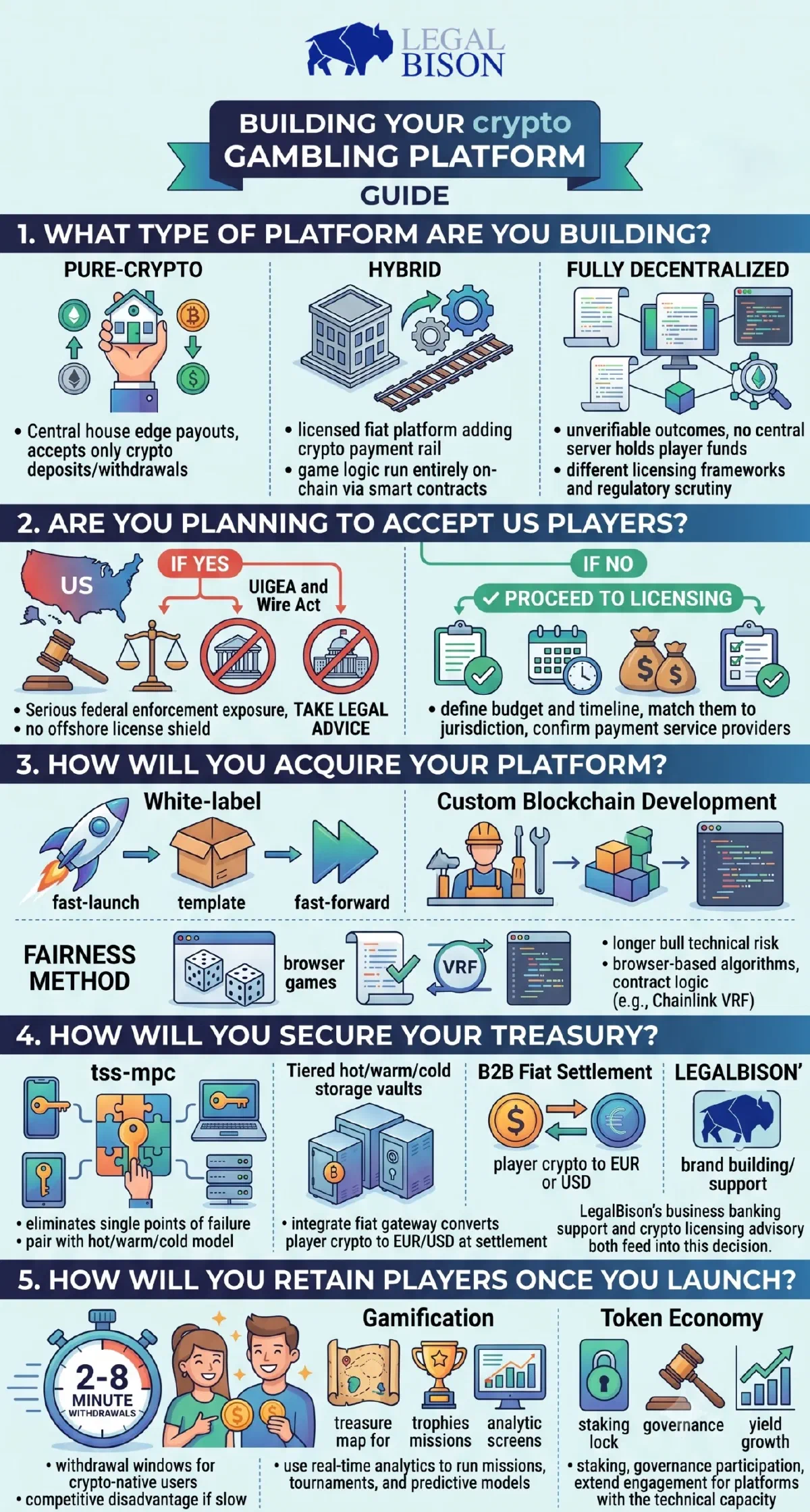
The crypto casino founder’s handbook
Launching a crypto casino involves five sequential decisions. Getting any one wrong can invalidate the entire operation: technically, commercially, or legally.
Conclusion
Successful Bitcoin casinos are built at the intersection of blockchain technology and regulatory compliance. The technical layer (provably fair algorithms, MPC custody, smart contract automation) determines whether the platform is credible to players. The legal layer (licensing jurisdiction, AML framework, geoblocking, corporate structure) determines whether it can operate at all.
Neither is sufficient without the other. A technically flawless casino without a license is a liability. A licensed casino with inadequate custody architecture is a security incident waiting to happen.
LegalBison provides end-to-end support across global company formation, crypto licensing, iGaming license applications, and AML program design. The firm’s advisory practice covers 50+ jurisdictions, from Anjouan and Nevis for fast-entry offshore structures to MGA for EU-regulated operations.
Don’t let regulatory hurdles slow down your launch. Let LegalBison handle your global company formation, crypto licensing, and compliance strategies. Book a free consultation with our iGaming legal experts now.
FAQ
What are the best Bitcoin casinos?
Platforms that perform consistently tend to combine regulatory compliance with technical credibility: a valid offshore license, demonstrated KYC and AML programs, and either a provably fair system or on-chain oracle integration. Stake.com and BC.Game are frequently cited as operators that have built this combination at scale.
Are crypto casinos legal in the US?
Not in any straightforward sense. UIGEA prohibits operators from accepting payments for unlawful internet gambling, and the Federal Wire Act restricts interstate wagers. Several states, Washington and Utah among them, outlaw online gambling outright. No offshore license provides immunity from US federal enforcement, and using cryptocurrency as the payment method does not change the legal analysis.
How do crypto casinos ensure game fairness?
Through two primary methods: provably fair algorithms for browser-based games, and decentralized oracles, specifically Chainlink VRF, for on-chain smart contract games. Both generate outcomes that players can independently verify after each round.
What is a provably fair algorithm?
A cryptographic system where the game outcome is derived from three inputs: a server seed (hashed and published before the round), a client seed (provided by the player), and a nonce (round counter). These inputs are combined via HMAC-SHA256. After the round, the server reveals the original seed, and the player can verify that the published hash matches, confirming the outcome was not manipulated.
How fast are cryptocurrency casino transactions?
Deposits are typically near-instant. Withdrawals settle in 2 to 8 minutes on most networks, compared to 24 to 72 hours for fiat casino withdrawals. Speed varies by network: Solana and Layer 2 Ethereum solutions are faster than base-layer Ethereum.
Which offshore license is best for a crypto casino?
It depends on budget and timeline. Nevis offers a modern mid-tier option (approximately EUR 28,000/year, ~4 weeks) with strong PSP recognition. Curacao is widely established (EUR 65,000-90,000/year, 4-6 months) but now subject to stricter LOK requirements. Malta MGA is the EU premium option (EUR 25,000-100,000+/year, 6-12 months) with strict crypto-specific conditions.
How much does it cost to get an online gambling license?
Annual licensing fees range from approximately EUR 17,000 (Anjouan) to EUR 100,000 or more (MGA). Total costs including corporate setup, compliance program build-out, legal documentation, and banking integration are typically higher. A structured breakdown by jurisdiction is available through LegalBison’s gambling license advisory.