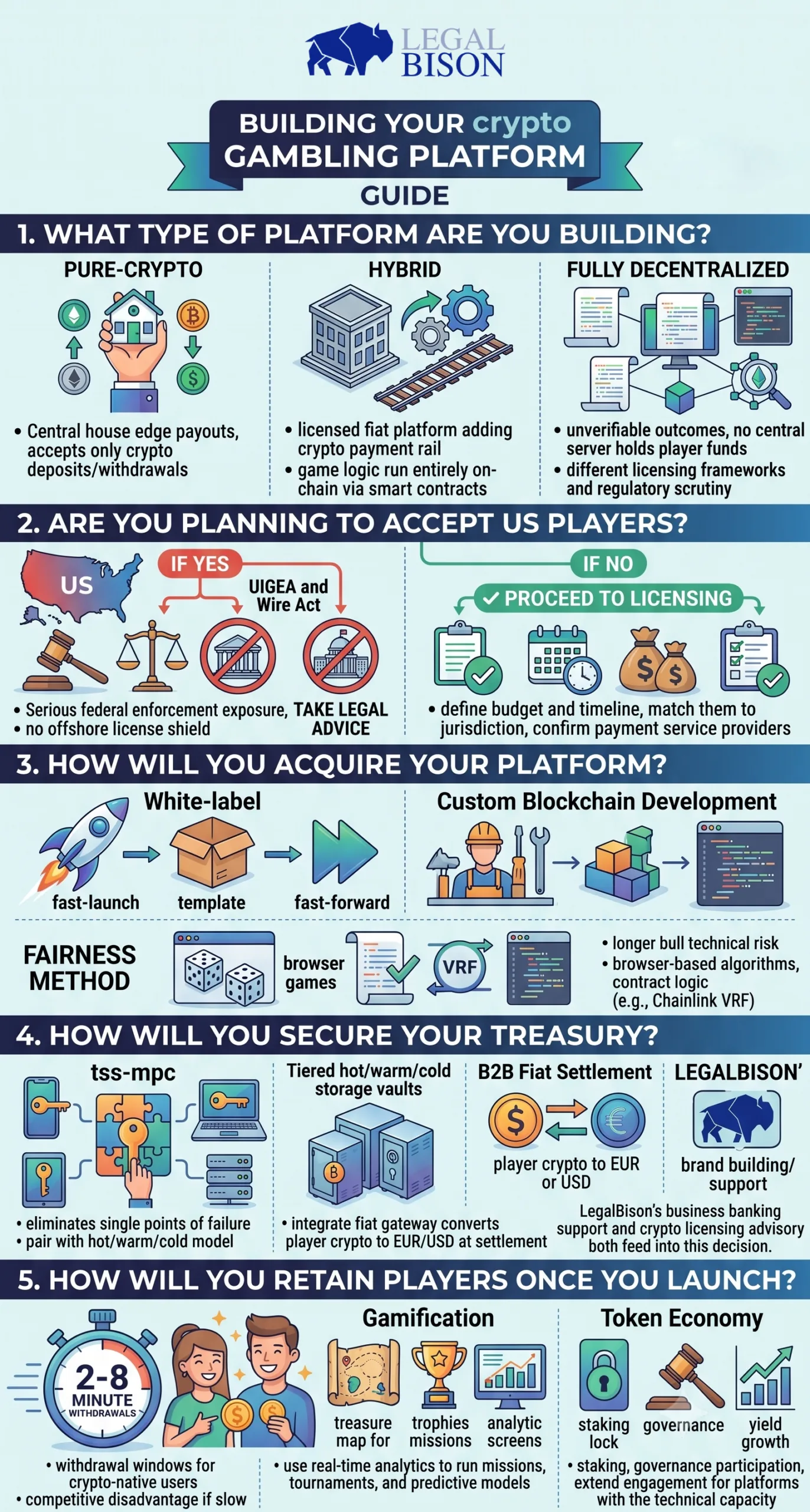
The global online gambling market is pushing past $600 billion annually, and crypto casinos are taking a larger share of the market. Crypto gaming platforms offer real advantages: near-instant payouts, provably fair mechanics, pseudonymous play, and access to markets where traditional payment processors simply won’t operate.
The crypto-native angle of your casino does not make you exempt from regulatory obligations. Regulators across Europe, the Caribbean, and Asia-Pacific are tightening their requirements for anti-money laundering controls, know-your-customer procedures, and responsible gambling frameworks. Meanwhile, banking partners and payment processors are demanding that crypto gaming operators meet the same standards they expect from a traditional online casino.
If you want to build a Bitcoin casino that can scale, attract institutional investment, pay staff, and off-ramp profits without triggering banking freezes or regulatory investigations, you need to treat it as a regulated financial business from the start.
Related: What’s the Difference Between Crypto and Bitcoin?
Starting a Crypto Casino: The Tech Stack and Game Integration
The first major decision every founder faces is whether to build custom or license a white-label platform. The best answer depends on your timeline, budget, technical resources, and long-term ambitions.
Buying a white-label casino platform allows you to essentially deploy a ready-built back-end with ready to use wallet connections, game aggregation APIs, affiliate tracking, and a configurable front-end. You rebrand it, configure it, add your games, and you’re operational in weeks rather than months.
The economics are straightforward where you pay an initial setup fee, ongoing monthly fees or revenue-share arrangements, and in return you get speed-to-market and a proven technical foundation. On the downside, you’re building on someone else’s infrastructure, which limits how deeply you can customize the product and means your margins will always include a technology provider’s cut.
Building from scratch gives you complete ownership and flexibility. You control the codebase, the user experience, the wallet architecture, and the data infrastructure. That’s valuable when you have a differentiated product vision or plan to license your technology to other operators down the line.
The cost and timeline are the tradeoffs. A properly built, audit-ready custom casino platform can easily run over $500,000+ in development costs and takes 12 to 24 months to build to a production-ready standard.
Related: How Does Bitcoin Casino Work?
Setting Up Off-Ramping & Fiat Settlement
A common misconception among early-stage founders is that a crypto casino can exist entirely outside the traditional financial ecosystem. Your staff need salaries in euros or dollars. Your office landlord wants a bank transfer. Your legal team invoices in fiat. Your tax authorities expect payment in the local currency. This is where off-ramping matters.
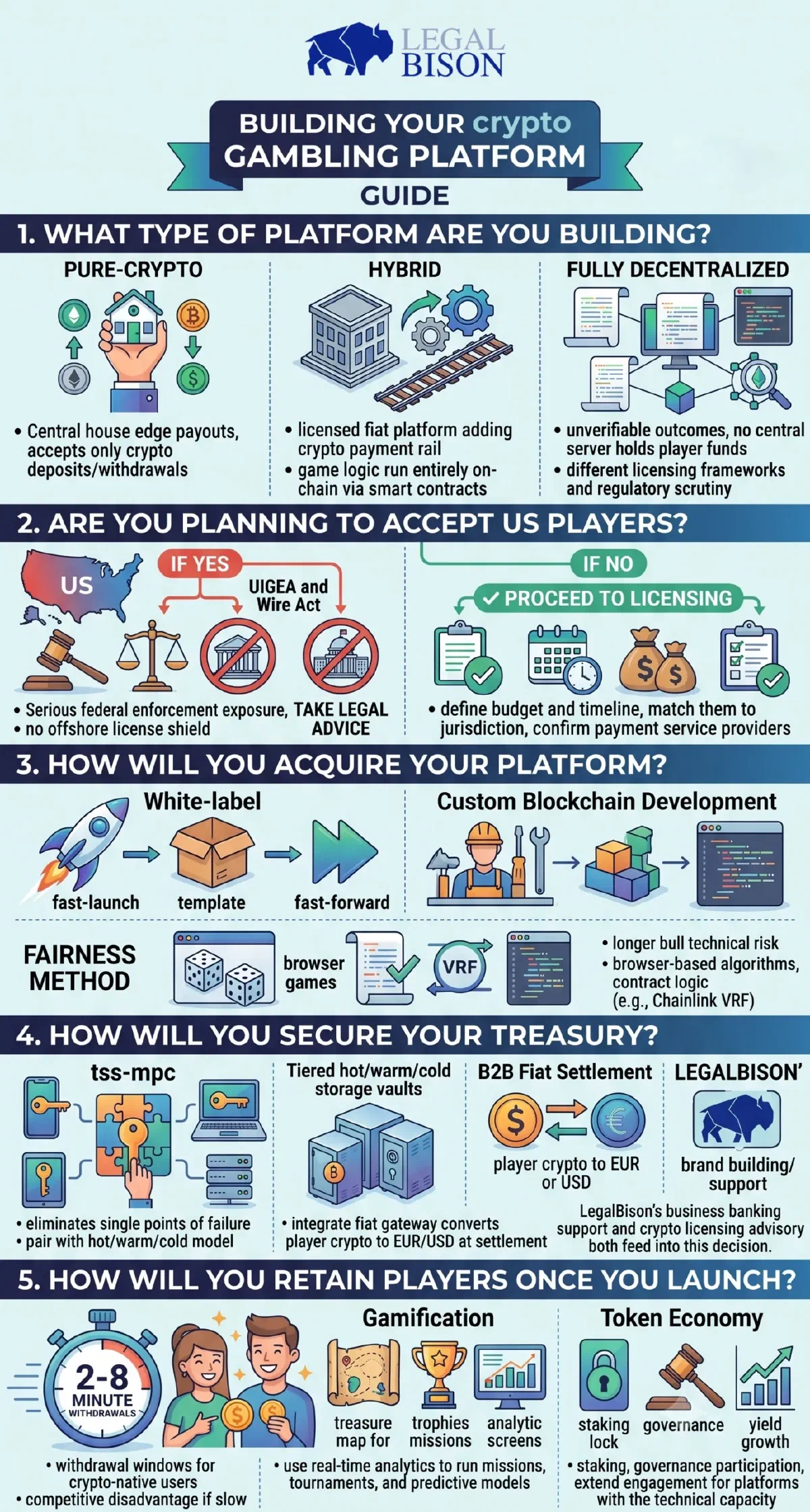
Why Crypto Casinos Struggle with Banking
Gaming is a high-risk sector for banks. Crypto gaming is doubly so. Traditional banks apply enhanced due diligence to gaming operators and are even more cautious about crypto-native businesses. Many standard business banking providers will refuse accounts for online gaming businesses outright.
The operators who successfully open and maintain banking relationships share common characteristics: they’re properly licensed, they have documented AML/KYC frameworks, their corporate structure is clean and transparent, and they approached banking partners with institutional-quality documentation from the outset.
The Crypto-to-Fiat Settlement Workflow
A practical settlement workflow for a crypto casino might look like this:
- Player Deposit: The player deposits cryptocurrency (e.g., BTC, ETH, or stablecoins like USDT) into your casino platform wallet.
- Revenue Accumulation: Gaming revenue accumulates in your platform’s front-facing hot wallet during daily operations.
- Treasury Sweep: Automated scripts periodically sweep excess revenue to a secure, multi-signature cold storage vault while maintaining a liquid buffer for daily player payouts.
- Settlement Request: The finance team initiates a fiat conversion request with a licensed B2B settlement provider or OTC desk.
- Asset Conversion: The OTC desk converts the digital assets into fiat currency at pre-agreed rates and transfers the funds to your corporate account.
- Capital Distribution: Fiat operating capital is then drawn down directly from your corporate account to settle payroll, vendor payments, affiliate commissions, and corporate tax remittances.
The most common point where startups get stuck is right between the OTC desk relationship and capital distribution. If you treat OTC desks like a standard retail exchange, making sporadic, massive transfers from poorly managed hot wallets, it raises significant red flags.
Not to mention, without a robust AML framework and real-time transaction screening at the deposit gateway, routing those flagged funds through your corporate settlement channels puts you at a near-guaranteed risk of being permanently de-banked before you can even distribute your first round of operating capital.
Related: When Does an In-Game Virtual Money Trigger a License?
Legal Structuring & Licensing Frameworks
Many founders ask whether a crypto-only casino really needs a gambling license. The answer, in nearly every commercially viable scenario, is yes.
A gaming license does multiple things simultaneously: it establishes your legal right to operate, it provides the regulatory cover that banking partners require, it gives affiliate networks and game providers confidence to work with you, and it signals to sophisticated players that your platform is legitimate. Without it, you’re operating in a regulatory grey zone that limits your future ability to secure stable banking rails.
Choosing the Right Jurisdiction
The right gambling license jurisdiction depends on your target markets, your budget, and your long-term business goals. For a startup with limited capital targeting emerging markets, launching with a Nevis license can be an excellent tactical move to secure a fast, low-cost path to market.
It establishes an active revenue stream that can directly fund a future Malta upgrade, allowing you to build operational momentum and finance an intensive compliance process while your platform remains live and profitable. Conversely, an operator targeting European players from day one with institutional backing should start with Malta from the outset, despite the heavy upfront costs and longer timelines.
Never choose a jurisdiction based solely on cost. Choose based on what your target market will accept, your long-term scalability plans, what your banking partners will support, and what your planned game providers and affiliate networks strictly require.
US Market Risks & Compliance
Accepting US players creates federal legal exposure that has driven operators who underestimated it out of business. This is not a matter of choosing a permissive jurisdiction and hoping for the best, as US gambling laws carry federal criminal liability.
The core laws that govern this space are broken down below:
The Federal Wire Act 1961
This makes it a federal crime to use wire communication facilities (which courts define as the internet) to transmit bets, wagers, or gambling information across state lines or international borders.
Even if your platform is hosted in a legal offshore jurisdiction, the moment a packet of data carrying a wager crosses into US digital borders, a violation of the Wire Act has occurred.
The Unlawful Internet Gambling Enforcement Act / UIGEA 2006
Prohibits gambling businesses from knowingly accepting payments in connection with unlawful internet gambling. It doesn’t directly criminalize players, but it creates significant liability for operators and payment processors working with US customers.
The 2026 GENIUS Act
If passed in its current form, the Guiding and Establishing National Innovation for US Stablecoins Act (GENIUS Act), proposed in 2026, would specifically target stablecoin regulation. Under this legislation, if an offshore casino’s operational wallets or deposit addresses are flagged on-chain for processing transactions from U.S. residents, federal regulators could compel the issuer to instantly freeze the casino’s core stablecoin liquidity, effectively trapping its corporate capital in digital space.
What This Means Operationally
At a minimum, any operator not holding a US state-level gaming license must implement robust geo-blocking to exclude US IP addresses and use KYC verification to identify and exclude US nationals and residents.
Even with these controls, operating a crypto casino that accepts any US player exposure without jurisdiction-specific US legal advice is a high-risk decision. The penalties include federal criminal prosecution, asset forfeiture, and permanent banking exclusions.
Founders’ question answered: Are No-KYC Online Casinos Legal?
Start Your Bitcoin & Crypto Casino Legally and Safely
Launching a sustainable crypto casino requires day-one structural foresight. Operating a Bitcoin casino without a license might offer a fast start, but it triggers irreversible bottlenecks the moment you attempt to scale.
Without a legitimate license, regulators will swiftly blacklist your domains, ad networks like Google and Meta will ban your accounts, and you face an immediate lockout from the banking system. Furthermore, because tier-one B2B partners, PSPs, and institutional investors treat a valid license as a non-negotiable baseline, scaling into high-growth markets or passing corporate audits becomes impossible.
The decisions that matter most are actually the ones made before your first player ever deposits:
- Product decisions: White-label for speed and capital efficiency; custom build for long-term IP ownership and product differentiation.
- Licensing strategy: Choose a jurisdiction that matches your target markets, banking needs, and budget; not the cheapest option available.
- Treasury security: multi-signature wallets, segregated player funds, and documented cold storage controls.
- Banking and off-ramping: Establish corporate accounts and licensed settlement relationships before launch, not after your first withdrawal crisis.
- Compliance requirements: KYC, AML, sanctions screening, and responsible gambling tools must be operational from day one.
Understanding how to start a bitcoin casino legally and safely requires day-one structural foresight. By choosing the right jurisdiction, securing reliable banking partners, and implementing robust compliance frameworks from the start, operators can avoid costly regulatory bottlenecks and build a sustainable platform.
FAQ
How much does it cost to start a crypto casino?
Total startup costs vary enormously based on your approach. A white-label crypto casino with a mid-tier license (Nevis) can be operational for $80,000–$200,000 including platform fees, licensing, legal structuring, initial game integration, and working capital. A custom-built platform with a premium license (MGA Malta) can easily exceed $1,000,000–$2,500,000 before you sign up your first player.
How long does it take to launch a Bitcoin casino?
With a white-label platform and a fast-turnaround jurisdiction like Nevis, a technically ready casino can be operational in 3–6 months from project kick-off. A custom-built platform with a Malta MGA license typically takes 18–30 months. The biggest variable is usually the licensing and banking timeline, which depends heavily on the quality of your application documentation.
Which licensing jurisdiction is best for a crypto casino?
There is no single “best” jurisdiction. The right choice depends entirely on how a platform balances target market accessibility, banking and payment processing compatibility, and operational cost vs. speed-to-market.
Can I operate a crypto-only casino without traditional banking?
Technically yes. But practically, it severely limits your business. You’ll eventually need fiat to pay staff, vendors, affiliates, and taxes. Operating without banking relationships also limits your ability to work with institutional game providers, access affiliate networks, and attract investment. The crypto-native angle of your platform does not eliminate the need for fiat infrastructure.
What banking do I need to open a crypto casino?
At minimum, you need a dedicated corporate IBAN with a financial institution that is willing to work with licensed gaming operators. This typically requires an existing gaming license, a documented AML/KYC framework, clean corporate structure, and often an introduction through a specialist adviser. Your banking setup should be established before launch, not after.
Can my Bitcoin casino accept US players?
Accepting US players without holding a US state gaming license creates significant federal legal exposure, including potential criminal liability under the Wire Act and UIGEA. Most international operators implement geo-blocking and KYC controls to exclude US residents. If you want to target US players, you must obtain jurisdiction-specific US legal advice before proceeding, this is not an area where general guidance is sufficient.
How do I off-ramp Bitcoin casino profits into fiat?
The standard process involves converting crypto gaming revenue to fiat via licensed OTC (over-the-counter) desks or settlement providers, with funds landing in your corporate IBAN. Having your licensing and legal structure in order is a prerequisite to accessing quality settlement rails.
Do crypto casinos need KYC and AML programs?
Yes. In virtually every licensing jurisdiction, KYC and AML programs are mandatory requirements of your gaming license. Even in jurisdictions with lighter regulatory frameworks, regulators and banking partners expect documented identity verification processes, transaction monitoring, suspicious activity reporting, and a designated AML officer.
What regulatory trends should crypto casino operators watch in 2025–2026?
Several major trends are reshaping the iGaming compliance landscape. The global FATF Travel Rule now mandates data sharing on crypto fund transfers; Curaçao’s gaming framework has undergone a total structural overhaul with stricter licensing controls; and the EU’s MiCA regulation has tightened how crypto service providers interact with operators. Globally, the industry is moving permanently away from anonymous loops and toward strict structural transparency, verified beneficial ownership, and total alignment with traditional financial services compliance.