“Provably fair” is a cryptographic verification system that lets players confirm, independently and after every round, that a game outcome was not manipulated. It eliminates the “black box” that defines traditional online gambling.
For founders building a crypto casino or Web3 gaming platform, grasping what the term means is step one. It answers only the technology question. The legal question sits alongside it, and it does not go away because the code is transparent.
This article covers both: how the system works, how to build it correctly, and what licensing and compliance requirements apply regardless of the technology you deploy.
Provably fair in iGaming
Player trust has always been the central problem in online gambling. When an online casino, regardless of the game type, controls the software and the outcome, players have no independent way to verify they were treated fairly. Third-party auditors like eCOGRA fill part of that gap, but they audit processes periodically, and do not give players real-time visibility into individual outcomes.
The “provably fair” technology changes that. By publishing a cryptographic commitment before each round and revealing the underlying data afterward, operators give players the tools to verify every result themselves.
The impact on player confidence is measurable: 93% of bettors report that a platform’s legal standing is a major factor in choosing where to play, and over 40% of iGaming players cannot reliably identify legal platforms, according to American Gaming Association data. Transparency at the game level helps, but it does not substitute for legal legitimacy.
This is the point the Malta Gaming Authority makes explicitly. The MGA accepts provably fair technology but has not relaxed its requirement for independent RNG certification. A platform can be cryptographically transparent and still non-compliant if it has not obtained the right authorizations. Founders building in this space need both. Operators who understand that early, and structure accordingly, avoid the costly corrections that come from launching the technology before the regulatory work is done.
How does the provably fair algorithm work?
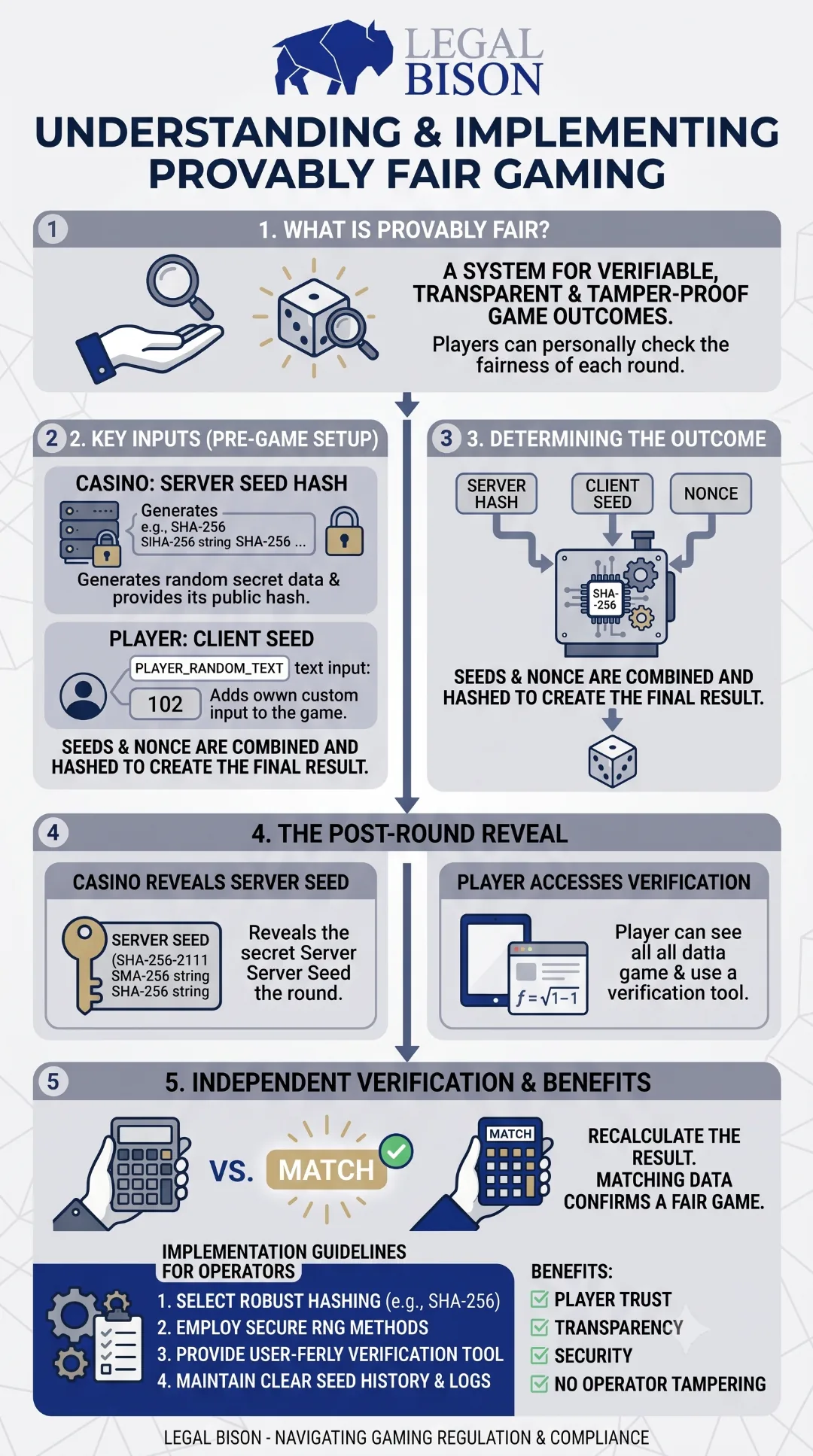
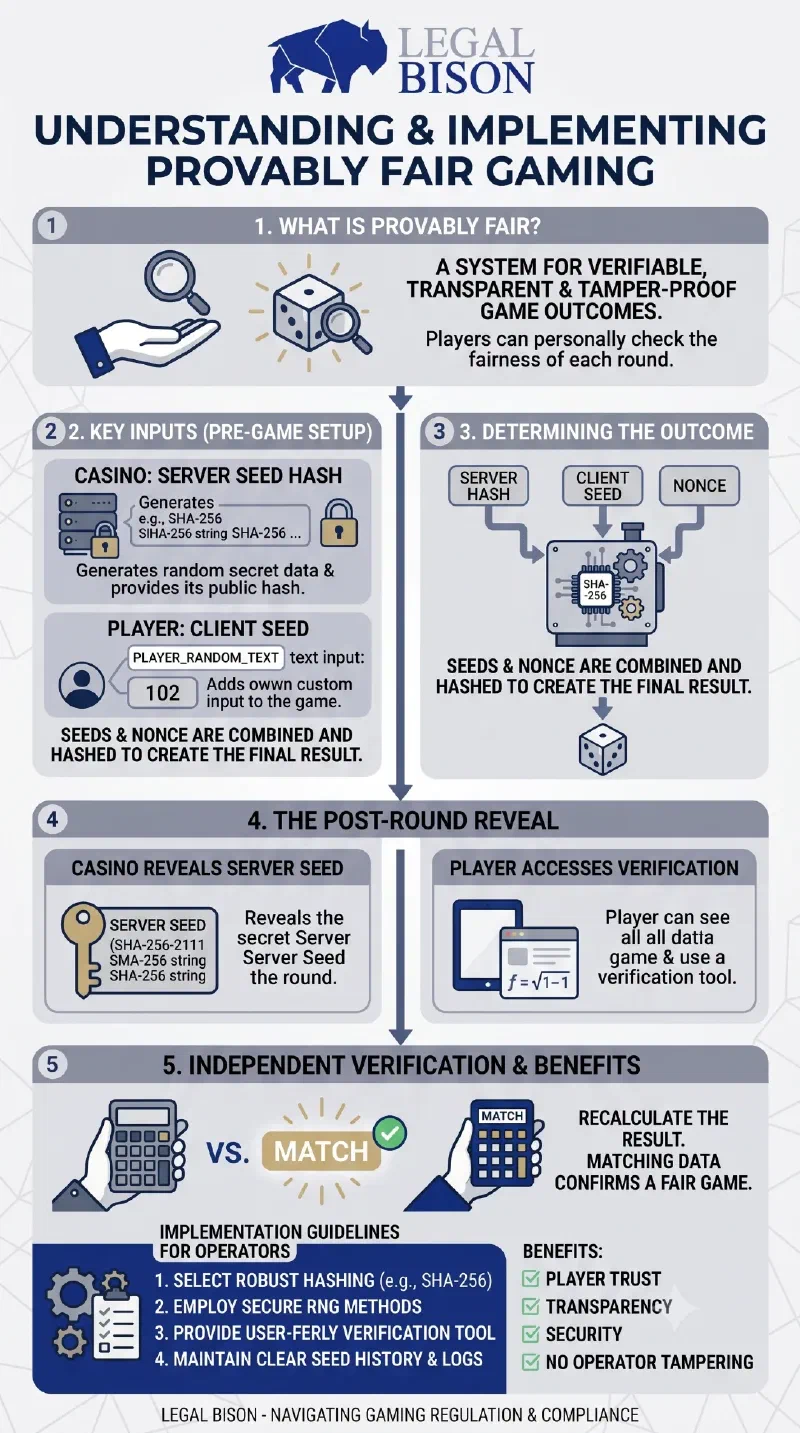
The provably fair algorithm produces each game outcome by combining three inputs, and the design of the system ensures that neither the casino nor the player can manipulate the result after a bet is placed.
The three inputs are:
- Server seed: The casino generates a random string before the round begins. Rather than sharing the raw seed, which would allow the player to calculate the outcome in advance, the casino shares a cryptographic hash of it, typically produced using SHA-256. The hash functions as a tamper-evident seal: the casino is now committed to that specific server seed, and any change to it would produce a different hash.
- Client seed: The player’s browser generates or modifies this string. Because the outcome depends on the client seed, the casino cannot pre-calculate a losing result for a specific player: it does not know what client seed the player will submit.
- Nonce: A sequential integer that increases by one with each bet. The nonce ensures that two rounds using the same seeds still produce different outcomes.
After the round, the casino reveals the original, unhashed server seed. The player then runs two checks: first, hash the revealed server seed and confirm it matches what the casino published before the round; second, combine the unhashed server seed, the client seed, and the nonce using the platform’s algorithm to reproduce the result. If the reproduced result matches what was recorded, the round was fair.
The entire verification process can be done manually or with a publicly available tool. Players do not need to trust the casino’s claims. They can confirm the mathematics themselves.
Traditional casino RNG vs. provably fair systems
Traditional RNG (Random Number Generation) operates inside a black box. The casino runs an algorithm, the result appears, and the player has no access to the underlying process. Fairness is delegated to third-party testing laboratories: eCOGRA, BMM Testlabs, GLI, which audit the algorithm periodically and certify that it performs within acceptable parameters. Players trust the certification, they can’t see the code.
Provably fair systems move the verification out of the black box and into public view. Every player, on every round, has the data needed to confirm the result was generated correctly. No intermediary is required.
One misconception worth addressing directly: the system does not mean the player will win more, or even that the odds are favorable. It guarantees that the outcome was not manipulated after the bet was placed. The house edge remains exactly what the operator has set it to be. The dice are not loaded. The house still has a built-in advantage on every round.
For founders, this distinction matters in how the technology is positioned. Provably fair is a transparency mechanism. It is not a competitive guarantee, and framing it as one creates regulatory and reputational risk.
Related: Things to Consider When Buying a Turnkey Online Casino From a Legal Standpoint
Correct implementation is where many early-stage platforms make mistakes. The cryptographic logic is well-documented, but the architecture decisions around it, particularly how seeds are managed, determine whether the system actually delivers the fairness it promises.
- HMAC-SHA256 is the standard algorithm for combining seeds into a deterministic, unpredictable result. Using HMAC rather than raw SHA-256 for the combination step prevents length-extension attacks and is considered best practice across the industry.
- Seed rotation is mandatory. Server seeds must be rotated regularly, and critically, a new server seed must be generated for each session or player request, not pre-generated in a static batch. Static pre-generation without requiring a fresh client seed input is a known vulnerability: an operator who pre-generates thousands of outcomes and maps them to seeds can retroactively select which seed to “reveal,” effectively controlling results while appearing transparent. The hash commitment only prevents manipulation if the seed is genuinely random and not chosen from a pool.
- On-chain and Web3 platforms face a different implementation challenge. Blockchains cannot natively generate secure random numbers. Any value that exists on-chain was put there by someone, and miners or validators can theoretically influence block-level randomness. Oracle networks resolve this. Chainlink VRF (Verifiable Random Function) generates random values off-chain and delivers them on-chain alongside a cryptographic proof, allowing anyone to verify that the value was not tampered with before it was used. For sports betting applications built on smart contracts, oracles serve a second function: feeding verified real-world match data into contracts so payouts can be settled automatically and transparently.
Proper architecture matters before launch, not after. A system built with the right seed management and oracle integration from the start is far easier to certify and license than one retrofitted later.
Provably fair gaming mechanics explained
The questions below reflect what most founders ask when they first evaluate this technology. The answers are direct. The final question is the one that determines whether a platform can operate legally.
If any of these questions surface doubts about your current architecture or legal position, those doubts need to be resolved before launch, not after. That is the work a licensing specialist handles.
Licensing your crypto casino
A provably fair system does not authorize a platform to operate. Every jurisdiction that accepts the technology still requires the operator to hold a valid gambling license, pass independent RNG certification, and maintain an active compliance program.
Two jurisdictions dominate the crypto casino licensing market:
Curaçao is the most common starting point for operators building a provably fair crypto casino on a startup timeline. The 2% gaming tax on net profits keeps operational costs manageable, and the licensing process moves faster than most EU frameworks. The trade-off is market access: a Curaçao gaming license does not give automatic access to EU-regulated markets.
TheMalta Gaming Authority sets a higher bar: more documentation, longer processing, and stricter ongoing obligations. It is the recognized standard for operators targeting EU players. MGA-licensed operators benefit from broader acceptance among payment processors, banking partners, and white-label B2B clients. For a provably fair bitcoin casino or multi-currency platform with ambitions in European markets, the MGA path is worth the additional lead time.
Jurisdiction selection depends on business model, target markets, and capitalization. Neither option is universally correct.
Compliance, KYC, and AML in crypto gambling
Crypto deposits do not exempt an operator from identity verification. Every licensed gambling platform, regardless of whether it accepts fiat, stablecoins, or native cryptocurrencies, must implement Know Your Customer (KYC) and Anti-Money Laundering (AML) programs that meet the requirements of its licensing jurisdiction.
Under MGA rules, player identity must be verified within 30 days of the first deposit. Operators who allow players to use real money for wagering before completing KYC take on the compliance exposure for every transaction that occurs in that window. Curaçao requirements differ in their specifics but the underlying obligations are consistent across licensing frameworks: verify identity, monitor transactions, flag suspicious activity.
A functioning AML program for a crypto gambling operator includes:
- Wallet verification and source-of-funds assessment for crypto deposits above defined thresholds
- Customer Due Diligence (CDD) procedures covering identity documents, beneficial ownership, and PEP/sanctions screening
- Transaction monitoring to identify unusual patterns, layering activity, or structuring behavior
- Suspicious Activity Reporting (SAR) obligations to the relevant financial intelligence unit
Corporate banking setup for gambling operators carries additional complexity. Banks with exposure to gaming and crypto often apply enhanced due diligence, and account opening timelines for licensed gambling entities can run significantly longer than for standard businesses. Getting the gambling license in place before approaching banking relationships is the standard sequence, as most banking partners will not engage without it.
Building a compliant crypto casino requires getting several things right in sequence: company formation, jurisdiction selection, license application, AML program design, RNG certification, and banking. Each step depends on the previous one, and mistakes at any stage create delays that compound.
LegalBison works with Web3 gaming founders and iGaming operators across the full lifecycle: from the initial jurisdictional strategy through company registration, gaming license acquisition in Curaçao, Malta, and other jurisdictions, crypto license registration where required, and on/off-ramp setup for platforms handling cryptocurrency deposits and withdrawals. The firm’s crypto casino and GameFi practices cover both the structural work and the ongoing compliance requirements that follow authorization.
The combination of technology decisions and regulatory obligations covered in this article is exactly the kind of multi-jurisdictional, cross-vertical complexity the firm structures daily. Founders who want to move from architecture to authorized operation without losing time to avoidable errors can get in touch with the LegalBison team directly.
FAQ
What does provably fair mean?
Provably fair refers to a cryptographic system used in online gambling that allows players to verify, independently and after every round, that the outcome was not manipulated by the operator. The verification relies on a hash commitment made before the round and a seed reveal made afterward.
How does provably fair work?
Before each round, the casino publishes a SHA-256 hash of its server seed. The player contributes a client seed, and a nonce increments with each bet. After the round, the casino reveals the server seed. The player confirms the revealed seed matches the pre-game hash, then recalculates the result using all three inputs to verify the outcome. That is how the verification process works at a mechanical level.
What is the $20 rule at the casino?
The $20 rule is an informal table etiquette convention at physical casinos, not a legal or regulatory requirement. It refers to the practice of handing cash to the dealer in $20 increments when buying chips at a table. It has no application in online or crypto gambling.
What is fair in probability?
In probability theory, a fair game or fair outcome is one where the expected value is zero, meaning no player or operator has a systematic advantage. Cryptographic verification systems address process fairness (the result was not manipulated) but do not produce probability-fair outcomes. The house edge remains, by design.
Do I need a gambling license for a provably fair casino?
Yes. The technology is a transparency mechanism, not a licensing substitute. Every jurisdiction that permits online gambling requires operators to hold a valid license regardless of the technology stack. Regulators evaluate authorization separately from game mechanics.
Does provably fair mean you will always win?
No. The system confirms that the outcome was generated according to the stated rules and was not altered after your bet was placed. It does not change the probability model or remove the house edge. The game can still favor the operator over time, and statistically will.
What is the difference between RNG and provably fair?
Traditional RNG produces random outcomes inside a closed system audited by third parties. Players trust the certification, not the algorithm. The provably fair method publishes the cryptographic inputs and allows players to verify each outcome themselves, without relying on an intermediary. Both can produce statistically random results; the difference is who can confirm it and when.