Take that “no payment necessary” element away, and the promotion crosses straight into unlicensed lottery territory.
We’ve had this conversation with clients more than once. Someone designs a “giveaway” where the only way in is to buy the product, and they call it a sweepstake because that’s the word everyone uses. It isn’t one.
The moment a prize, a chance element, and a required payment sit in the same promotion, most US states treat that combination as a lottery, and running a lottery without a license is a criminal offense in nearly every one of them.
A sweepstake is what you get when you deliberately remove one leg of that three-legged structure: the payment.
The three ingredients, and the one you have to remove
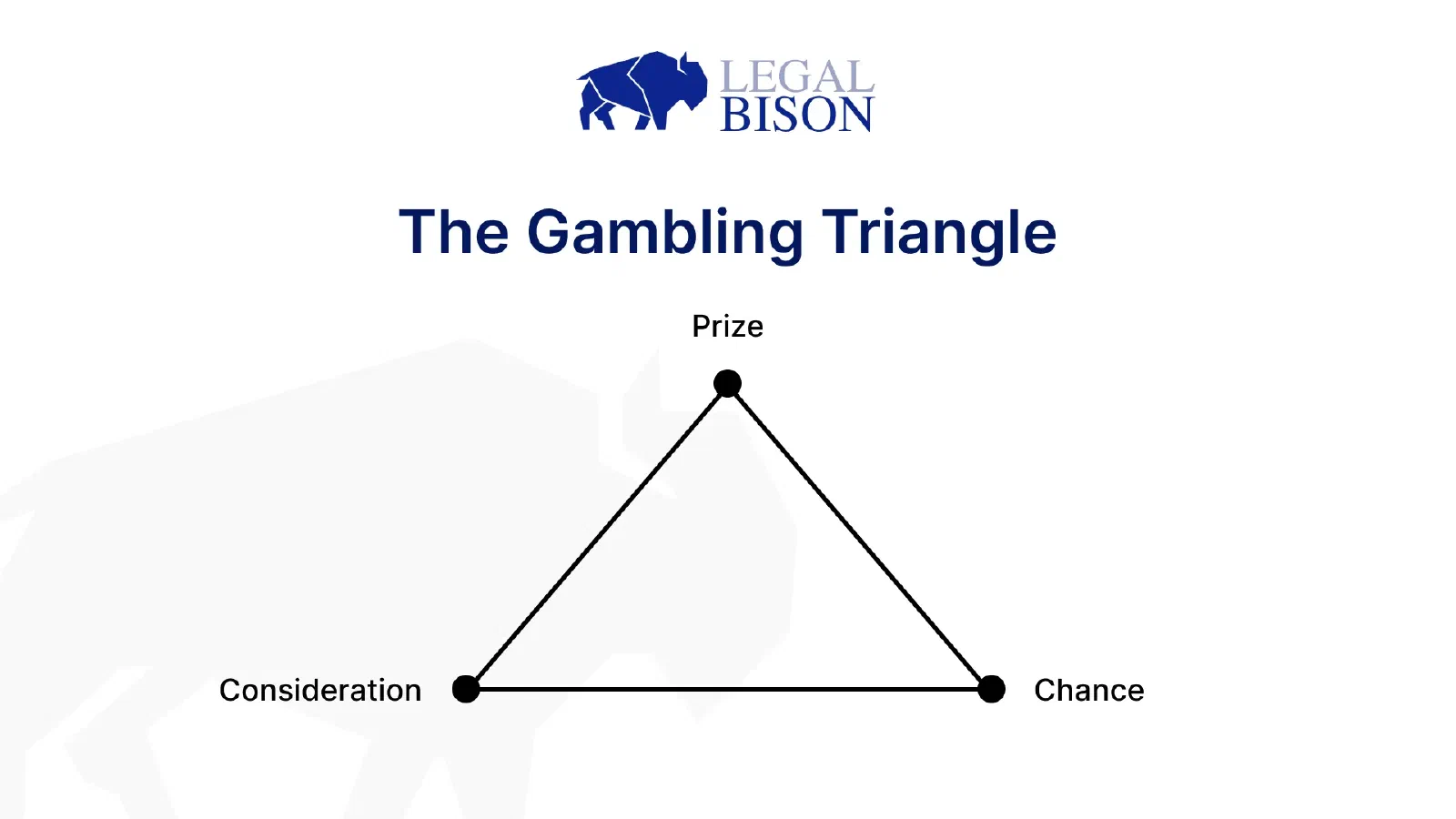
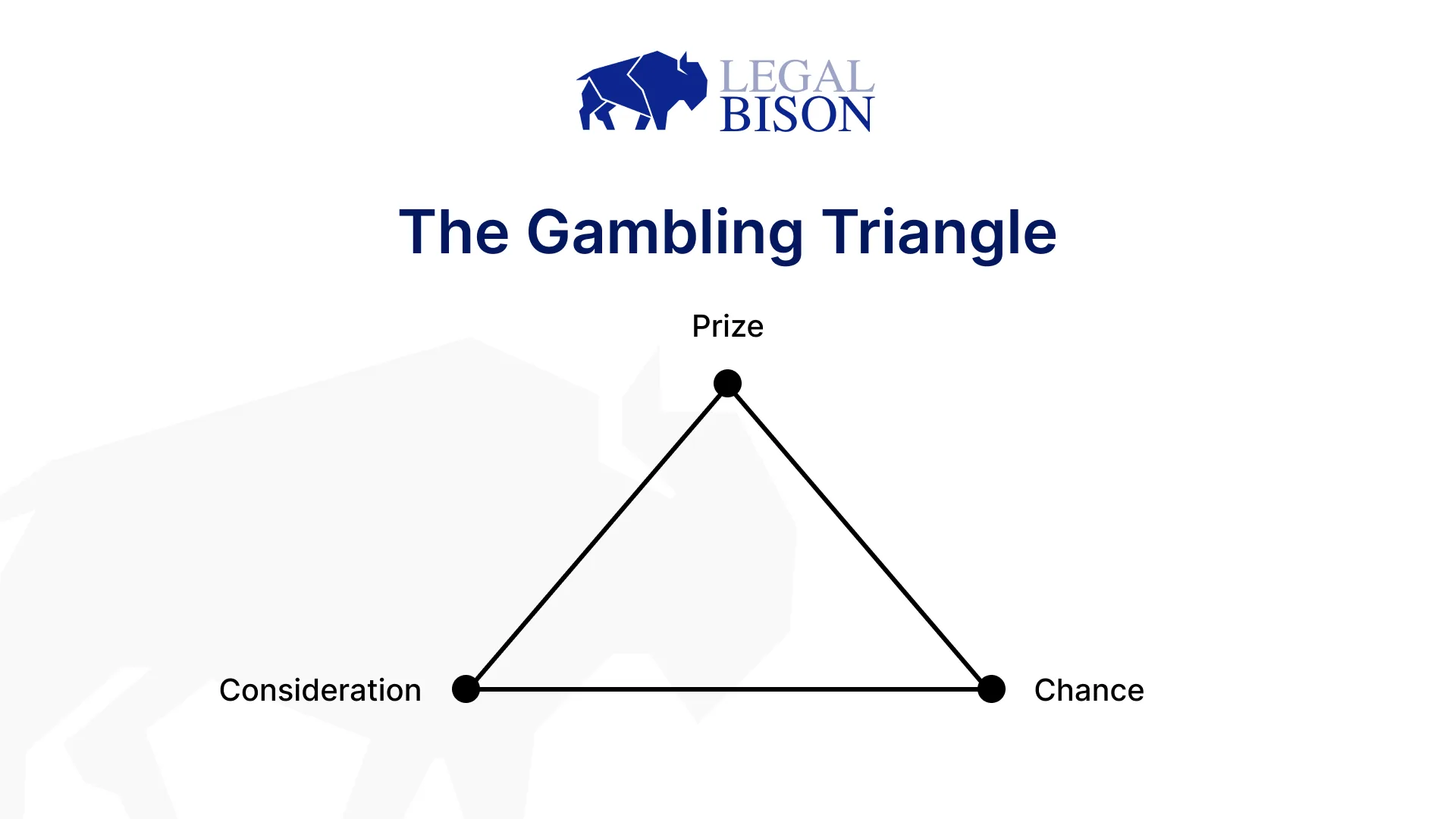
Regulators across the US analyze promotions using the same basic test, sometimes called the gambling triangle: prize, chance, and consideration.
- Prize means something of value is at stake
- Chance means the outcome isn’t decided by skill
- Consideration is where the participant has to give something up, usually money, just to take part
Combine all three in one promotion, and you’ve built a lottery, something only licensed operators can legally run.
A sweepstake works by knocking out consideration. The prize stays. The random selection stays. What disappears is the requirement to pay.
That’s why nearly every sweepstake you’ve ever seen carries some version of the phrase “no purchase necessary”, paired with a free method of entry, often a mail-in postcard or an online form that doesn’t require buying anything.
An example would look something like this: a beverage company runs a code-on-the-cap promotion where buying a bottle gets you an entry code, but the official rules also let you request a code by mail, free of charge, with the same odds of winning as a purchased code.
Buy the bottle if you want the drink. You don’t have to buy anything to be in the running for the prize. That’s the structure that keeps the whole promotion out of lottery territory.
Also read: We Explain the Business Model of Social Casinos
Designing the entry mechanism sounds like the easy part, and it’s usually where we see the most mistakes. A sponsor has to build two entry paths that are functionally equal: a purchase path and a free path, with identical odds and comparable effort.
If the free path requires a notarized letter and a USD 2 stamp while the paid path takes ten seconds online, the disparity itself can undercut the “no purchase necessary” defense.
Selecting a winner looks simple until you’re the one running the draw. Sponsors need a documented, auditable random selection process because a regulator or a disappointed entrant can and will ask how the winner was actually chosen.
Fulfilling the prize brings its own workload: odds disclosures in the official rules, tax reporting obligations once a prize crosses the USD 600 threshold that triggers IRS Form 1099 requirements, and in several states, registration and bonding with the state government before the promotion can even launch if the prize value is high enough.
Most of the actual practitioner hours go into the official rules document and the state-by-state compliance check. A promotion that looks finished from a marketing standpoint is often only half-built from a legal one.
Related: A Look Into the Rising Trend of Sweepstakes Sports Betting
The near-miss that costs the most
The most common misconception we run into treats the phrase “no purchase necessary” as the whole legal defense on its own. In practice, those four words only describe an intention. What actually matters is whether the free entry method is genuinely equal to the paid one in odds, in effort, and in how visibly it’s promoted.
We’ve reviewed promotions where the free-entry instructions were buried in eight-point font at the bottom of a webpage while the “buy now to enter” button sat front and center.
On paper, a free path existed. In practice, almost nobody would ever find it or use it, and a regulator reviewing that setup has every reason to treat the free path as a fig leaf rather than a genuine alternative.
That’s the near-miss that costs sponsors the most: mechanics that look compliant on a checklist but fall apart the moment someone examines how an actual entrant experiences the promotion.
Who regulates sweepstakes
The US doesn’t have a single sweepstakes regulator. Oversight is split across the Federal Trade Commission, which polices deceptive advertising in promotions nationally, the US Postal Service, which enforces the Deceptive Mail Prevention and Enforcement Act for anything run through the mail, and each state’s own anti-lottery statutes, which are criminal law provisions rather than a consumer protection framework with a fine attached.
That patchwork is exactly why jurisdiction selection matters as much as the mechanics of the entry itself, and it’s also where the picture changes once you look at the markets our clients actually operate from.
Inside the EU, the same three-ingredient test doesn’t disappear, but it gets applied by whichever national gambling authority holds jurisdiction, and the threshold for what counts as a licensable game of chance varies from one member state to the next.
A prize draw that clears easily as a promotional device in one EU country can require a formal gaming authorization in another. This is why the jurisdiction gets chosen before the entry mechanics are designed.
Costa Rica sits at the other end of that spectrum. It has no dedicated online gambling or raffle-specific licensing regime for platforms serving a global, non-domestic user base, and that absence of a dedicated regime is one reason prize-draw and raffle businesses often land there instead of building inside a jurisdiction that would require a license from day one.
The analysis doesn’t disappear just because the license requirement does.
It shifts from “Which license do we need?” to “Does this model trigger a licensing requirement here at all?” Confirming that answer before launch is still the actual work.
What structuring this correctly looks like in practice
We ran exactly that analysis for watch.fun, an online luxury raffle platform where collectors enter weekly drops for a chance to win authenticated watches like the Rolex Daytona, the Audemars Piguet Royal Oak, and the Patek Philippe Nautilus, with entry starting from as little as USD 19 and every draw independently verifiable.
The team needed a jurisdiction that could support a raffle model with payment processing that accepts card and cryptocurrency, serving a global audience, without forcing a restructure later as the business grew.
Our experts assessed the raffle mechanism, the dual fiat-and-crypto payment structure, the offshore gaming context, and the global user base against the regulatory environments across relevant markets.
Costa Rica came out as the jurisdiction suited to all four variables, and the confirmed regulatory position was that watch.fun’s model was operable within the Costa Rica framework without triggering additional licensing requirements at launch.
From there, we handled the full incorporation, alongside structural guidance so the corporate setup stayed compatible with both payment rails.
Also read: Sweepstakes vs. Contest vs. Giveaway, What’s the Real Legal Difference?
What to carry forward
The working principle here is simple to state and easy to skip in practice: a promotion only stays outside licensing territory if the jurisdiction and the entry mechanics are evaluated together, market by market, regardless of what the fine print claims.
If you’re building or evaluating one of these tomorrow, start with that question before you touch the creative concept.
Would the regulator with actual jurisdiction over this model, looking at how an entrant experiences it in that specific market, agree that no license was triggered?
At LegalBison, our gaming and gambling licensing team works with operators structuring raffle, sweepstakes-style, and dual-currency platforms across the jurisdictions where these models actually launch, from EU member states to offshore hubs like Costa Rica, as part of our broader reach across 50+ jurisdictions.
That includes official rules and structural documentation, jurisdiction selection, and the regulatory navigation that confirms whether a promotion can launch as planned before it ever goes live.